User Research
Adaptive Interface Accessibility: Keep Users in the Control Loop
How to test AI-mediated journeys for dark patterns, preserve delegated intent, design useful oversight, and define evidence-based release conditions.
A replay is an event, not an explanation
Session 4, minute 6: the participant replays a spoken instruction.
Minute 7: the prototype reduces its speech rate and expands the next answer.
Minute 8: the participant skips the expanded answer halfway through.
Minute 9: the prototype shortens the following response.
Minute 10: the participant asks the moderator where the missing detail went.
This short sequence is hypothetical, but every event is plausible in a behavior-adaptive interface. A team watching the log might conclude that the system is learning. It noticed a replay, slowed down, detected a skip, and became more concise. The mechanism responded exactly as designed.
The participant's reasons are still unknown. The first replay might indicate that the speech was too fast. It might also follow a notification in the room, an unfamiliar term, a momentary loss of attention, a poor audio connection, or a need to compare the instruction with another screen. The skip might signal excessive detail, or it might mean the system placed the needed information at the end and the participant gave up. Two clean behavioral events can support several incompatible interpretations.
That ambiguity is central to adaptive interface accessibility. Runtime personalization can reduce effort when it fits the person's needs and context. It can also replace a stable problem with an unpredictable one. If the system changes silently, the person must notice the change, infer why it happened, decide whether it helped, and find a way to correct it. The work saved by adaptation can return as monitoring and repair.
Accessibility teams therefore need a higher standard than “the interface adapted.” They need evidence that the change was understandable, controllable, useful in context, and recoverable when the interpretation was wrong. They also need to know what data produced the change and whether collecting that data is proportionate to the benefit.
Three ways an interface can personalize, with three different burdens
Personalization is often discussed as one capability. For research and governance, it helps to distinguish three modes.
The first is a declared preference. A person chooses larger text, reduced motion, shorter instructions, higher contrast, a preferred input method, or a speech rate. The system's responsibility is relatively clear: apply the choice consistently, expose its current state, and avoid overriding it without a compelling and visible reason.
The second is a suggestion. The system observes a pattern and proposes a change: “You replayed the last three instructions. Would you like slower speech?” The person can connect the evidence to the proposed response. They may accept, modify, dismiss, or ask for more information. A suggestion adds a decision, but it preserves a chance to reject the system's interpretation before the interface changes.
The third is silent inference. The system observes behavior and changes the experience automatically. A long pause may trigger simpler language. Repeated navigation may hide secondary controls. A skipped explanation may make future answers shorter. This mode can feel seamless when it works. It carries the largest burden when it fails because the evidence, interpretation, and change may all remain invisible.
These modes should not be treated as stages of maturity in which silent inference is automatically more advanced. The appropriate mode depends on consequence, confidence, reversibility, and user preference. Automatically increasing spacing between controls for the current session may be low risk if the change is visible and easy to undo. Removing navigation options because the system believes they create cognitive load is more consequential. It may hide functions the person needs, alter a learned path, or create a different experience across devices.
W3C's WAI-Adapt overview emphasizes user adaptation and preferences. It describes ways content can be personalized to meet individual needs, including hiding extraneous information or changing how numeric information is presented. The overview also identifies several documents as working drafts. It offers an important standards direction, but teams should not turn that direction into a claim that any behavior-inferred interface is accessible or standards-compliant.
Observable behavior does not reveal a person's need by itself
Product analytics encourages teams to interpret replay, skip, dwell time, repeated clicks, backtracking, and abandonment as direct indicators of friction. Those signals are useful because they show what happened. Trouble starts when the system converts an event into a personal attribute or stable need without enough evidence.
A replay in a voice interface may relate to comprehension, audio quality, terminology, distraction, fatigue, working memory, or simple preference. A long dwell time may indicate confusion, careful reading, a screen-reader navigation pattern, a motor pause, a conversation happening beside the user, or a deliberate comparison. Backtracking can expose a poor information architecture, but it can also be part of a skilled strategy.
The same person can produce different patterns across tasks and days. Someone who wants concise instructions during a familiar workflow may need more explanation for an unfamiliar financial decision. Fatigue, pain, medication, device, environment, stress, and available assistive technology can change what support is useful. A profile that becomes more confident over time can preserve an interpretation after the context has changed.
This is why behavioral inference should be framed as a hypothesis about the interaction, not a diagnosis of the person. “The last two instructions were replayed” is observable. “This user needs simplified language” is an interpretation. “Reduce all future content complexity” is a product action with wider consequences. Each step requires more evidence than the one before it.
The distinction also protects identity. Disability is not a single configuration, and adaptive behavior should not force people into categories they did not choose. A system may infer a need without naming a disability, yet the data can still feel sensitive because it reveals patterns about how a person reads, listens, moves, remembers, or communicates. Teams need to examine who can access those signals, how long they are retained, whether they follow the person across contexts, and whether the person can delete or reset the profile.
Technical movement is early evidence, not validated accessibility
A 2026 Scientific Reports paper presents AURA, a voice-based assistant that adjusts verbosity, speech rate, and language complexity in response to replay, skip, and listening-time signals. Under controlled simulation, the adaptive version moved toward predefined interaction profiles and changed proxy measures such as replay frequency and completion time.
The study is useful because it shows a concrete mechanism, observable variables, and an interpretable rule-based adaptation cycle. Its limitation is equally important: there were no human participants. The authors explicitly describe the work as proof of concept rather than validation of practical usability or user satisfaction. The simulated profiles establish what the mechanism can do under its own assumptions. They cannot establish that blind people would interpret the changes as helpful, understand why they occurred, accept the data use, or recover when the rule is wrong.
This gap appears often in accessibility innovation. A technical component functions, a proxy metric improves, and the result is described as an accessibility benefit. Four claims are being compressed:
- The adaptation can be implemented reliably.
- The system can detect and change a target signal.
- The change improves task performance in a representative context.
- Disabled people experience the outcome as usable, accessible, acceptable, and worth its costs.
Evidence for the first claim does not automatically support the fourth. Even human research needs limits. The CHI 2026 study on interaction data and UI personalization interviewed 12 participants using experimental vignettes. Participants could identify personalization opportunities and preferred visible system support. That supports the design value of reflection and suggestions. It does not establish how every disability group will respond, how behavior changes over months, or whether a specific adaptation works with real assistive technology in a consequential task.
Another CHI 2026 study used seven cross-disability focus groups with 20 participants to examine disabled people's use of generative AI. Participants described autonomy, efficiency, and communication benefits alongside privacy concerns, mistrust, identity tensions, and what the authors call accessibility taxes. The qualitative findings show that access and risk can coexist. They do not provide population prevalence or a universal ranking of concerns.
The practical lesson is to keep the claims separate. Report technical feasibility as technical feasibility. Report proxy movement as proxy movement. Report participant behavior and interpretation with the sample and context attached. Treat accessibility as a continuing product obligation, not a label earned by one successful experiment.
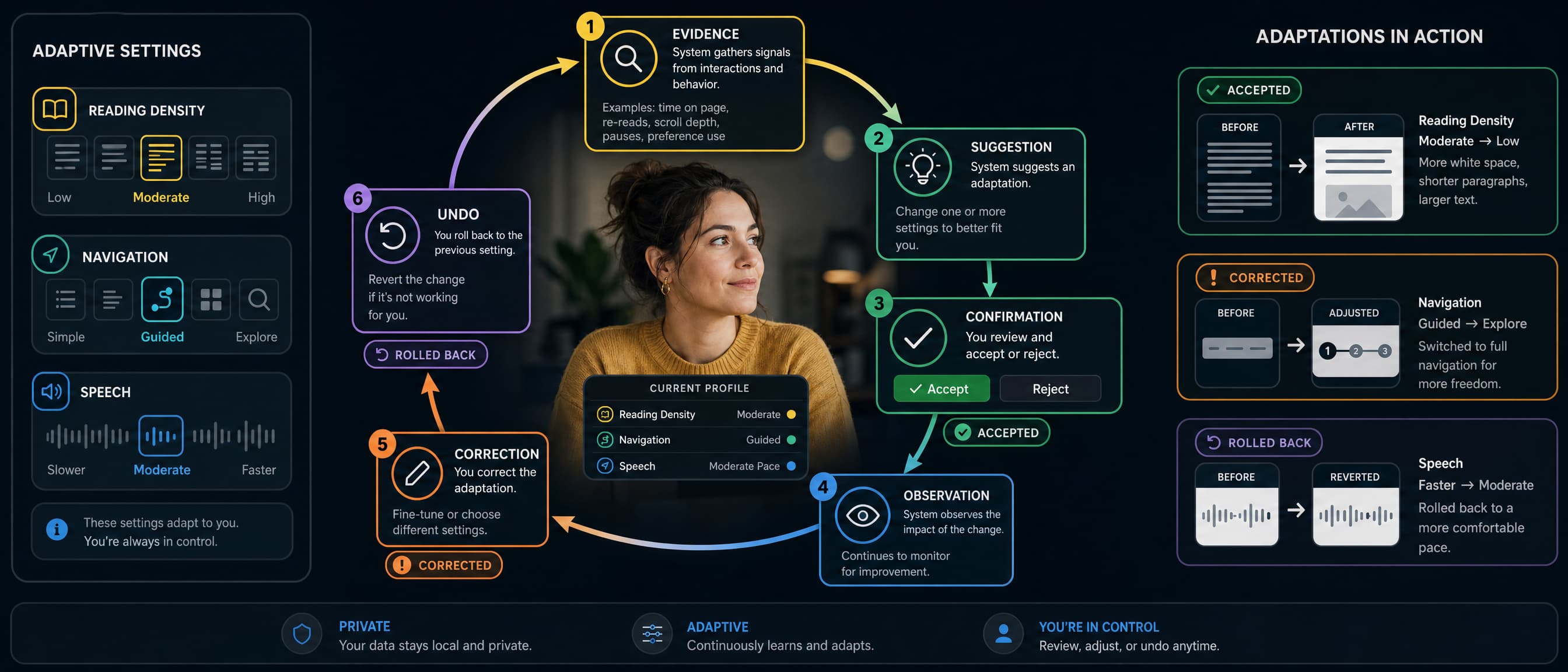
The Accessibility Adaptation Control Loop
An adaptive interface needs a way for the person to remain part of the interpretation. The Accessibility Adaptation Control Loop is a six-step editorial model for designing and evaluating that relationship. It is not a scientific instrument or conformance standard.
- Observe the interaction. Record the smallest event needed for the current purpose, such as a replay or repeated navigation. Do not attach a diagnosis to it.
- Form a bounded hypothesis. Express what the event might mean and what remains uncertain. Prefer session-level hypotheses over permanent profiles when the evidence is temporary.
- Make the proposed change legible. Explain what will change and, when useful, which interaction prompted the suggestion. Use language the person can understand without requiring them to inspect a technical log.
- Give control at the right moment. Let the person accept, adjust, postpone, or reject the change. Low-risk automatic adaptations should still have a visible state and an immediate correction path.
- Observe the outcome without declaring victory. Look at task behavior, effort, comprehension, confidence, and qualitative response. One faster action may conceal confusion or lost information.
- Preserve correction and undo. Make it possible to restore the prior state, reset the inferred profile, and prevent the rejected change from immediately returning.
The loop changes the research question. Instead of asking whether the algorithm predicted the preferred setting, the team asks whether the whole interaction allowed the person to understand and shape the adaptation. Prediction accuracy can be one measure. It cannot substitute for agency, comprehension, and recovery.
The loop also creates observable failure classes. The system may collect a signal that is too ambiguous. Its hypothesis may be reasonable but wrong for the current task. The explanation may be inaccessible to the same person the change is meant to support. The control may appear after the adaptation has already caused harm. The interface may allow undo while retaining the inferred profile, causing the unwanted change to return. Each failure points to a different owner and response.
A constrained example: adapting a benefits-enrollment journey
Consider a hypothetical employee completing benefits enrollment with speech output and keyboard navigation. They have chosen a moderately fast speech rate and concise help. The system may suggest adaptations from session behavior, but company policy forbids it from hiding legally required information. The employee is working in a shared room and does not want sensitive health-related content read aloud without confirmation.
During plan comparison, the employee replays an explanation of deductible and out-of-pocket maximum. The system proposes slower speech for financial explanations and shows the reason: two replays in the current section. The employee accepts a slightly slower rate but rejects expanded explanations because they already understand the terms and were comparing two figures.
The next page contains optional wellness benefits and a mandatory disclosure. The employee skips two optional descriptions. A poorly designed adaptive system might shorten all remaining content or collapse “secondary” sections. That would be efficient according to the skip signal and dangerous according to the task. The skip does not show that the employee wants less information everywhere, and the mandatory disclosure must remain available and identifiable.
Suppose the system instead suggests a compact mode for optional benefit descriptions while keeping legal and cost information unchanged. The employee accepts. Completion time falls for the next page, but the moderator observes more backtracking when the employee tries to compare eligibility conditions. The adaptation helped navigation density and harmed cross-option comparison.
There is no neat success. The team has evidence for a narrower conclusion: compact descriptions may reduce scanning effort for this participant in this section, provided eligibility details remain visible and comparison state is preserved. It does not support a permanent “prefers concise content” profile. It does not support applying the change to health information, legal notices, or another device.
The privacy constraint reveals another issue. If the system uses replay and skip events only within the current session, the data burden may be limited. If it stores a long-term profile associated with the employee's account, exposes inferred needs to an employer, or combines them with benefits choices, the governance question becomes materially different. A useful adaptation cannot justify unrestricted secondary use.
The recovery test should be explicit. Ask the employee to restore the original presentation, reset the session inference, revisit the comparison, and explain which settings will persist next time. If they can undo the visible layout but cannot clear the behavioral profile, the experience is only partly reversible.
Research the mismatch, not just the happy adaptation
Adaptive interfaces should be tested with people who represent the intended disability, assistive-technology, role, language, and context range. “Disabled participants” is not a sufficient sampling description. A screen-reader user with deep expertise, a person using magnification, someone with fluctuating cognitive fatigue, and a person using switch access may encounter different benefits and failure modes. Intersecting identities and privacy expectations can also shape what feels acceptable.
Start with tasks where adaptation could change a meaningful outcome. Include routine and unfamiliar work, low and high consequence, stable and noisy contexts, and moments when the system should decline to infer. Observe the baseline before introducing adaptation so the team understands existing strategies rather than treating every workaround as a defect.
Test at least four conditions where appropriate: the person's chosen settings, a visible suggestion, an automatic change, and a mismatch deliberately introduced by the study. The mismatch matters because a system that only encounters its expected profile can look reliable while offering no usable recovery. Ask participants to notice the change, explain what they think caused it, correct it, and predict what will happen later.
Measure several layers separately:
- Task outcome: accuracy, completion, missed information, and recovery.
- Interaction effort: replays, skips, navigation, correction steps, time, and assistance needed.
- Comprehension: what changed, why it changed, what data was used, and whether the change will persist.
- Agency: ability to accept, tune, reject, reset, and prevent recurrence.
- Accessibility cost: extra monitoring, explanation, privacy work, identity exposure, or repeated correction created by the adaptation.
- Longitudinal stability: whether useful settings survive appropriately and whether temporary context is mistaken for a permanent preference.
This approach resembles the broader need to test AI behavior for control and recovery described in Fred's guide to usability testing AI agents. The application here is narrower. The adaptive interface may not be an autonomous agent, but it still interprets behavior and changes the person's experience. Variable outputs and hidden state require similar attention to comprehension and repair.
Analysis should retain contradictions. If most participants accept a suggestion while a smaller group experiences identity or privacy harm, the minority result should not disappear into an acceptance rate. The decision may require a different default, local processing, shorter retention, a non-adaptive path, or a restriction on where inference is allowed.
Release conditions should match consequence and uncertainty
An adaptive feature can be ready in one context and unjustified in another. Teams should define the boundary in operational terms.
Automatic adaptation may be appropriate when the change is low consequence, immediately visible, easy to reverse, and based on a short-lived signal. Suggestions are safer when the interpretation is ambiguous or the change affects navigation, content availability, communication style, or a learned workflow. Explicit settings should govern high-consequence preferences, sensitive data, persistent profiles, and changes whose failure could block access or distort consent.
Some findings should stop release. Examples include an inaccessible explanation, an undo control that cannot be reached with the participant's assistive technology, repeated oscillation between states, a rejected preference that returns, sensitive inference exposed to an unrelated role, or a change that hides required information. Faster task completion does not offset those failures.
Monitoring after release needs the same restraint as the adaptation. Track whether people accept, adjust, reject, reset, and recover, but do not assume that acceptance proves benefit. People may tolerate a poor change because correction is harder. Pair aggregate behavior with recurring qualitative research and support evidence. Review whether the original purpose still justifies the data retained.
Keep the decision trail. Fred's article on AI research quality explains why evidence can lose meaning as it moves through an AI-assisted pipeline. Adaptive accessibility has an additional transformation: observed behavior becomes a runtime product action. Store the observation, hypothesis, participant response, limitation, and release boundary close enough to inspect later.
That context also belongs in a searchable research repository. When a model, rule, interface, assistive technology, or policy changes, the team should be able to find which evidence supported the old behavior and where it was explicitly limited. Otherwise, a bounded finding can harden into a permanent product assumption.
Adaptive accessibility earns trust through repeated opportunities for the person to shape the experience. The product team observes carefully, makes modest claims, exposes meaningful changes, and treats correction as normal behavior rather than user failure. The result may be less seamless than silent personalization. It is more defensible because the person can still tell what the interface is doing and take it back.
Bring one consequential adaptive journey into Fred. Connect the behavioral events to participant interpretation, accessibility evidence, privacy constraints, contradictions, and release conditions. Decide which changes may happen automatically, which require a suggestion, and which should remain under explicit user control.
Source notes
- W3C Web Accessibility Initiative, “WAI-Adapt Overview,” updated January 5, 2023, opened August 3, 2026: source. Used for the user-controlled personalization direction and the maturity status of WAI-Adapt documents.
- Alves, Duarte, Montague, and Guerreiro, “Exploring the Role of Interaction Data to Empower End-User Decision-Making in UI Personalization,” CHI 2026, published April 13, 2026; author preprint submitted March 19, 2026: published paper and author preprint. Used for the 12-participant interview study, experimental-vignette method, and evidence that visible suggestions and interaction data can support reflection. The small qualitative sample and vignette design limit generalization.
- Algamdi, “A behaviour-adaptive AI assistant enhancing accessibility and usability for blind users through real-time interaction personalization,” Scientific Reports, published March 9, 2026: source. Used for the proof-of-concept mechanism and behavioral proxies. The study used simulated profiles and no human participants, so it does not validate usability or accessibility for blind people.
- Johnson, Lewis, Mankoff, and Banner, “I Don't Trust it, but I Use it: Navigating Trust, Privacy, and Identity in Disabled People's Use of Generative AI,” CHI 2026, published online April 13, 2026: source. Used for qualitative evidence from seven cross-disability focus groups with 20 participants about autonomy, access, privacy, mistrust, identity, and accessibility taxes. The findings provide qualitative depth, not population prevalence.
- The Accessibility Adaptation Control Loop is an original Fred editorial model. It is not a validated scientific instrument, accessibility conformance standard, or substitute for research with disabled people.