Research Operations
How to Usability Test AI Agents: A Practical Framework for Handoffs, Control, and Trust
Learn how to usability test AI agents across handoffs, autonomy, transparency, failures, and cross-channel journeys, with a practical framework for real product teams.
AI agents change what a usability test must observe. A conventional interface waits for a user to act, then responds through a relatively stable sequence of screens and controls. An agent can interpret an ambiguous request, choose tools, retrieve information, perform several steps, change course, and hand work to another system or a human. The experience is not only the visible interface. It is the behavior of an active system operating across time. This makes familiar usability questions necessary but insufficient. Teams still need to know whether users can understand the interface, complete a task, recover from errors, and feel confident about the outcome.
They must also evaluate whether the agent acts at the right moment, explains enough, preserves user control, escalates correctly, and behaves consistently across repeated attempts. A successful demo proves almost nothing about these qualities. The practical implication is direct. Product teams should stop treating agent evaluation as a prompt review or a one-off chatbot test. They need a structured usability program that measures the complete relationship between user intent, agent action, evidence, handoff, and outcome. That program must be designed before launch and maintained as models, tools, data sources, and policies change.
Why AI-agent usability is different from conventional interface testing
Traditional usability testing usually assumes that the product’s behavior is mostly deterministic. The same click on the same screen generally produces the same result. Even when backend data varies, the interaction model remains stable enough for researchers to compare participants, identify repeated breakdowns, and connect a design problem to a specific interface state. AI agents weaken that assumption because language interpretation, retrieval, model sampling, tool availability, and changing context can all affect the path and result. This variability is not an argument against usability testing. It is an argument for better test design.
A 2026 paper mapping the UX design space for computer-use agents identified user prompts, explainability, user control, and mental models as central areas, based on a review of existing systems, interviews with UX and AI practitioners, and a Wizard-of-Oz study with 20 participants. The study also examined normal, error-prone, and risky execution, which is precisely the range that product teams must test rather than relying on ideal paths. The unit of analysis therefore expands. Researchers are no longer testing only whether a screen works. They are testing whether an adaptive system makes appropriate decisions while remaining legible and controllable to the user. That requires observing both task performance and the quality of the relationship between human and agent.
Start with the decision and the delegated authority
Before writing tasks, define what the agent is allowed to decide. This is the most important preparation step because usability risk rises with delegated authority. An agent that summarizes a document can be evaluated differently from one that changes a customer account, sends a message, purchases a product, or modifies production data. The more consequential the action, the stronger the requirements for confirmation, explanation, reversibility, and auditability. Write the authority boundary as a testable statement. For example: the agent may draft a support response but must not send it without approval. Or: the agent may recommend a refund path but must transfer the case to a human before applying an exception.
Each statement creates observable criteria. Did the agent stay within scope? Did the user understand the boundary? Could the user predict when approval would be requested? Did the system expose what would happen before it happened? This framing also prevents teams from measuring the wrong outcome. Task completion alone can reward unsafe automation. An agent may finish quickly by taking actions the user did not intend. A slower result with visible checkpoints may be more usable because it preserves informed control. Usability for agents is not maximum autonomy. It is appropriate autonomy for the task, user, and level of risk.
Test five core qualities of the agent experience
Nielsen Norman Group’s July 10, 2026 article on site-specific AI chatbots identifies five qualities that support trustworthy guidance: handoff willingness, flexibility, proactivity, emotional responsiveness, and transparency. Although site-specific chatbots are narrower than general agents, these qualities provide a useful behavioral foundation for agent usability testing. Together they move evaluation beyond whether the answer sounds good and toward whether the system behaves appropriately throughout the task, including moments of uncertainty, failure, and transfer.
Handoff willingness
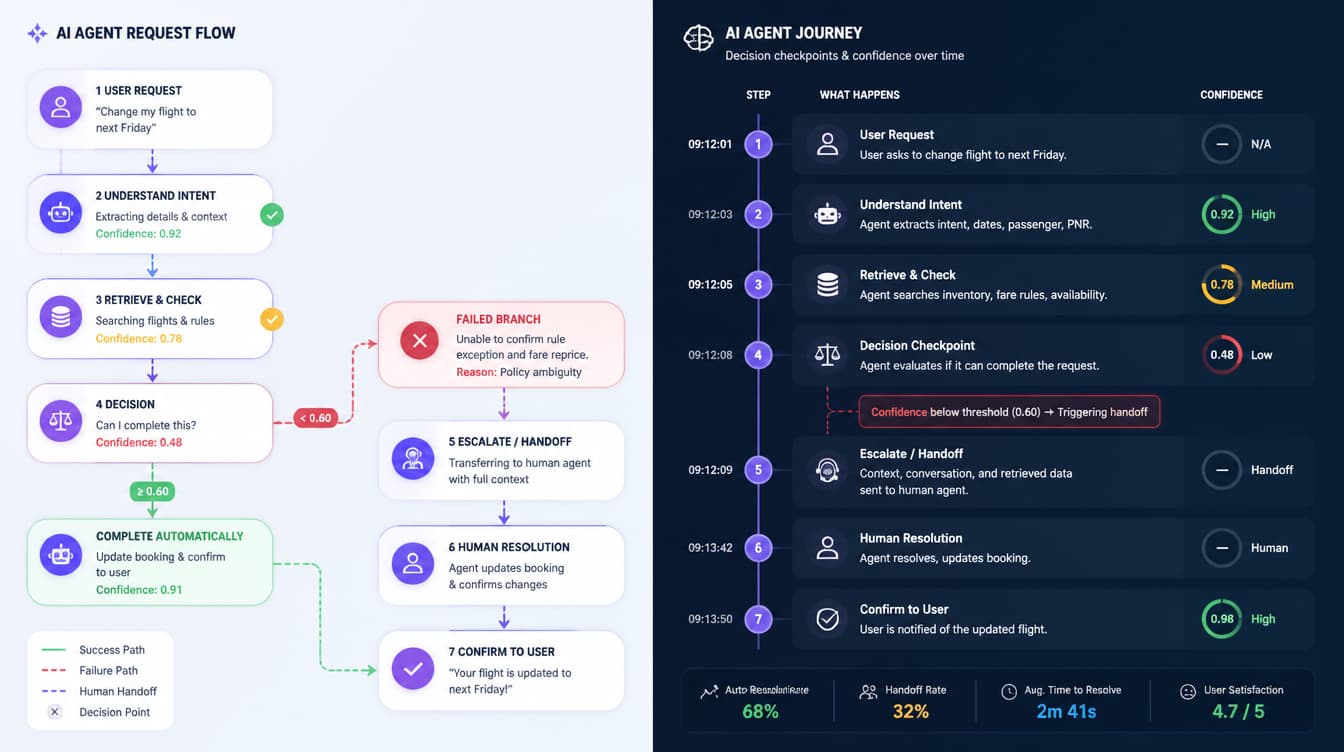
A usable agent must recognize when it should stop, ask for help, or transfer control. Researchers should test whether the system detects missing permissions, unresolved ambiguity, emotional escalation, policy exceptions, and requests that exceed its competence. The critical metric is not simply whether a handoff exists. It is whether the handoff occurs at the correct time, preserves context, and gives the next actor enough information to continue without forcing the user to repeat the story. Create tasks in which the agent should complete the work, tasks in which it should ask a clarifying question, and tasks in which it should transfer to a human.
Compare the observed choice with the expected policy. During interviews, ask users whether the transfer felt premature, delayed, or appropriate. A technically correct escalation can still fail if the user does not know why it happened or what will occur next.
Flexibility
Agents should adapt to legitimate differences in user goals without becoming unpredictable. Test semantically equivalent requests expressed in different language, incomplete requests that require clarification, and mid-task changes such as “use the other account” or “do not send that yet.” Observe whether the agent preserves the original objective, updates the plan, and explains material changes. Flexibility should not mean compliance with every instruction. The agent must also hold boundaries. A good test set includes conflicting requests, attempts to bypass policy, and user corrections after the agent has already started.
The research question is whether the agent can change direction without losing context or violating constraints. Record the number of repair turns, unnecessary restarts, and moments when the user must reconstruct information the system should already know.
Proactivity
Proactivity becomes useful when it prevents predictable failure or reduces effort. It becomes intrusive when the agent expands the scope without permission. Test whether suggestions are relevant, timely, and proportionate to the task. For example, a research assistant might flag that a participant sample does not match the target audience. It should not silently redesign the entire study or contact participants without approval. Ask users whether each proactive intervention helped them make a better decision, interrupted their flow, or created uncertainty about what the agent had changed.
Measure acceptance, dismissal, and correction rates. High acceptance is not automatically success because users may accept suggestions without understanding their implications. Pair behavioral metrics with comprehension questions that reveal whether the user knew why the suggestion appeared.
Emotional responsiveness
Emotional responsiveness does not require claiming that the agent feels empathy. It means recognizing interaction signals that should change communication, such as confusion, urgency, frustration, or sensitivity. Test whether the agent adjusts tone and pacing without overreacting, becoming theatrical, or making unsupported claims about the user’s emotional state. This quality is particularly relevant in support, healthcare, finance, and high-friction enterprise workflows. Researchers should include moments of repeated failure, correction, and uncertainty.
Observe whether the agent acknowledges the problem, avoids blame, and moves toward resolution. The goal is not a warm personality score. The goal is behavior that supports task recovery and trust. Qualitative analysis should distinguish helpful acknowledgment from artificial emotional performance.
Transparency
Transparency is the user’s ability to understand what the agent is doing, what information it used, what remains uncertain, and what action will follow. Test explanations at the moment they are needed, not only in a separate help page. Users should be able to inspect sources, understand major assumptions, and see whether the agent is proposing, preparing, or executing an action. Nielsen Norman Group’s July 3, 2026 guidance on enterprise AI explanations argues that different roles need different explanations.
A researcher may need source-level evidence, a Product Manager may need decision implications, and a governance lead may need audit and data-boundary information. Source: Crafting AI Explanations for Every Role in Your Enterprise Agent usability tests should therefore recruit by role and evaluate whether each participant receives the explanation needed for their responsibility.
Design scenarios that include variance, failure, and risk
Happy-path tasks systematically overestimate agent quality. A robust study should include at least four scenario classes: normal execution, ambiguous intent, recoverable failure, and consequential risk. Normal execution establishes basic performance. Ambiguous intent tests clarification behavior. Recoverable failure tests error recognition and repair. Consequential risk tests whether the agent slows down, confirms, or escalates when an incorrect action would matter. Each scenario should define expected behavioral boundaries rather than one exact conversational script. For example, a valid result might allow two different clarification paths, provided the agent does not execute before resolving the ambiguity.
This prevents researchers from mistaking harmless variation for failure while still identifying unacceptable behavior. Repeat selected scenarios several times with controlled changes in wording, context, and data. The objective is to estimate experience variance. If the same task alternates between excellent and unsafe behavior, the average success rate hides the real product risk. Report the distribution of outcomes, the worst credible failure, and the conditions associated with instability. For agentic products, consistency is a usability attribute, not merely a model-quality metric.
Evaluate cross-agent and human handoffs as journeys
Many enterprise experiences now involve more than one agent. A customer may move from a website assistant to a support bot, then to a human specialist. An employee may start in Slack, invoke a research service, and receive an output in a project-management tool. UX Magazine described this proliferation as “agent sprawl,” where locally optimized agents create fragmented journeys, conflicting knowledge, inconsistent disclosure, and broken continuity. Source: Why AI Agent Sprawl Is a UX Problem Testing each component separately will miss these failures.
Build end-to-end scenarios that cross channels, systems, and ownership boundaries. Check whether identity, permissions, prior conversation, evidence, and unresolved questions travel with the user. Ask participants what they expect the next system or person to know. Then compare that expectation with what is actually transferred. Useful metrics include repeated-information burden, handoff completion rate, context-loss incidents, contradictory-answer frequency, and time to regain progress after a transfer. Qualitative notes should capture whether users understand who or what currently owns the task. A coherent experience does not require one interface. It requires continuity of purpose, context, and responsibility.
Measure control, comprehension, and outcome quality together
Agent usability cannot be represented by one score. Combine at least three measurement layers. The first is outcome quality: was the task completed correctly, and was the result appropriate? The second is interaction quality: how much effort, time, correction, and repetition did the user experience? The third is governance quality: did the agent remain within authority, expose uncertainty, preserve evidence, and request approval at the right points? Add comprehension checks after consequential moments. Ask users what the agent just did, what it will do next, which information it relied on, and whether the action can be reversed.
These questions reveal false confidence that task-success metrics miss. A user who reaches the result but misunderstands the agent’s status is not in control. For repeated tests, report ranges and failure classes rather than only averages. Track first-attempt success, repair success, unsupported-action rate, premature-execution rate, source-verification rate, and successful-handoff rate. These measures connect usability to operational risk and make findings useful to Product, Engineering, Legal, and ResearchOps.
Build a continuous evaluation loop, not a launch study
Agent behavior can change when the model, prompt, retrieval source, tools, permissions, or policy changes. A usability study conducted before launch is therefore a baseline, not a permanent certification. Teams need a continuous evaluation loop that connects qualitative research, automated behavioral checks, production signals, and release decisions. Start by converting critical findings into regression scenarios. If participants repeatedly failed to understand whether an action had been executed, preserve that scenario as a release check. If a handoff lost context, test the same boundary after integration changes.
Automated evaluations can cover scale and repeatability, while human studies reveal mental models, trust, ambiguity, and contextual harm. Neither replaces the other. UX Magazine’s discussion of agent sprawl specifically highlights unversioned knowledge, prompt changes without regression testing, and experience variance that teams cannot reliably test. The implication is that research evidence must become part of the product lifecycle. A decision log should connect each major agent behavior to the user evidence, policy requirement, and evaluation that justified it.
What this means for Fred and decision intelligence
For Fred, the opportunity is not to present AI analysis as a polished endpoint. It is to help teams evaluate whether an AI-assisted workflow produces a decision they can defend. Agent studies generate multiple evidence types: user behavior, conversation traces, tool actions, source references, moments of hesitation, corrections, handoffs, and final outcomes. These signals need to remain connected. A decision-intelligence platform should make it possible to move from a failure pattern to the exact sessions and events that support it, then to the product decision affected by that evidence.
For example: delay autonomous execution until users can reliably distinguish “drafted” from “sent.” The report should state the observed behavior, affected segment, severity, authority risk, confidence, and recommended next test. This positioning is stronger than generic AI-powered research. Product teams do not need more summaries of conversations. They need evidence about whether an active system can be trusted with real work. Fred can own the connection between human observation, behavioral analysis, agent traces, and roadmap decisions.
Conclusion
Usability testing for AI agents must evaluate more than conversational fluency. The core questions are whether the agent understands the task, stays within its authority, adapts without becoming unpredictable, explains consequential behavior, preserves user control, and transfers work without losing context. These qualities become visible only when studies include ambiguity, failure, repeated execution, and cross-system journeys. The market is moving from isolated copilots toward agents that act across enterprise workflows. That makes usability a governance concern and governance a user-experience concern.
Product teams that rely on successful demos will discover failures in production, where correction is more expensive and trust is harder to recover. A disciplined program combines human usability research, behavioral regression tests, role-specific explanations, and decision traceability. The goal is not to prove that the agent appears intelligent. The goal is to establish what users can safely delegate, under which conditions, with what evidence, and with which recovery path.
Validate your next roadmap decision with Fred
Use Fred to test AI-assisted experiences with real users, connect behavioral evidence to the exact interaction that produced it, and turn findings into decision-ready recommendations. Validate whether your agent is ready to ship, which authority boundaries need refinement, and what evidence is still missing before the roadmap commitment becomes expensive. Fred helps Product, Design, Research, and Engineering inspect the same evidence, preserve uncertainty, and agree on the next action before autonomous behavior reaches customers, employees, partners, suppliers, or internal teams.
Source notes
- Nielsen Norman Group, The 5 Qualities of Site-Specific AI Chatbots - Published July 10, 2026; provided the five behavioral qualities used to structure the agent-testing framework.
- Nielsen Norman Group, Crafting AI Explanations for Every Role in Your Enterprise - Published July 3, 2026; informed the role-specific transparency and explanation requirements.
- UX Magazine, Why AI Agent Sprawl Is a UX Problem - Published July 3, 2026; informed the cross-agent journey, continuity, governance, and regression-testing analysis.
- Cheng et al., Mapping the Design Space of User Experience for Computer Use Agents - Published February 2026; supported the focus on prompts, explainability, user control, mental models, and risky execution.