Research Operations
AI in UX Research: How to Use Automation Without Losing Insight Quality
AI in UX research can accelerate the process, but weak pipelines create meaning drift. Learn how to evaluate AI-assisted research, protect evidence quality, and turn findings into decisions.
AI in UX research has moved from curiosity to operating model
AI in UX research has crossed a threshold. The question is no longer whether researchers will use AI somewhere in the workflow. They already are. The 2025 State of User Research report from User Interviews says that 80 percent of researchers reported using AI to support some part of their work, up 24 percentage points from the previous year. Their 2026 UX Research Tools Map also describes a landscape of more than 150 curated UXR tools and a broader downloadable list of nearly 800 UX tools, with AI-native or AI-augmented products becoming increasingly common across research operations, methods, analysis, repositories, transcription, and AI research companions.
That changes the strategic problem for UX and product teams. The old question was, Should we use AI in research? The better question in 2026 is, Can we prove that our AI-assisted research pipeline preserves meaning, exposes uncertainty, and produces decisions we can defend? That is a very different standard. It moves the discussion away from tool enthusiasm and toward research governance, evidence quality, and operational trust.
Why the pipeline, not the model, is the risk surface
The new risk is not simply that an AI tool might hallucinate. That is too narrow. The bigger issue is that user research is a chain of transformations. A customer says something in an interview. That becomes a transcript. The transcript becomes notes. Notes become themes. Themes become insights. Insights become recommendations. Recommendations become roadmap decisions. Every handoff can change meaning. AI makes some of those handoffs faster, but speed does not remove the transformation risk. In some workflows, it can hide it.
The research risk cascade
User Interviews has been publishing a useful frame for this problem: the AI research risk cascade. The basic point is that small upstream shifts can become large downstream distortions when qualitative evidence passes through transcription, synthesis, analysis, and reporting. If the transcript is slightly wrong, the summary may smooth over uncertainty. If the summary removes nuance, the analysis may convert an observation into a recommendation. If the recommendation is presented with too much confidence, a product team may treat weak evidence as a roadmap mandate.
This is why AI accuracy is an insufficient quality target. Accuracy has to be defined in context. A transcript can be technically readable and still fail to preserve the participant’s hesitation. A summary can be coherent and still erase contradiction. A theme can be plausible and still combine two different user problems into one neat bucket. A report can be persuasive and still overweight a minority behavior because the AI found it narratively convenient. For UX research, quality is not just factual correctness. It is fidelity to the user signal, traceability to evidence, and usefulness for the decision being made.
Why calibration matters more than automation
That is the reason AI evaluation needs to become part of ResearchOps. Lindsey DeWitt Prat’s blueprint for evaluating AI across the research pipeline proposes a practical set of moves: define what accuracy means in your context, check outputs against that definition, compare tools to reveal divergences, maintain the evaluation infrastructure, and ask questions that reveal hidden risks. That is the right direction because it treats AI evaluation as an operating discipline, not a one-off vendor comparison.
The same logic appears in the discussion around agentic research systems. George Jensen’s argument that calibration matters more than automation is important because it refuses a simplistic replace the researcher narrative. AI-enabled research systems need a clear understanding of deterministic versus probabilistic behavior, well-defined workflow stages, revision loops, and outputs that can be evaluated. His six-phase frame, extraction, summarization, collation, sorting, labelling, and synthesis, is a useful reminder that research automation is not one task. It is a sequence of tasks, each with a different failure mode.
For product teams, this matters because AI can make weak research look complete. A polished AI-generated report can create the impression that the team has reached clarity. But clarity is not the same as confidence. Confidence requires knowing where the evidence came from, how it was transformed, what uncertainty remains, and which decision the evidence is strong enough to support. A user quote that supports a minor usability tweak should not be used to justify a strategic pivot. A cluster of complaints from unqualified participants should not determine prioritization. A sentiment score should not be treated as a behavioral fact.
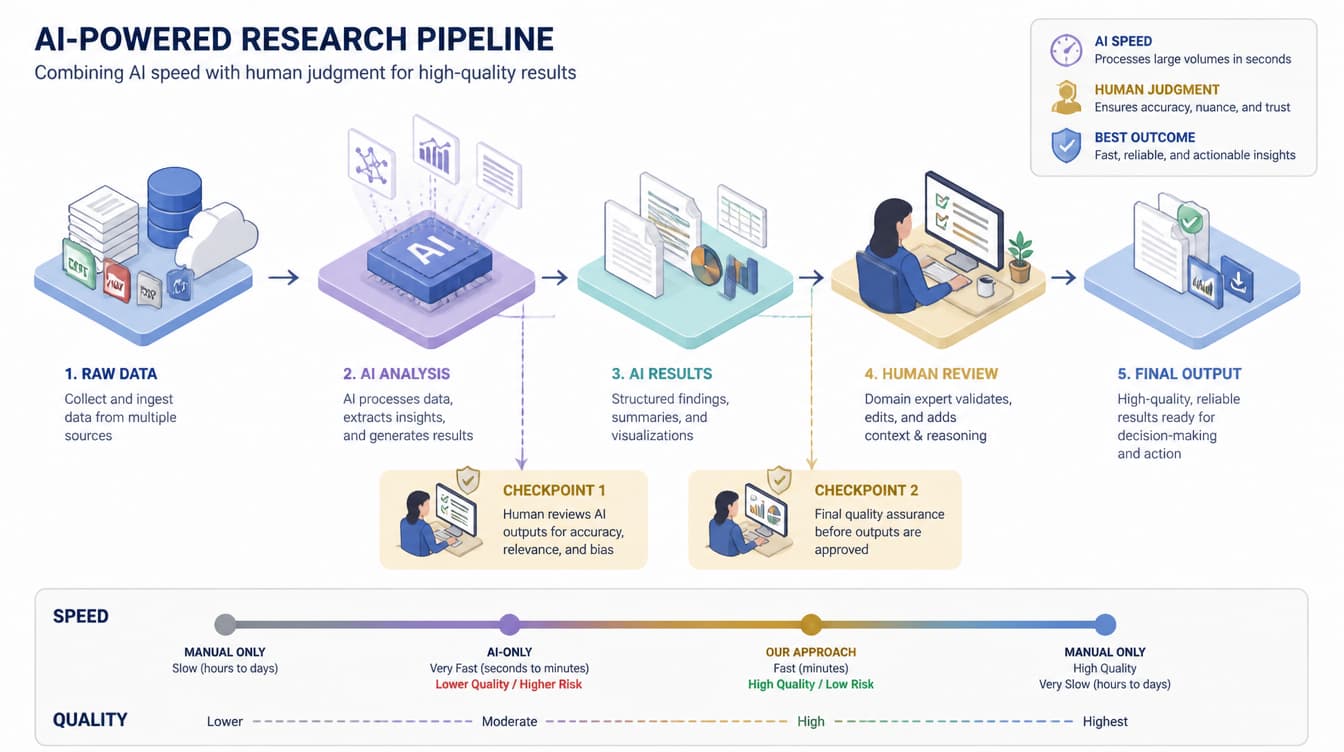
This creates a new responsibility for UX researchers. They are not just collecting and interpreting evidence. They are increasingly responsible for designing the evidence pipeline itself. That includes deciding which parts of the process can be automated, which require human review, which signals should be preserved, and how uncertainty should be communicated to stakeholders. In traditional research, the method often carried the credibility. In AI-assisted research, the pipeline carries the credibility.
The five checkpoints every AI-assisted research workflow needs
Source integrity
The first checkpoint is source integrity. Before a team analyzes anything, it must know whether the input is valid. This includes participant qualification, consent, recording quality, language issues, sampling bias, and whether the data actually maps to the decision being studied. AI cannot repair bad sampling. It can only make bad sampling easier to summarize. If a team runs a survey with the wrong audience or uploads interviews that were conducted for a different research question, the AI output may still look clean, but the conclusion will remain structurally weak.
Transcription and capture fidelity
The second checkpoint is transcription and capture fidelity. For video interviews and usability tests, what matters is not only the words. Tone, pauses, confusion, task hesitation, screen behavior, and contextual cues can all change the interpretation. AI transcription and summarization tools can be useful, but they should not be treated as neutral pipes. They are interpretation layers. Teams should preserve raw recordings, timestamped transcripts, and task-level behavioral metadata so that final claims can be traced back to specific moments.
Meaning preservation
The third checkpoint is meaning preservation. This is where many AI-assisted workflows become risky. Summarization tends to compress. Compression is useful, but it can remove contradiction, hedging, and minority signals. In discovery work, those signals often matter. One frustrated enterprise admin may expose an integration risk that ten satisfied users never encounter. One confused first-time user may reveal a positioning problem that activation metrics later confirm. A good AI research workflow should not only identify common themes. It should surface outliers, contradictions, and unresolved questions.
Analysis calibration
The fourth checkpoint is analysis calibration. Teams need to define what the AI is allowed to infer. Is it allowed to cluster observations? Suggest themes? Detect sentiment? Identify possible friction points? Recommend product changes? Score confidence? Each step carries a different level of interpretive risk. The more the system moves from description to recommendation, the more explicit the human review should be. AI can accelerate sensemaking, but product decisions still require judgment about market context, feasibility, strategic fit, and opportunity cost.
Decision traceability
The fifth checkpoint is decision traceability. A research report should not end with users want X. It should show what decision is being considered, what evidence supports it, what evidence weakens it, how confident the team should be, and what next action follows. This is where research becomes decision intelligence. The output is not just an insight repository. It is a structured decision artifact that helps a team decide whether to build, pause, iterate, test again, or kill an idea.
What this means for Product Managers and Heads of Product
Nielsen Norman Group’s recent article on enterprise AI explainability reinforces the same design principle from another angle. Enterprise AI explanations cannot be one-size-fits-all because governance leads, builders, domain experts, and end users need different explanations at different moments. For research platforms, the implication is direct: a UX researcher, a Product Manager, a Head of Product, and a compliance stakeholder do not need the same view of AI-assisted analysis. The researcher needs evidence traceability and raw-data access. The Product Manager needs decision implications and risk. Leadership needs business impact and confidence. Governance needs auditability, data boundaries, and oversight.
How Fred should frame the opportunity
This is a major opening for Fred. The market is full of AI research features. There are AI note takers, AI synthesis tools, AI repositories, AI moderation tools, and AI research companions. But the trend suggests that the next competitive frontier is not we have AI analysis. That is becoming table stakes. The stronger position is we help teams make defensible product decisions from user evidence, with AI acceleration, human oversight, and traceable reasoning.
For Fred, that means the product language should avoid promising generic speed. Speed alone is not enough, and it can sound irresponsible in a market increasingly aware of AI risk. A better message is controlled acceleration. Fred can say that teams should not have to choose between slow manual research and unverified AI summaries. They need a pipeline where collection, analysis, behavioral evidence, reporting, and decision-making are connected, with quality checks at the points where meaning can drift.
This is especially relevant for roadmap validation. Roadmap decisions are expensive because they commit engineering capacity, commercial expectations, and opportunity cost. A feature that consumes six weeks of engineering is not just a design choice. It is a resource allocation decision. AI-assisted research should therefore be evaluated by whether it improves the quality of that allocation. Did it reduce uncertainty? Did it reveal a critical failure mode? Did it clarify which segment has the problem? Did it prevent a team from building a feature that sounded plausible but lacked evidence?
Practical implementation checklist
The practical implication for teams is straightforward: do not start with tools. Start with decision risk. Before running AI-assisted research, write down the decision the team is trying to make. Then define what evidence would be strong enough to support that decision. Then decide what parts of the pipeline can be automated, what must be reviewed, and what confidence threshold is required. This prevents the workflow from becoming a content factory that produces findings without strategic consequence.
Here is a practical checklist. First, define the decision: what roadmap, design, or go-to-market question will the research inform? Second, define the evidence standard: what would change your mind? Third, validate the sample: are these the users whose behavior or opinion should influence the decision? Fourth, preserve the raw signal: recordings, transcripts, task events, survey metadata, and quotes should remain accessible. Fifth, evaluate each AI step: transcription, summary, theme generation, sentiment detection, and recommendation should be checked separately. Sixth, expose uncertainty: the report should say where evidence is strong, weak, contradictory, or missing. Seventh, connect findings to action: build, refine, test again, pause, or reject.
The teams that adopt this discipline will get more value from AI than teams that treat it as a shortcut. They will move faster because they reduce rework, not because they skip thinking. They will build more trust because their reports will show how conclusions were reached. They will involve stakeholders more effectively because each role will see the explanation it needs. They will also defend research budgets better, because the output will be tied to business decisions rather than research activity.
Conclusion
The market signal is clear. AI is entering every part of UX research, from recruitment operations to synthesis and repositories. The weak version of this trend is automation theatre: more summaries, more dashboards, more synthetic certainty. The strong version is decision infrastructure: better evidence flow, better calibration, better traceability, and better product bets. Fred should align with the strong version.
In 2026, the winning research platform will not be the one that generates the most polished insight summary. It will be the one that helps teams know what they can safely decide. That is the real promise of AI in UX research. Not replacing researchers. Not replacing users. Not replacing judgment. The promise is turning messy user evidence into decision-ready intelligence, while preserving enough context to know when the evidence is not ready yet.
Validate your next roadmap decision with Fred
Validate roadmap decisions with a research pipeline that connects user evidence, AI-assisted analysis, behavioral signals, and decision-ready reporting. Explore Fred or start with a template.
Related reading:
- AI-Powered UX Research in 2026: What It Actually Means and Which Tools Do It Right
- Best UX Research Repository Tools in 2026
- GDPR-Compliant User Research: A Complete Guide for EU Teams
Source notes
- User Interviews, The State of User Research Report 2025: https://www.userinterviews.com/state-of-user-research-report
- User Interviews, UX Research Tools Map 2026: https://www.userinterviews.com/ux-research-tools-map
- User Interviews, What is the New AI in Research Risk Cascade?: https://www.userinterviews.com/blog/what-is-the-ai-research-risk-cascade
- User Interviews, A Blueprint for Evaluating AI Across the Research Pipeline: https://www.userinterviews.com/blog/evaluating-ai-across-research-blueprint
- User Interviews, Calibration Matters More Than Automation: https://www.userinterviews.com/blog/building-agentic-research-systems
- Nielsen Norman Group, Crafting AI Explanations for Every Role in Your Enterprise: https://www.nngroup.com/articles/crafting-ai-explanations/