Research Operations
AI Is Expanding UX Work. Who Owns the Evidence?
How to govern AI-enabled UX task crossover with explicit method, evidence, interpretation, reuse, and decision ownership.
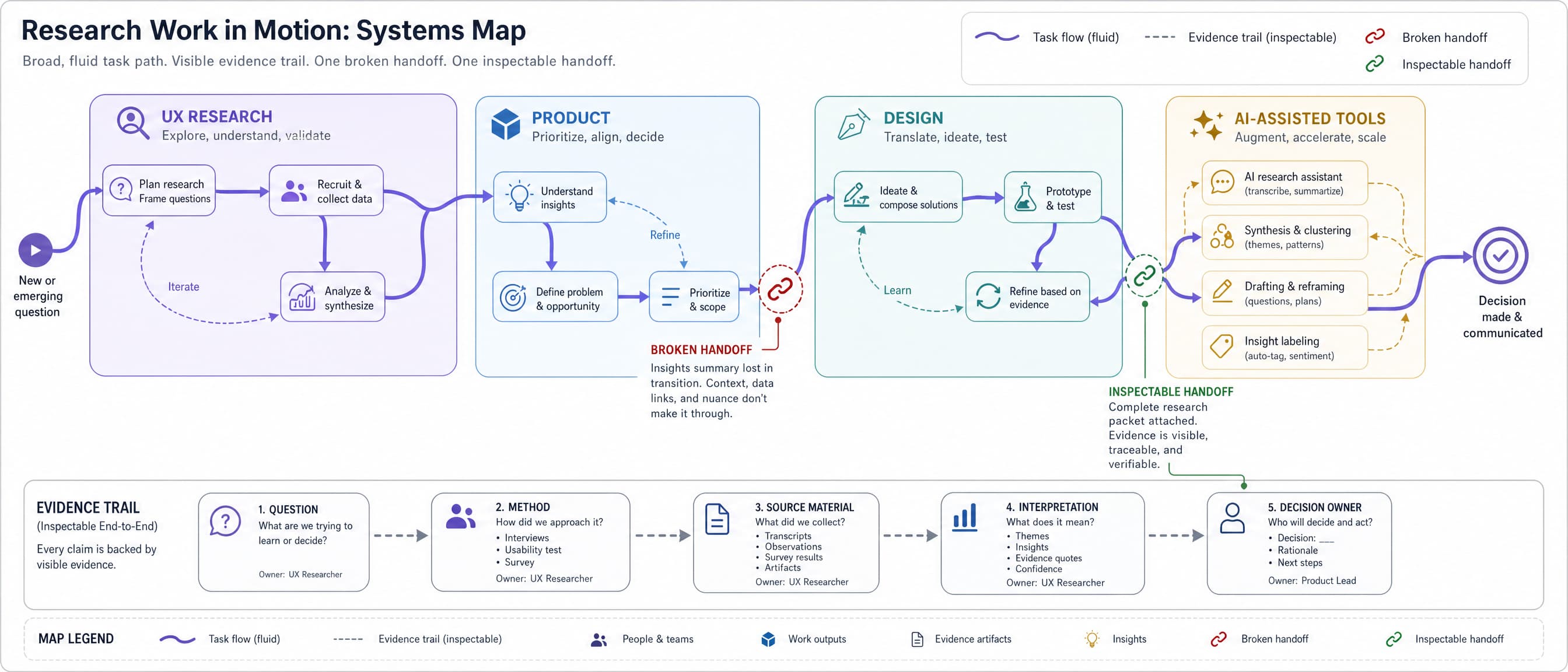
The research task is complete, but nobody owns the claim
A Product Manager needs an answer before a retention review. They export cancellation comments, ask an AI tool to group the reasons, add five customer-call notes, and produce a clear summary: onboarding confusion is the leading cause of churn. A designer turns the summary into a revised onboarding concept. A researcher sees the deck two days later, after the roadmap proposal has already been circulated.
The work looks efficient. The data was collected, themes were generated, and a recommendation reached the people who can act. Yet basic questions have no clear owner. Who decided that cancellation comments and five calls were suitable evidence for a churn claim? Who checked whether the comments represented different customer segments or duplicated the same account history? Who inspected the AI-generated grouping for merged causes, missing contradictions, or unsupported labels? Who can approve using this analysis beyond the retention review? Who owns the decision to redirect onboarding work?
None of those questions requires the Product Manager to stop doing research tasks. They reveal a different problem: access to a task has expanded, while authority over the resulting evidence has remained implicit.
AI is making this condition more common because it reduces the effort needed to perform work associated with another role. The interface can draft a discussion guide, summarize transcripts, suggest themes, create a journey map, or turn notes into a recommendation. The handoff that once made role boundaries visible may disappear. A person can move from question to polished output without encountering the colleague, review step, or operational checkpoint that used to expose uncertainty.
Teams should welcome useful participation and still demand an accountable evidence trail. The standard cannot be based on job title alone. Researchers can make weak method choices, and non-researchers can conduct careful, bounded studies. The standard has to follow the consequence of the claim, the quality of its support, and the decision it is allowed to influence.
Task crossover is a signal about work, not proof of capability
OpenAI's July 2026 analysis of more than 800,000 messages from U.S. ChatGPT users offers a useful view of task crossover. It reports that 43.5% of occupation-specific messages involved tasks associated with another occupation. The study excludes generic work such as writing and scheduling from that calculation, then compares the remaining activity with the user's occupation.
The finding suggests that people use AI to take on tasks that might previously have required a specialist handoff. It does not establish that the output was accurate, that the person had enough context to evaluate it, or that an organization relied on it. The sample covers U.S. ChatGPT messages rather than every tool, worker, country, or offline activity. It is an early indicator of changing task content, not a competence score or forecast of which roles will disappear.
UX has a parallel stability. Nielsen Norman Group surveyed 604 tech and design professionals in April 2026 and found that UX remained the dominant umbrella label, while proposed alternatives were fragmented. The research was recruited through NN/G channels and had stated geographic limits. It can show that a familiar label remains useful within the sample. It cannot guarantee common role definitions across organizations, countries, or specialisms.
Put the two signals together and an organizational tension appears. A stable label can sit above a fluid task system. A person called a Product Manager may plan interviews. A designer may analyze support data. A researcher may configure an AI-assisted repository search. An operations specialist may design the intake and review controls used by all three. The job title tells us less about who touched the work than it once did.
That fluidity becomes risky when teams infer authority from completion. Producing a research-shaped output does not answer whether the method fits the question, whether the evidence supports the claim, or whether the claim can travel into a higher-consequence decision. Those are governance decisions, even when they happen informally.
Democratization expanded access before governance caught up
Research democratization already moved studies beyond dedicated research teams. AI accelerates the execution layer, but the infrastructure gap predates the current generation of tools.
Maze's 2026 survey of nearly 500 professionals reported research activity among Product Managers, market researchers, and marketers. It also found that represented organizations more often supplied tools and templates than dedicated researcher support, structured training, or research libraries. The survey is vendor research and its sample was concentrated among researchers and designers, with substantial but not universal representation across Europe and North America. It should guide questions, not define the state of every company.
The pattern is credible because it describes a familiar asymmetry. An organization can distribute a template in one afternoon. Building review capacity, method education, consent processes, evidence storage, and reuse rules takes sustained ownership. Access scales by adding seats. Judgment scales through standards, coaching, feedback, and systems that make weak work visible before it becomes a decision.
The common response is to divide work into “researcher-led” and “self-serve.” That can help, but the labels are often too coarse. A short preference check may be low risk when it explores presentation options and high risk when a team treats the result as proof of customer demand. A survey may use a familiar method and still involve a vulnerable population, sensitive data, or a contractual decision. An AI summary may be acceptable for navigation through known evidence and unacceptable as the only support for a market claim.
Governance should therefore attach to the proposed use as well as the activity. The same task can require different oversight when consequence, uncertainty, sensitivity, or methodological complexity changes.
How evidence becomes orphaned
Evidence becomes orphaned when an output has consumers but no accountable owner for the chain of judgments behind it. The orphaning can begin at several points.
At framing, a broad business concern becomes a researchable question without anyone checking whether the question contains an assumed solution. “Why do customers abandon onboarding?” may hide evidence that some customers never intended to complete it, that cancellation happens months later, or that the relevant problem belongs to implementation rather than onboarding.
At method choice, a convenient source is treated as a representative one. Support tickets show what reached support. Cancellation comments show what people chose to type at one moment. Sales notes show what entered a commercial conversation. Each source can contribute evidence, but none automatically represents all users, silent failures, future customers, or observed behavior.
At collection, consent, access, and retention can become somebody else's concern. Copying a transcript into a general AI tool may create a privacy issue even when the analytical prompt is sensible. Combining sources can expose identities or sensitive attributes that were not visible within each source separately.
At interpretation, a plausible summary becomes a settled finding. AI can produce coherent themes from contradictory material. A person can do the same. The risk increases when reviewers see the clean output but cannot inspect the underlying cases, coding choices, excluded data, and alternative explanations.
At reuse, a bounded observation escapes its context. A finding from existing enterprise customers becomes a statement about the market. A usability problem from one flow becomes a general persona trait. A theme generated for an exploratory review becomes a number in a prioritization system.
At decision, responsibility dissolves into the meeting. Research “recommended” the change, Product “prioritized” it, and leadership “aligned.” If the evidence later proves weak, nobody can state who accepted the uncertainty or what contrary signal would reopen the decision.
ResearchOps can reduce these failures by treating ownership as metadata attached to the work, not as institutional memory held by whoever attended the meeting.
The Evidence Ownership Map
The Evidence Ownership Map is a six-part operating model for cross-role UX and research work. It is an editorial tool for assigning responsibility, not a professional certification or scientific framework. For each consequential research output, name the person accountable for six judgments:
- Question ownership: Who confirms the decision to be informed, the assumptions being tested, and the boundary of the inquiry?
- Method ownership: Who decides that the chosen participants, sources, tasks, and analytical approach can answer the question well enough for the intended use?
- Data stewardship: Who is accountable for consent, access, minimization, approved tools, retention, and deletion across the evidence used?
- Interpretation ownership: Who reviews how observations became themes and claims, preserves contradictions, and states confidence and limitations?
- Reuse ownership: Who decides whether the evidence may support another audience, context, model, market, or future decision?
- Decision ownership: Who accepts the business or product consequence, including the remaining uncertainty and the conditions that would trigger reconsideration?
One person can own more than one judgment. A small team may assign question and decision ownership to the Product Manager, method and interpretation ownership to a researcher, and data stewardship to ResearchOps or another authorized owner. A trained designer may own a bounded method. An AI tool owns none of them. It can assist with drafting, retrieval, classification, or synthesis, but accountability remains with a named person who can inspect the work and respond when it fails.
The map should be visible before collection when possible. Retrofitting owners after a polished output appears encourages ceremonial approval. An owner needs enough time, access, and authority to change the plan, require a review, narrow a claim, or stop an unsafe use.
Ownership must also include refusal. If the available evidence cannot support the proposed decision, the method owner should be able to say so without being treated as a blocker. If the data cannot be used in an approved system, the steward should be able to constrain the workflow. If a decision owner proceeds despite uncertainty, that acceptance belongs in the record.
Escalate by consequence, uncertainty, sensitivity, and complexity
Not every task needs a researcher to supervise every step. That would preserve a bottleneck and discourage useful participation. Escalation works better when it responds to observable triggers.
Increase review when the decision is difficult to reverse, affects many people, creates legal or accessibility exposure, changes access or pricing, or could materially harm a vulnerable group. Increase review when the evidence is sparse, contradictory, indirect, or being stretched beyond the sampled population. Increase review when the source contains sensitive participant or customer information. Increase review when the method depends on specialist judgment, such as causal inference, complex sampling, accessibility research, or interpretation across cultures and languages.
AI-assisted analysis adds its own triggers. Require interpretation review when source traceability is missing, when a model combines sources with different consent or quality conditions, when generated themes cannot be linked back to evidence, or when a confident recommendation appears despite material contradictions. Require data-steward review before private material enters a new tool or crosses an approved processing boundary.
Low-risk self-service remains possible. A team might run a lightweight comprehension check on internal navigation copy, with declared participants, a narrow question, no sensitive data, and no claim beyond the tested wording. The record can be small because the consequence and reuse boundary are small. If the same result is later used to justify a redesign across markets, the intended use has changed and the evidence needs a new review.
A detailed example: the churn story under delivery pressure
Return to the retention review. The Product Manager has cancellation comments, five call notes, and an AI-generated set of themes. Engineering planning starts in four days. Leadership wants one recommendation.
The first move is to identify the decision: whether to commit the next onboarding cycle to reducing setup confusion. That gives question ownership and decision ownership a concrete object. The question owner rewrites the inquiry from “Why does onboarding cause churn?” to “What evidence supports setup confusion as a material contributor to churn among the customers represented here, and what uncertainty remains?”
Method review reveals that cancellation comments cover 86 accounts, but only 31 include substantive text. Twelve comments came from administrators whose teams had not adopted the product. The five calls were selected by Customer Success and all involved larger accounts. Two call notes mention setup confusion, three describe missing integrations, and one covers both. The AI grouped “could not connect our data” under onboarding because the notes described the problem during implementation.
The original summary is now too broad. Setup friction appears in the evidence, but “leading cause of churn” is unsupported. The sources overrepresent administrators and larger accounts, and the classification merges product setup with integration coverage. Silent churners and smaller customers are largely absent.
The team does not need to discard the work. It can narrow the claim: setup and integration obstacles appear in a limited set of cancellation and Customer Success evidence and merit targeted validation. A smaller, reversible next step may be to inspect onboarding behavior for affected workflows, recruit customers from underrepresented segments, and separate setup comprehension from missing capability.
Data stewardship also changes the workflow. The call notes include customer names and commercial context. The team verifies which material may enter the approved analysis environment and removes fields that are not needed for the question. The stored output links each theme to its sources rather than preserving a detached AI summary.
Interpretation ownership sits with a researcher for this review because the claim affects roadmap allocation and the current evidence is heterogeneous. The Product Manager retains decision ownership. If the team still chooses onboarding work because it is low cost or strategically useful, it records that rationale separately from the research claim. Product judgment is allowed. It simply cannot borrow false certainty from the evidence.
Give every handoff a minimum evidence contract
Cross-role work fails at handoffs because the receiver often gets conclusions without the conditions needed to evaluate them. A minimum evidence contract can travel with any human or AI-assisted output.
It should name the intended decision, question, source set, participants or represented population, method, collection dates, analysis process, accountable owners, material limitations, contradictory evidence, confidence, and permitted reuse. It should link claims to inspectable sources where access rules allow. It should state when the evidence expires or requires review, especially when a product, policy, model, market, or customer population changes.
This does not require a long report for every task. The contract should be proportional. A small self-serve check may need a short record. A sensitive multi-source analysis informing a roadmap commitment needs more detail. The essential property is that another person can tell what the output supports, what it does not support, and who can answer for each judgment.
Fred's guide to AI research quality describes how meaning can drift as evidence moves from transcript to summary, theme, recommendation, and decision. Cross-role task movement adds another transformation at each stage: the person producing or consuming the output may change. Traceability needs to cover both the evidence and the ownership handoff.
Different roles can experience the same AI output differently
Condens surveyed 332 practitioners about AI in research analysis. Product Managers reported median satisfaction of 9 on a 10-point scale, while researchers reported 6. Researchers were 63% of the sample and Product Managers only 9%, so the comparison is directional rather than representative of every organization. It also comes from a vendor study of self-reported experience.
The underlying pattern is still useful. A Product Manager may value a fast synthesis that helps prepare a decision. A researcher working close to transcripts, contradictions, and methodological limits may notice where the same synthesis becomes generic or overconfident. Neither experience alone establishes output quality. The difference indicates that review should include the people who can see the relevant failure modes.
Teams should avoid turning that gap into a contest between speed and rigor. Speed can be valuable, and methodological concern can protect the decision. The operating response is to expose the source trail, define which outputs require review, and give reviewers enough time to change the claim. A researcher who only sees a deck after commitment is being asked to validate history, not govern evidence.
AI tools should be evaluated against those role needs. Can the Product Manager get a useful overview without losing the path to sources? Can the researcher inspect why items were grouped, recover excluded context, and revise the interpretation? Can ResearchOps control approved data flows and reuse? Can the decision owner see unresolved contradictions before acting?
Decision intelligence requires accountable evidence movement
Decision intelligence becomes valuable when evidence stays connected to the decision it supports. The roadmap validation evidence pipeline provides a related operating idea: research gains influence when framing, method, quality control, synthesis, reporting, and post-decision learning remain connected rather than appearing as one-off studies.
Cross-role task crossover makes that connection more important. More people can contribute observations, conduct bounded studies, retrieve prior findings, and explore possible explanations. The organization gains reach. It also creates more opportunities for a provisional result to lose its limitations as it travels.
A searchable research repository helps when it preserves study context, sources, findings, and the decision that followed. Storage alone does not create governance. The repository needs the ownership and reuse information that tells a later team whether an old finding can support a new claim. A source-linked theme with no method boundary can still be misused.
The practical aim is to make authority visible at the moments when a task becomes evidence and evidence becomes action, without rebuilding rigid professional borders around every task. That visibility supports broader participation because people know what they can do independently, when they need review, and who has the authority to resolve uncertainty.
Start with one current cross-role workflow. Map who owns the question, method, data, interpretation, reuse, and decision. Inspect where an AI tool or informal handoff hides a judgment. Add an escalation trigger where consequence or uncertainty rises. Attach a minimum evidence contract to the output.
Then bring the workflow into Fred. Connect the source evidence, method choices, limitations, interpretation, and decision owner before the output becomes roadmap direction. When tasks travel, the evidence trail and accountability should travel with them.
Source notes
- Nielsen Norman Group, “No New Name Has Replaced UX,” published July 31, 2026, based on an April 2026 survey of 604 tech and design professionals: source. Used for the finding that UX remains the dominant umbrella label in the sample. Recruitment through NN/G channels and geographic concentration limit generalization.
- OpenAI Economic Research, “How AI is expanding what people do at work,” published July 27, 2026: source. Used for the analysis of more than 800,000 U.S. ChatGPT messages and the 43.5% occupation-specific task-crossover result. The observational, platform-specific, U.S.-specific analysis does not measure output quality, competence, job replacement, or all work activity.
- Maze, “The Future of User Research Report 2026,” survey fielded December 23, 2025 to January 13, 2026: source. Used for non-researcher participation and enablement-infrastructure figures from nearly 500 respondents. This is vendor research with a role and regional composition that does not represent every organization.
- Condens, “The State of AI in User Research Analysis,” published May 22, 2026: source. Used for the role-composition data and median satisfaction gap in 332 valid responses. Researchers were 63% of the sample and Product Managers 9%, so subgroup comparisons require caution.
- UX Magazine, “Designing with AI, Not for It,” published July 28, 2026: source. Used as practitioner interpretation about authorship and unexamined AI defaults, not as quantitative evidence.
- The Evidence Ownership Map is an original Fred editorial model. It is not a validated scientific instrument, professional certification, or substitute for context-specific research and governance review.