Research Operations
Roadmap Validation: Why Product Teams Need Evidence Pipelines, Not One-Off Research
Product teams need more than scattered usability tests and survey results. Learn how roadmap validation connects user research, data quality, AI analysis, and decision intelligence.
Roadmaps fail when evidence is fragmented
Most product roadmaps do not fail because teams lack ideas. They fail because teams cannot tell which ideas deserve capacity. A backlog can be full of customer requests, sales feedback, internal opinions, analytics anomalies, competitor reactions, and executive priorities. None of that is automatically evidence. It becomes useful only when the team can connect it to a real user problem, validate the severity, understand the affected segment, test the proposed solution, and decide what to do next.
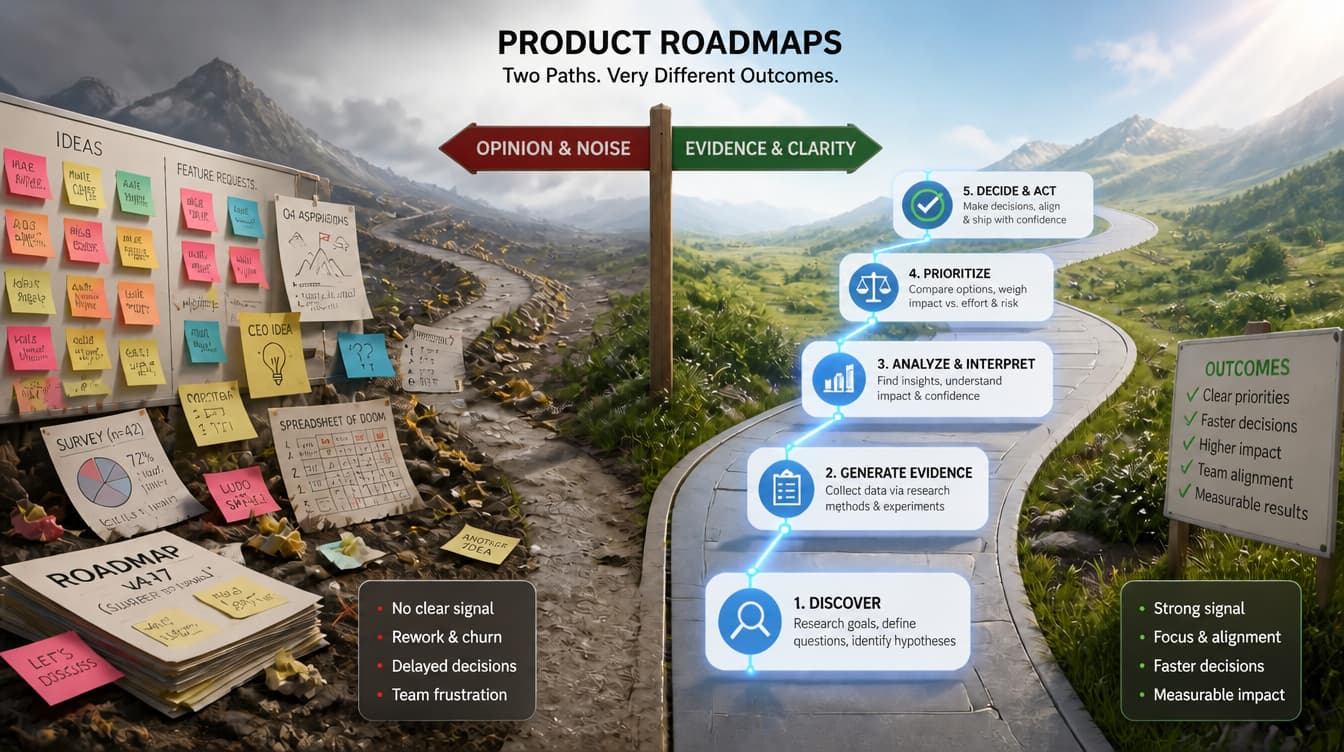
That is why roadmap validation needs to be treated as a pipeline, not a meeting. A roadmap meeting can prioritize what people already believe. An evidence pipeline can change what the team believes. The difference is material. In a meeting, the loudest stakeholder can win. In a pipeline, claims are checked against user behavior, qualitative context, usability evidence, and decision criteria.
The current UX research trend supports this shift. Nielsen Norman Group’s recent writing pushes UX teams to report business outcomes rather than activity. That matters because roadmap decisions are business decisions. They determine where engineering time goes, which customer promises become real, which risks get accepted, and which opportunities are delayed.
At the same time, the research tooling market is expanding and fragmenting. User Interviews’ 2026 UX Research Tools Map describes more than 150 curated UXR tools across research operations, methods, and analysis or insight management, with a broader list of nearly 800 UX tools available. It also lists method and analysis categories such as usability testing, surveys, diary studies, AI moderated research, biometrics, research repositories, qualitative analysis, transcription, and AI research companions.
This creates a paradox. Product teams have more tools than ever, but more tools do not automatically create better decisions. A survey tool can collect responses. A usability-testing tool can capture behavior. An AI analysis tool can summarize interviews. A repository can store findings. But if those artifacts are not connected to roadmap questions, the team still has a decision problem. The evidence exists, but it does not travel.
Why one-off research cannot keep up with product velocity
Roadmap validation starts with a simple discipline: every research activity should be attached to a decision. Not a topic. Not a vague curiosity. A decision. Understand onboarding is a topic. Should we redesign the onboarding checklist before launching the team plan? is a decision. Learn what users think about reporting is a topic. Should reporting become a paid-tier differentiator or remain part of the core plan? is a decision. Collect feedback on the new dashboard is a topic. Is the dashboard clear enough to ship to enterprise admins without customer success support? is a decision.
The method problem: choosing the right test for the decision
Once the decision is clear, the method becomes easier to choose. A five-second test can validate whether positioning is immediately understood. A first-click test can validate whether users know where to start. A tree test can validate whether an information architecture supports findability. A card sort can reveal mental models before navigation is finalized. A usability test can reveal task failure, hesitation, confusion, and severity. A survey can quantify preference, frequency, or segment-level patterns. Interviews can uncover motivation, context, constraints, and language. Diary studies can capture behavior over time.
The problem is that product teams often choose methods based on convenience. They run a survey when they need behavioral evidence. They run interviews when they need task validation. They ask preference questions when they need adoption signals. They collect feature requests when they need problem validation. Each mismatch creates false confidence. The team feels research happened, but the method did not actually answer the decision.
Roadmap validation needs method-decision fit. If the decision is Can users complete this critical task?, use usability testing. If the decision is Do users understand what this product does in the first few seconds?, use a five-second test. If the decision is Can users find the right feature in the navigation?, use tree testing or first-click testing. If the decision is Which categories match users’ mental models?, use card sorting. If the decision is How frequently does this problem occur in the target segment?, use a survey with strong sample controls. If the decision is What is the underlying job, context, and constraint?, use interviews.
The quality problem: bad data, bots, weak samples, and overconfident summaries
The next issue is data quality. A roadmap decision is only as strong as the input evidence. Nielsen Norman Group’s June 2026 article on survey bots is a useful warning. Survey bots can produce fraudulent responses, including AI-assisted open-text answers that look plausible, pass basic checks, and distort findings if they remain in the dataset. The article recommends looking for patterns such as extremely fast completions, uniform completion times, generic polished open-ended answers, suspicious IP patterns, and email anomalies.
This matters for roadmap validation because bad data does not merely pollute a dashboard. It can redirect product strategy. If a survey says users urgently want a feature, but 20 percent of the responses are fraudulent or low-quality, the roadmap may absorb a false signal. If AI-assisted responses produce fluent but vague open-ended comments, a team may believe it has qualitative support for a decision that no real user actually made. Participant quality is not an operations detail. It is a roadmap risk.
The same is true for sample quality. A team cannot validate an enterprise roadmap using responses from hobbyists if the product will be sold to operations leaders. A team cannot validate admin workflows using feedback from end users who never configure the system. A team cannot validate pricing packaging using people who have no budget authority. The sample must match the decision. Otherwise the result may still be interesting, but it should not drive roadmap commitment.
How AI changes roadmap validation
AI intensifies both the opportunity and the risk. It can help teams process more interviews, identify patterns faster, generate summaries, compare tools, and maintain repositories. But it can also create the illusion of completeness. User Interviews’ writing on the AI research risk cascade warns that errors can compound across transcription, synthesis, analysis, and final deliverables, transforming small upstream drift into significant downstream distortion.
For roadmap validation, this means AI should be treated as an acceleration layer, not an authority layer. The system can cluster evidence, flag contradictions, extract quotes, connect observations to decisions, and generate draft reports. But the team still needs traceability. Every recommendation should link back to raw evidence. Every confidence statement should explain its basis. Every automated summary should preserve uncertainty. Every roadmap decision should remain reviewable by humans who understand product strategy, technical feasibility, customer context, and business constraints.
The evidence pipeline model
This is where an evidence pipeline becomes valuable. A pipeline has stages. It starts with the decision. It defines the target user or segment. It selects the method. It collects evidence. It validates input quality. It preserves raw signals. It analyzes patterns. It checks for uncertainty. It maps findings to options. It recommends a decision. It tracks what happened after the decision. That is fundamentally different from a folder of research reports.
Decision framing
The first stage is decision framing. The team writes the decision as a question with action consequences. For example: Should we ship the AI summary feature to beta customers in July, or keep it internal until source traceability is improved? This is a real decision because each answer changes the plan.
Risk framing
The second stage is risk framing. The team identifies what could go wrong if it chooses incorrectly. In this example, the risk might be that customers overtrust summaries, miss source context, and make decisions based on unverified outputs. Risk framing helps select the method and confidence threshold.
Evidence design
The third stage is evidence design. The team chooses methods that match the decision. For the AI summary example, the team might run usability tests with target users, compare summary outputs against raw interview evidence, and run a comprehension test on report confidence labels. It might also ask Product Managers what evidence they need before acting on a summary.
Data-quality control
The fourth stage is data-quality control. The team screens participants, validates completion quality, detects bot patterns in surveys, checks recording quality, and records sample limitations. This stage prevents weak inputs from contaminating the decision.
Analysis and synthesis
The fifth stage is analysis and synthesis. AI can help here, but the output should be structured around the decision. Instead of producing generic themes, the system should answer: what supports shipping, what argues against shipping, what must change before shipping, what uncertainty remains, and which user segment is affected?
Decision reporting
The sixth stage is decision reporting. The final output should be a decision memo, not just a research report. It should include recommendation, confidence, supporting evidence, counterevidence, severity, business implication, and next step. If the evidence is insufficient, the recommendation should say so. Do not decide yet is a valid output when the cost of a wrong decision is high.
Post-decision learning
The seventh stage is post-decision learning. After the team acts, it should track whether the decision produced the expected outcome. Did activation improve? Did support volume drop? Did trial users adopt the feature? Did enterprise admins complete setup? Did the team avoid rework? This closes the loop and turns research from a pre-launch ritual into a learning system.
This model also helps product teams deal with competing inputs. Sales may want one thing. Customer success may want another. Analytics may show a drop-off. Leadership may push for a strategic bet. Research does not have to win against those inputs. Instead, it should clarify what each input proves and what it does not prove. Sales feedback can reveal deal friction, but not necessarily product usability. Analytics can show where users drop, but not why. Interviews can reveal motivation, but not prevalence. Usability tests can reveal task failure, but not market size. A good evidence pipeline integrates these signals without pretending they are interchangeable.
What Fred should own in the market
For Fred, this is the category opportunity. The market already understands user research. It increasingly understands AI-assisted research. What is less owned is roadmap validation as an evidence pipeline. Fred can position itself around the gap between research activity and product decision. The promise is not simply collect user feedback. It is turn user evidence into validated product decisions.
This positioning fits the trend toward business-outcome reporting. If UX teams need to show impact on revenue, cost, risk, speed, and retention, Fred can help structure research around those outcomes. If AI introduces a research risk cascade, Fred can help preserve traceability from raw data to recommendation. If survey bots and low-quality samples threaten evidence quality, Fred can make quality checks part of the workflow. If product teams need faster learning cycles, Fred can help run the right method for the right decision and produce decision-ready reports.
The language matters. Research repository is useful, but passive. Insights platform is useful, but often vague. Decision intelligence for product teams is stronger if the product actually connects evidence to decisions. It says Fred is not only where research is stored. It is where product uncertainty gets reduced.
There is also a product implication. Fred should make the decision object central. Every study should have a decision question. Every method should map to the evidence type it can produce. Every insight should retain a source link. Every AI-generated conclusion should expose confidence and limitations. Every report should include a recommended action and business-risk framing. The interface should help teams avoid treating all findings as equal.
A roadmap validation workflow in Fred could look like this. A Product Manager creates a decision: Should we prioritize collaborative reporting in Q3? Fred asks for the target segment, current assumption, expected business outcome, and decision deadline. The team selects methods: customer interviews for context, a usability test for the current reporting flow, and a survey to quantify frequency of collaboration pain. Fred collects and analyzes the evidence, flags weak signals, detects contradictions, and produces a decision report. The final recommendation might be: Prioritize a lightweight share-and-comment workflow before advanced dashboards. Confidence: medium-high. Evidence: repeated collaboration breakdown in interviews, usability failure in report handoff, and survey confirmation among team-based accounts. Risk: building advanced dashboards first may improve perceived power but not solve the handoff problem blocking adoption.
That is much more useful than a generic insight saying users want better reporting. It is actionable, scoped, traceable, and connected to roadmap sequence.
The broader market trend is moving in Fred’s favor, but only if Fred avoids weak AI positioning. AI features are multiplying. User Interviews lists purpose-built AI research tools across generation, testing, moderation, analysis, synthesis, repository building, and all-in-one categories, and notes that the challenge is no longer finding AI tools but finding the right ones.
That means we use AI is not a differentiator. We make AI-assisted evidence decision-safe is closer. Validate roadmap decisions in one sprint is stronger because it names the buyer’s real problem: uncertainty under time pressure.
The product teams that benefit most are not the ones with no research. They are the teams with scattered research, weak prioritization rituals, and pressure to move quickly. They have enough feedback to argue, but not enough structured evidence to decide. They have analytics but no context. They have customer calls but no synthesis. They have surveys but questionable data quality. They have AI summaries but limited trust. Fred should speak directly to that condition.
Conclusion
Roadmap validation is not about proving that users like an idea. It is about deciding whether the team should commit scarce capacity. Sometimes the answer will be yes. Sometimes it will be no. Often it will be not yet, but test this smaller version. The value is not always in greenlighting a feature. Often the value is preventing waste, narrowing scope, sequencing correctly, or exposing a hidden risk before it becomes expensive.
That is why evidence pipelines matter. One-off research can answer one question. A pipeline improves the organization’s ability to decide repeatedly. It creates a shared standard for evidence. It makes uncertainty visible. It prevents weak data from looking strong. It helps stakeholders compare options. It keeps research connected to product movement.
In 2026, product teams do not need more disconnected feedback. They need better decision infrastructure. Roadmap validation is the practical expression of that shift. It turns user research from a service request into a strategic operating system. For Fred, that is the market to own.
Validate roadmap decisions in one sprint with Fred
Use Fred to validate roadmap decisions in one sprint with connected research methods, AI-assisted analysis, behavioral evidence, and decision-ready reporting. Try it with a 15-day free trial. Start your 15-day free trial →
Related reading:
- AI-Powered UX Research: What It Actually Means
- Why Startups Fail Without User Research (And How to Avoid It)
- How to Build a UX Research Stack for Product Teams
Source notes
- User Interviews, UX Research Tools Map 2026: https://www.userinterviews.com/ux-research-tools-map
- Nielsen Norman Group, Stop Reporting UX Activity and Report Business Outcomes: https://www.nngroup.com/articles/reporting-ux-business-outcomes/
- Nielsen Norman Group, Kick the Bots Out of Your Survey Data: https://www.nngroup.com/articles/survey-bots/
- User Interviews, What is the New AI in Research Risk Cascade?: https://www.userinterviews.com/blog/what-is-the-ai-research-risk-cascade
- User Interviews, 30+ AI Tools for Every Phase of UX Research: https://www.userinterviews.com/blog/ai-ux-research-tools
- User Interviews, A Blueprint for Evaluating AI Across the Research Pipeline: https://www.userinterviews.com/blog/evaluating-ai-across-research-blueprint