Research Operations
AI Product Dogfooding: A Triangulation Gate for Launch Decisions
Learn what AI product dogfooding can reveal, where employee evidence stops, and how to combine internal use, QA, and representative research before launch.
A release memo can contain true evidence and an unsupported conclusion
Consider a fictional release memo for an AI assistant that recommends the next action in a complex account workflow. It contains three lines:
- Employees used the assistant during internal work and exposed retrieval failures.
- QA cleared the specified paths, permissions, and error states.
- Therefore, the assistant is ready for customer administrators.
The first two lines can be accurate while the conclusion remains unsupported. Internal use shows what knowledgeable insiders encountered. QA shows whether defined behaviour held under the tested specification. Neither establishes that customers understand the assistant, can use it with their permissions and data, or accept the authority it appears to hold.
Representative sessions could reveal a different layer of risk. An administrator might read “apply” as an immediate change rather than a proposed action. Another might lack access to the data source named in the explanation. A third might assume the recommendation reflects company policy because the assistant uses internal terminology. Someone may complete the task but remain unsure whether rejecting a suggestion changes future recommendations.
Those findings would not invalidate the internal trial. Employees genuinely helped improve the product, and QA genuinely established important reliability conditions. They would invalidate the broad launch claim.
AI product dogfooding is valuable when teams keep that boundary visible. It becomes risky when volume, enthusiasm, or executive attention turns internal use into a substitute for representative evidence.
A team still needs to decide: Which launch claims can internal use support, which require another method, and what should happen when the evidence sources disagree?
Three evidence streams, three different questions
Dogfooding, QA, and representative-user research overlap in the product they examine. They differ in population, procedure, and the claim they can support.
Dogfooding puts the product into the hands of employees during real or semireal work. It can reveal recurrent breakage, weak defaults, confusing internal workflows, retrieval gaps, slow responses, surprising model behaviour, and problems that scripted tests did not anticipate. Employees often know where the system connects to other tools, which states are fragile, and which outputs violate domain expectations. Their repeated exposure is especially useful for finding variable failures that appear only after many interactions.
Quality assurance evaluates whether the product behaves as specified. QA can cover paths, permissions, state transitions, boundary values, exception handling, regression cases, and defined reliability requirements. It can deliberately reproduce conditions that ordinary use may never encounter. A strong QA result supports a claim about implemented behaviour under the test specification. It does not establish that the specification reflects customers' goals or that people understand the behaviour.
Representative-user research examines whether the intended population can understand the product, achieve relevant goals, recover from failure, and fit the experience into real constraints. It can reveal mental models, language, workarounds, trust conditions, accessibility barriers, authority expectations, and context that insiders do not share. A small qualitative study cannot establish prevalence across a market by itself, but it can expose failure mechanisms and show that an internal assumption does not generalise.
Nielsen Norman Group describes employee success as a weak positive signal and employee failure as a stronger warning. If people who know the product cannot use it, external users are unlikely to fare better. If employees succeed, their knowledge may be doing work the interface does not.
That asymmetry should shape the launch review. Dogfooding can falsify readiness quickly. It cannot certify readiness broadly.
AI makes internal use more useful and more misleading
A deterministic product can still surprise its makers, but the same input usually leads to the same state. An AI-enabled product introduces more variation. Output can change with prompt wording, retrieved data, model version, tool availability, permissions, timing, and conversation history. A successful internal path does not guarantee the next run will behave the same way.
More employee use creates a larger surface for finding instability. An internal cohort can identify rare hallucinations, inconsistent explanations, brittle escalation, unsafe tool selection, or outputs that technically satisfy a prompt while violating domain practice. These observations can become regression scenarios and monitoring requirements.
The same activity can create false reassurance for three reasons.
First, insiders repair the product silently. They know which phrase produces a better result, which menu hides the source, when to ignore an implausible answer, and whom to message when a workflow stalls. Their success rate includes knowledge that customers have not been given.
Second, employees often operate with privileged access and unusually clean context. They may have complete data, broad permissions, fast internal support, and familiarity with organisational language. A customer may face missing records, delegated authority, local policy, older integrations, shared devices, or partial access.
Third, incentives differ. Employees may want the launch to succeed, feel observed by the team building it, or hesitate to criticise a senior sponsor's initiative. Even when participation is voluntary, colleagues know that their comments may be identifiable through role, team, or examples. Internal enthusiasm can be authentic and still be an incomplete measure of customer fit.
This does not make internal evidence contaminated or disposable. It defines its generalisability limit.
Audit the distance between insiders and the affected users
Before internal findings enter a launch decision, compare the employee cohort with the population that will live with the outcome. The comparison should be concrete enough to change the evidence weight.
Start with six dimensions.
Language: Do employees understand product labels, model terminology, internal abbreviations, and system boundaries that customers may not know?
Access: Do they have broader permissions, better data, newer integrations, faster devices, or direct contact with the product team?
Task and context: Are they performing the same job, at the same frequency, under similar time pressure and interruption? A sales engineer demonstrating a feature is not equivalent to an administrator resolving a live account problem.
Incentives and power: Can participants criticise the product freely? Could feedback affect their team, manager, status, or access? Do they believe adoption is expected?
Risk and consequence: What happens when the system is wrong? An employee trial may use reversible test data while a customer action changes money, access, compliance, or a relationship.
Population coverage: Which languages, abilities, organisation sizes, markets, expertise levels, and edge contexts are absent?
The purpose is not to calculate a universal insider score. A numeric result would imply precision the team does not have. The purpose is to name the distance that matters to this decision.
For an internal expense tool, employees may be exactly the affected population. The relevant gaps may be role, location, accessibility, employment type, or managerial power. For a customer-facing recommendation system, employees may be close on domain expertise and far away on account context, incentives, vocabulary, and consequence.
The audit turns “we tested internally” into a qualified statement: who tested, under which conditions, what their evidence can support, and where it cannot travel.
Put the launch claim through the Triangulation Gate
The Triangulation Gate is a review of one consequential claim, not a scorecard for the whole product. It has five questions.
- What decision will this evidence change? State the choice and the consequence. “Gather feedback” is not a decision. “Release recommendations to all administrators, limit them to a supervised beta, or keep them internal” is.
- What claim must be true for that choice? Separate reliability, specified behaviour, comprehension, contextual fit, adoption, and acceptable risk.
- Which evidence source can test each claim? Dogfooding, QA, representative research, analytics, security review, legal review, and domain evaluation have different jobs.
- Where do sources agree, conflict, or leave a gap? Do not average contradictions into a single confidence label.
- Who owns the action and the residual risk? Name the person who can launch, narrow, pause, or stop the release.
Apply the gate to the account-workflow assistant.
The decision is whether to release the recommendation feature to all customer administrators.
The launch claims include:
- the system retrieves permitted data and follows specified access rules;
- recommendations remain within the defined action scope;
- administrators understand whether an action is proposed or applied;
- explanations use language customers recognise;
- users can reject, correct, or escalate a recommendation;
- failures are observable and recoverable;
- the feature remains useful when data is incomplete;
- the remaining error risk is acceptable for the affected accounts.
Internal use can supply repeated observations about retrieval, latency, inconsistent output, workflow fit for employees, and unexpected model behaviour. QA can test permissions, state transitions, rejection paths, error handling, and regression conditions. Representative research can examine comprehension, authority, language, recovery, and real-context fit. Security and domain owners must evaluate claims that neither usability evidence nor employee preference can settle.
The gate makes one common mistake harder: allowing the largest evidence stream to dominate. Five thousand internal interactions do not answer a population-fit question if every interaction comes from people who share the same insider knowledge.
Treat agreement, conflict, and absence differently
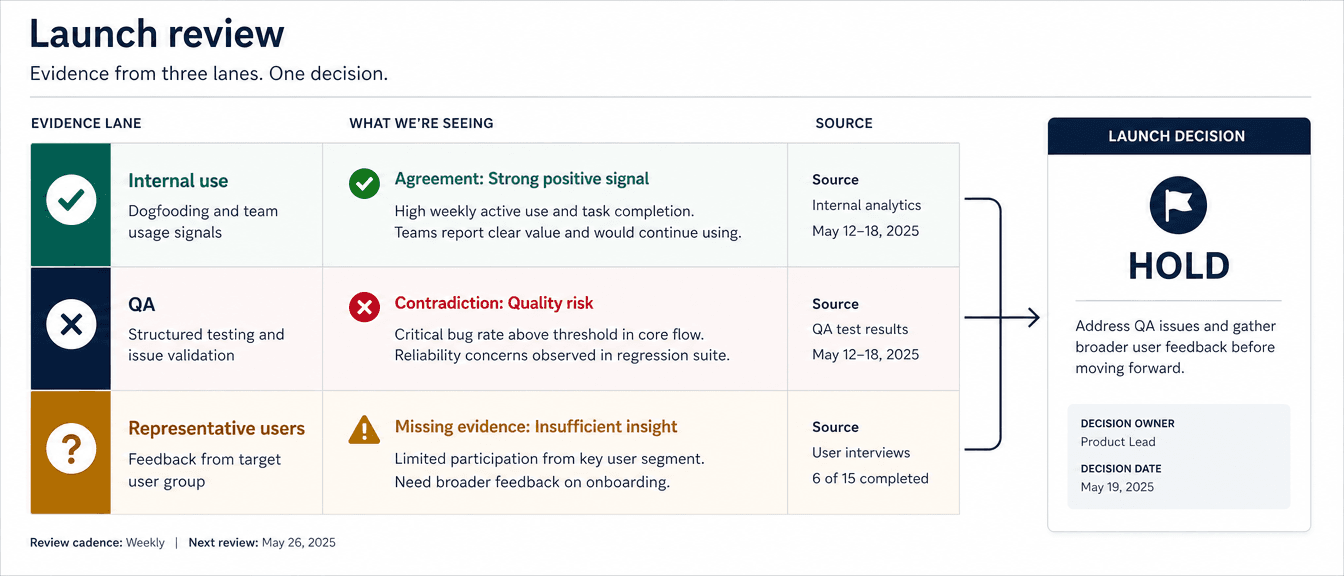
When all sources agree, the team can act with clearer confidence. Suppose employees find the assistant's action label ambiguous, QA confirms that the state change occurs immediately, and representative administrators also expect a preview. The methods converge on a release condition: separate proposed and applied states, make the transition explicit, and verify comprehension before broad launch.
Conflict is more informative than a blended average.
Imagine employees prefer terse explanations because they know the domain, while administrators need the source, affected account, and reversible next step. The team should not choose the explanation with the higher satisfaction score. The populations and tasks are different. The customer-facing interface should serve customer comprehension, while an internal expert mode might remain terse if that is a real product need.
Another conflict may reveal a specification problem. QA passes the rejection flow because the product returns to the prior screen exactly as defined. Representative users believe rejection also teaches the assistant not to repeat the recommendation. The implementation matches the requirement, but the requirement missed the user's mental model. The next action belongs to Product and Design, not QA.
A gap should remain a gap. If no source tests behaviour with incomplete customer data, the team cannot infer safety from clean internal accounts. The options are to run the missing evaluation, narrow eligibility to accounts that meet verified data conditions, introduce a monitored trial with recovery controls, or stop the release. “No evidence yet” is a valid decision input.
NIST's AI RMF supports this discipline by calling for deployment-like evaluation, representative human-subject work where applicable, documented limitations, external perspectives, and continuing measurement. It remains voluntary guidance and does not turn this editorial gate into compliance or certification.
Internal products still require representative internal research
“Employees are the users” is sometimes correct. An HR service, finance workflow, research-operations tool, or internal support assistant may exist only for colleagues. Dogfooding alone still does not guarantee that the employee cohort represents the affected workforce.
A product team and a regional operations team may use the same internal system with different permissions, vocabulary, equipment, workload, and exposure to customers. Contractors may lack access that permanent staff take for granted. Assistive-technology users may encounter states absent from the trial. Frontline staff may be unable to pause for a workaround that headquarters employees tolerate.
Internal research also needs ethical care. The Department for Education guidance warns about consent, identifiability, organisational relationships, and data handling when colleagues participate. Its page is under review, so teams should follow current organisational policy and qualified research guidance rather than treating the page as a complete standard.
Practical safeguards include voluntary participation, clear explanation of how feedback will be used, separation from performance management, data minimisation, careful reporting for small groups, and a route to raise concerns outside the participant's management line. If criticism could affect a person's work, the research design must address that power relationship.
The evidence question remains the same: does the sample match the people, context, and consequence behind the decision?
Keep provenance and limitations attached to the finding
Triangulation fails when sources are merged into a theme and their origins disappear. “Users found the recommendation helpful” may combine employees, beta customers, support staff, and a survey item. Without population, method, environment, and date, the statement cannot carry a defensible decision weight.
Each material finding should retain:
- source population and recruitment criteria;
- method and task;
- product, model, prompt, data, and environment version;
- direct evidence and interpretation;
- affected claim and decision;
- contradictions and credible alternatives;
- generalisability limit;
- severity and reversibility;
- confidence basis;
- owner and next validation action.
A searchable research repository helps teams retrieve prior work, but retrieval is only the start. The team still has to decide whether a finding fits the current population, system version, and decision. An old employee observation may become useful again when the same failure reappears. It should not become a timeless product truth.
The same traceability protects AI-assisted analysis. As Fred's guide to AI in UX research explains, meaning can drift through transcription, synthesis, and reporting. Preserve the source relationship so a confident summary cannot hide a mixed or unrepresentative sample.
Choose a release outcome, not a ceremonial approval
A launch review should end with an action whose scope matches the evidence.
Launch when the critical claims have relevant support, contradictions are resolved or bounded, recovery is credible, and an accountable owner accepts the residual risk.
Run a limited trial when evidence supports controlled use but population coverage, variability, or consequence remains uncertain. Define eligibility, monitoring, stop conditions, support, and the decision the trial will inform. A beta without a learning question is only a smaller launch.
Validate further when a material claim lacks the method or population required to test it. Choose the smallest study that can change the decision. Fred's roadmap-validation guide offers the broader rule: select the method for the decision, not for convenience.
Stop or redesign when the product cannot stay within authority, failures are hard to detect or reverse, representative users cannot understand consequential behaviour, or the risk exceeds the organisation's tolerance.
Nielsen Norman Group's PROVE framework makes a related point about AI-tool adoption: evaluate one tool against one real task, include quality, risk, velocity, experience, and workflow friction, then treat the result as provisional. PROVE is designed for task-level tool decisions, not product-launch certification, but its insistence on real benchmarks and revisitable conclusions is useful here.
For AI agents, the representative study should also test variability, control, handoffs, and failure, not only one polished path. Fred's guide to usability testing AI agents provides a practical starting point for those scenarios.
A reusable checklist for the decision owner
Before treating internal use as launch evidence, ask:
- What exact release decision is being made?
- Which claims concern reliability, specified behaviour, comprehension, context, adoption, or risk?
- Who supplied each signal?
- How far are internal participants from the affected population in language, access, task, incentives, context, and consequence?
- Which critical claims were tested by QA?
- Which critical claims were tested with representative users?
- Were tests conducted under conditions similar to deployment?
- Which populations, environments, data states, and failure modes remain absent?
- Where do evidence sources agree?
- Where do they conflict, and what explains the conflict?
- Which gap could change the release decision?
- What happens if the system is wrong?
- Can people detect, reject, recover from, and appeal the outcome?
- What monitoring and stop conditions continue after release?
- Who owns the decision and the residual risk?
Dogfooding earns its place by exposing what a product team would otherwise miss. QA earns its place by testing whether defined behaviour holds. Representative research earns its place by showing whether the product makes sense and works in the lives of the people affected.
The disciplines reinforce one another when their boundaries remain visible. They become misleading when a team treats internal volume as customer representation, a passing specification as contextual fit, or a small study as universal prevalence.
Bring one AI launch decision into Fred. Connect internal observations, QA evidence, representative-user findings, contradictions, limitations, confidence, and the next validation action in one decision case. The team can move quickly without pretending that every signal answers the same question.
Source notes
- Nielsen Norman Group, “Dogfooding vs. QA vs. User Research”, published 7 August 2026 .
- NIST, “AI Risk Management Framework Core”, AI RMF 1.0 published in 2023.
- Department for Education User Research Manual, “Research with internal users”.
- Nielsen Norman Group, “How to Decide When an AI Tool Is Worth Keeping”, published 7 August 2026.
- The Triangulation Gate, insider-distance dimensions, account-workflow scenario, agreement-conflict-gap handling, decision outcomes, and checklist are original Fred editorial contributions. They are practical decision aids, not validated scientific instruments, regulatory guidance, legal advice, customer outcomes, or claims that Fred certifies AI launch readiness.