Research Operations
Proactive Research Needs a Decision Gate
Govern proactive UX research with a decision gate that tests relevance, evidence gaps, source boundaries, ownership, and measurable decision impact.
When the insight pipeline creates a second backlog
On Monday morning, a ResearchOps lead opens a dashboard that has monitored support themes, repository searches, roadmap changes, sales-call tags, and recent study coverage. It proposes 14 knowledge gaps.
Three look urgent. Enterprise buyers are asking more questions about export controls. Repository searches for “approval workflow” have increased. A product team planning an onboarding redesign has not run research with administrators for nine months.
Every signal is plausible. Together, they exceed the team's available research capacity.
The dashboard has done what it was designed to do: detect patterns before somebody submits a request. It has not established that 14 studies should begin, that the loudest signal represents the largest risk, or that absence in the repository means absence of knowledge. The team still has to decide which gaps deserve attention and which apparent gaps are artifacts of source access, vocabulary, timing, or organizational noise.
That is the central governance problem in proactive UX research. A reactive request queue can conceal late involvement and political prioritization. A proactive system can improve timing, yet produce its own demand. Once an automatically generated gap enters a backlog, acquires a priority, and appears in a leadership report, it begins to look like authorized work. The prediction becomes a commitment by administrative momentum.
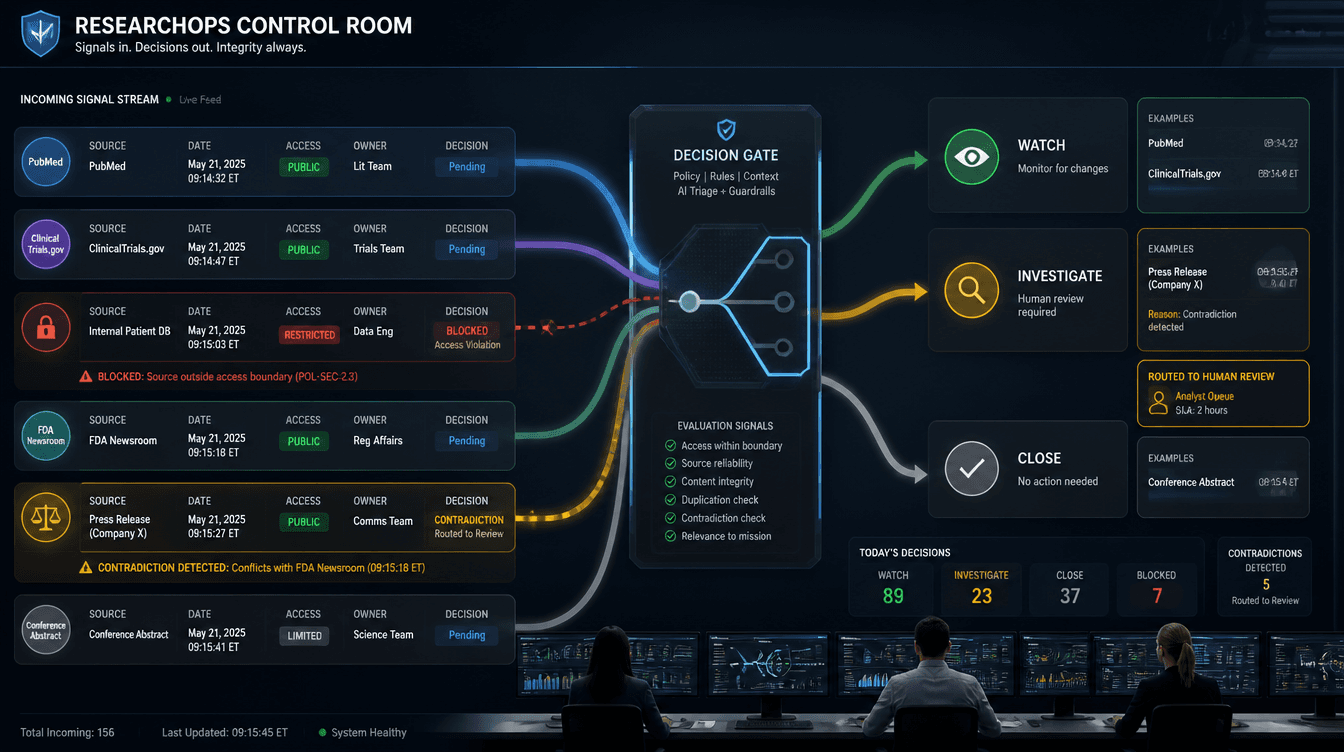
Research leaders need a control point between detection and action. The Signal-to-Decision Gate is a portfolio review that asks whether a detected signal is connected to a real decision, whether current evidence is insufficient for that decision, whether the sources may be used for this purpose, and whether new evidence could change an action. A gap that fails the gate can remain visible. It simply does not become a study by default.
Four objects that should remain separate
Proactive pipelines become difficult to govern when they use “insight,” “gap,” and “research need” as interchangeable labels. Each term should represent a different state of knowledge.
A signal is an observed change or pattern. It may be a rise in a search term, a cluster of support cases, an unrepresented segment, a contradiction between studies, a roadmap milestone, or a repeated stakeholder question. The signal says something happened in the sources the system could see.
A knowledge-gap hypothesis is an interpretation of that signal. It proposes that the organization lacks information required to understand a problem or make a choice. The hypothesis can be wrong. People may search for an approval workflow because the label changed, not because the capability is missing. A repository may appear silent because teams used a different term or because relevant evidence sits behind an access boundary.
An approved research need exists when a decision owner and a qualified reviewer agree that the unresolved gap matters to a real decision and warrants evidence work. Approval should state the decision, the consequence of error, the evidence standard, the deadline, the permitted sources, and the owner.
Decision evidence is what the approved work eventually produces. It can support, weaken, or fail to resolve the original hypothesis. Its value depends on method fit, source quality, population fit, contradictions, limitations, and the action it informs.
Keeping these objects separate prevents a common escalation error. A high-frequency signal may deserve a low-confidence gap hypothesis. A well-supported gap may still have no decision window. An approved need may be resolved by retrieving prior evidence rather than collecting new data. A completed study may leave the decision unchanged and still be useful if it prevents an expensive commitment.
This separation also makes automation easier to evaluate. The pipeline can be assessed for how reliably it detects and describes signals without granting it authority to approve research or make a product decision.
How proactive systems manufacture demand
The emerging practice is real enough to deserve careful design. The ResearchOps Review's May 2026 map describes teams moving toward gap analyses across roadmaps, repositories, and recruitment panels, along with proactive updates and continuous insight streams. The article also stresses evaluation, human validation, and risks such as disintermediation, weak familiarization with raw data, synthetic loops, and participant fraud.
Those risks interact with ordinary portfolio mechanics.
First, monitored channels reward volume. Support cases, sales notes, and repository searches are countable. People who do not contact support, customers who never reached a sales conversation, and users whose needs are poorly represented in the taxonomy produce fewer signals. A system may create precise demand around visible populations while leaving less observable groups under-researched.
Second, recency can masquerade as relevance. A new cluster may outrank an older unresolved risk because the pipeline is tuned to change. Freshness deserves attention when the underlying product or environment changed. It should not automatically displace a consequential question simply because the older evidence has stopped generating alerts.
Third, organizational language can become self-reinforcing. If leadership starts using “AI assistant adoption” in planning, that phrase spreads into tickets, searches, calls, and reports. A monitoring system may interpret the repeated vocabulary as independent confirmation even though several sources inherited the same internal framing.
Fourth, a prediction can detach from a decision. “Stakeholders will need evidence about trust” sounds strategic, but trust is a broad topic. Which interaction, population, choice, and consequence are involved? What would the team do differently if trust were high, low, or mixed? Without those answers, the pipeline has forecast interest rather than research demand.
Finally, coverage can expand silently. Connecting more systems appears to improve completeness. It also changes whose data is processed, who can infer what, how long signals persist, and whether material collected for service delivery or commercial work is being reused for research planning. Source access is a governance decision, not a setup detail.
The Signal-to-Decision Gate
The gate uses eight questions. It is an editorial operating model, not a validated scientific instrument or an automated scoring feature in Fred.
- What signal was detected? Record the source, observation window, comparison baseline, and uncertainty. Preserve what the system actually observed before interpreting it.
- Which decision could this affect? Name the choice, owner, deadline, and available options. A topic without an action consequence remains on watch.
- What evidence already exists? Search the repository, previous decisions, current product data, support evidence, and relevant external sources. Note freshness, population fit, methods, and reuse limits.
- What material gap remains? State exactly what the existing evidence cannot support. Absence from search results is not enough.
- What is the consequence of being wrong? Consider reversibility, affected people, financial or operational exposure, accessibility, privacy, and strategic opportunity cost.
- What new evidence would be sufficient? Define an evidence threshold proportional to the decision. More data is not a threshold.
- Are the sources permitted and bounded? Confirm purpose, access, minimization, retention, provenance, and whether sensitive material requires exclusion or specialist review.
- What action could change? List at least two plausible outcomes. If every result leads to the same plan, the proposed research may be ceremonial.
The output is a state and a rationale, not a universal numerical score. “Investigate” means the gap is material and a bounded next step is justified. “Watch” means the signal is worth retaining but has no sufficient decision connection or urgency. “Close” means current evidence resolves the question, the signal was misinterpreted, or no action could change. “Validate” means an investigation has produced a concrete claim that now needs decision-proportionate evidence. A closed item may reopen when the product, population, evidence, or decision changes.
This gate extends the decision discipline in Fred's guide to roadmap validation evidence pipelines. That guide starts research with a decision and follows evidence through post-decision learning. Proactive operations add an earlier step: deciding whether a detected gap should enter that pipeline at all.
Bound the monitoring system before judging its outputs
A high-quality review cannot compensate for an undefined monitoring boundary. The team should document each input before the pipeline begins scanning it.
For every source, record the operational purpose, lawful and approved use, accountable owner, accessible fields, excluded fields, retention period, refresh cadence, population represented, known blind spots, and permitted downstream consumers. Keep raw sensitive content out when a count, category, or de-identified event can answer the monitoring question. Separate access to a gap signal from access to the underlying material.
Provenance should survive transformation. A statement such as “approval concerns increased” needs a link to the source definition, date range, query or classification rule, exclusions, and previous baseline. If an AI system classified the material, retain the model or service context needed for review, the evaluation method, and the human correction path. Fred's article on AI research quality explains why quality has to be checked across the pipeline rather than inferred from a polished summary.
NIST's voluntary AI RMF offers useful governance principles here. Its Map function asks organizations to document targeted scope, knowledge limits, expected benefits and costs, data suitability, human oversight, and feedback from relevant actors. Applying those principles does not make a ResearchOps pipeline NIST-certified. It does provide a disciplined way to expose context and limits before an AI-assisted recommendation reaches a portfolio board.
Stop conditions belong in the boundary. Pause a source when permission changes, a classification rule drifts, expected fields begin carrying sensitive content, a source population changes materially, or reviewers cannot trace a signal back to its inputs. Deleting or correcting a signal must propagate to downstream gap records where retention and audit requirements allow.
Three signals, three different outcomes
Return to the Monday dashboard. The portfolio board reviews the three urgent signals.
Approve an investigation: administrator onboarding
The product team must decide in five weeks whether to redesign administrator onboarding before an enterprise rollout. Current repository evidence covers end users, while administrators configure permissions and integrations. Support data shows recurring setup failures, but it cannot explain whether the cause is comprehension, missing capability, implementation conditions, or access policy.
The decision is named, the population mismatch is material, the existing evidence is insufficient, and different findings would change the roadmap. The gate approves a bounded investigation. It starts with evidence review and a small set of administrator sessions designed to distinguish comprehension failures from capability gaps. The method owner can expand or stop based on what the first stage reveals.
Keep on watch: searches for approval workflow
Repository searches for “approval workflow” increased after a terminology change in a leadership document. No related roadmap decision is due, and searchers come from several roles with different possible meanings. The team cannot tell whether people are seeking a product capability, an internal process, or an old study.
The signal remains on watch. ResearchOps improves query instrumentation, adds synonym coverage, and checks whether searches lead to existing evidence. The item reopens if a product decision appears, search failure persists, or support and behavioral evidence converge. Starting interviews now would convert ambiguous vocabulary into unearned urgency.
Close without a new study: export controls
Enterprise buyers are asking more questions about export controls. The repository already contains recent procurement interviews, usability evidence for the permissions flow, a documented product decision, and unresolved technical constraints. The commercial team used a new tag, making an established concern appear novel.
The gap closes without new collection. The team retrieves the prior evidence, confirms that its population and product version still fit, and routes the existing decision case to Product and Sales. If the technical constraint changes, the item can reopen for validation. Avoided duplicate research is a successful portfolio outcome.
These examples show why a single priority score is inadequate. Similar signal strength can lead to different states because decision timing, evidence coverage, actionability, and source meaning differ.
Ownership across the portfolio
Proactive research requires several forms of authority, and they should not collapse into one approval.
ResearchOps owns the pipeline definition, source inventory, operating states, audit trail, and capacity view. It should be able to stop a source or downgrade a signal when provenance fails.
A research craft owner assesses whether the knowledge-gap hypothesis is coherent, whether existing evidence fits, and what method can reach the required threshold. This reviewer also guards against turning a convenient source into a population claim.
The data or privacy owner confirms permitted use, minimization, access, retention, and escalation for sensitive material. Approval to access a business system does not automatically authorize every research-planning use of its contents.
The Product or business owner names the decision, deadline, options, and action consequences. This person should not manufacture a decision merely to move an interesting topic through the gate.
The decision owner accepts the remaining uncertainty and chooses whether to act. AI can support detection, retrieval, clustering, and preparation. It cannot hold accountability for the decision or approve expansion of its own source access.
Small teams can assign several responsibilities to one person, but the judgments should remain explicit. A named owner needs enough access, time, and authority to challenge the signal, narrow the scope, or close the item.
Run the portfolio as a learning system
The board should review states and transitions, not celebrate the volume of detected gaps.
Track how many signals enter watch, investigate, validate, close, and reopen. Then add measures that reveal whether the portfolio improves decisions: time from decision identification to usable evidence, percentage of investigations tied to an active decision, prior evidence reused, duplicate studies avoided, decisions changed or narrowed, unresolved contradictions preserved, and items closed because no action could change.
Quality measures should include provenance failures, unauthorized source attempts, stale evidence used without review, sensitive fields detected outside the approved boundary, and human corrections to classifications. Capacity measures should show how much reviewer time the system creates. A pipeline that saves analyst hours while doubling expert review may still be valuable, but the total workflow cost should be visible.
Avoid optimizing for studies launched, insights generated, summaries delivered, or alerts resolved. Those measures reward throughput and can recreate the demand factory in a cleaner interface. Decision impact can also be subtle. Narrowing scope, delaying a commitment, reusing valid evidence, and closing a false gap are legitimate outcomes.
Use a searchable research repository to retrieve study purpose, source material, limitations, and the decision that followed. Retrieval quality is part of the gate because the apparent gap may be a findability failure. Storage becomes valuable when it changes the next decision, not when it merely increases the corpus a pipeline can scan.
Review the system itself on a schedule. Which sources dominate? Which populations remain quiet? Which gap hypotheses repeatedly close as terminology errors? Where do reviewers disagree? Which decisions arrive too late for the gate to help? Those questions expose whether the portfolio reflects customer and product risk or simply the data exhaust the organization finds easiest to collect.
Put one proposed gap through the gate
Proactive UX research can move evidence earlier, while a decision is still open. That advantage disappears when every detected absence becomes work, every repeated phrase becomes demand, or every connected source becomes acceptable input.
Begin with one proposed gap. Preserve the original signal. Name the decision, owner, deadline, existing evidence, material uncertainty, consequence of error, evidence threshold, source boundary, and action that could change. Choose watch, investigate, validate, or close, and record why. Reopen the item only when the context changes.
Then bring the case into Fred. Connect the decision, prior evidence, contradictory signals, confidence, owner, and next validation step before commissioning another study. The pipeline can help the team see earlier. The gate determines when seeing something should change what the team does.
Source notes
- Kate Towsey, “How to AI UXR: A Map for Building AI-Augmented Research Operations”, published 21 May 2026.
- Kate Towsey, “AI, Margins, and the New Division of Labour: Three Reversals Reshaping How Research Operates”, published 3 August 2026.
- NIST, “AI Risk Management Framework Core”.
- The Signal-to-Decision Gate, portfolio states, three scenarios, source-boundary checklist, ownership allocation, and portfolio measures are original Fred editorial contributions. They are decision aids, not validated scientific instruments, legal advice, privacy approval, customer outcomes, or claims that Fred autonomously predicts or approves research demand.