Research Operations
Customer Feedback Prioritization: When ARR Distorts Roadmaps
Learn how to use ARR in customer feedback prioritization without letting current revenue override evidence quality, strategic fit, or missing users.
On 14 July 2026, Dovetail announced that Channels 2.0 could generate revenue-weighted product ideas from customer feedback, attach CRM context such as affected accounts and ARR at stake, and move the resulting context into planning or coding tools. The launch matters beyond one vendor. It shows where customer intelligence is heading: from helping teams read evidence to helping them decide what deserves action.
Revenue belongs in that decision. A request connected to a renewal worth €400,000 deserves different commercial attention from an isolated preference expressed by a free account. Product teams that deliberately ignore account value will make avoidable mistakes, especially in B2B markets where one workflow failure can threaten implementation, expansion, or renewal.
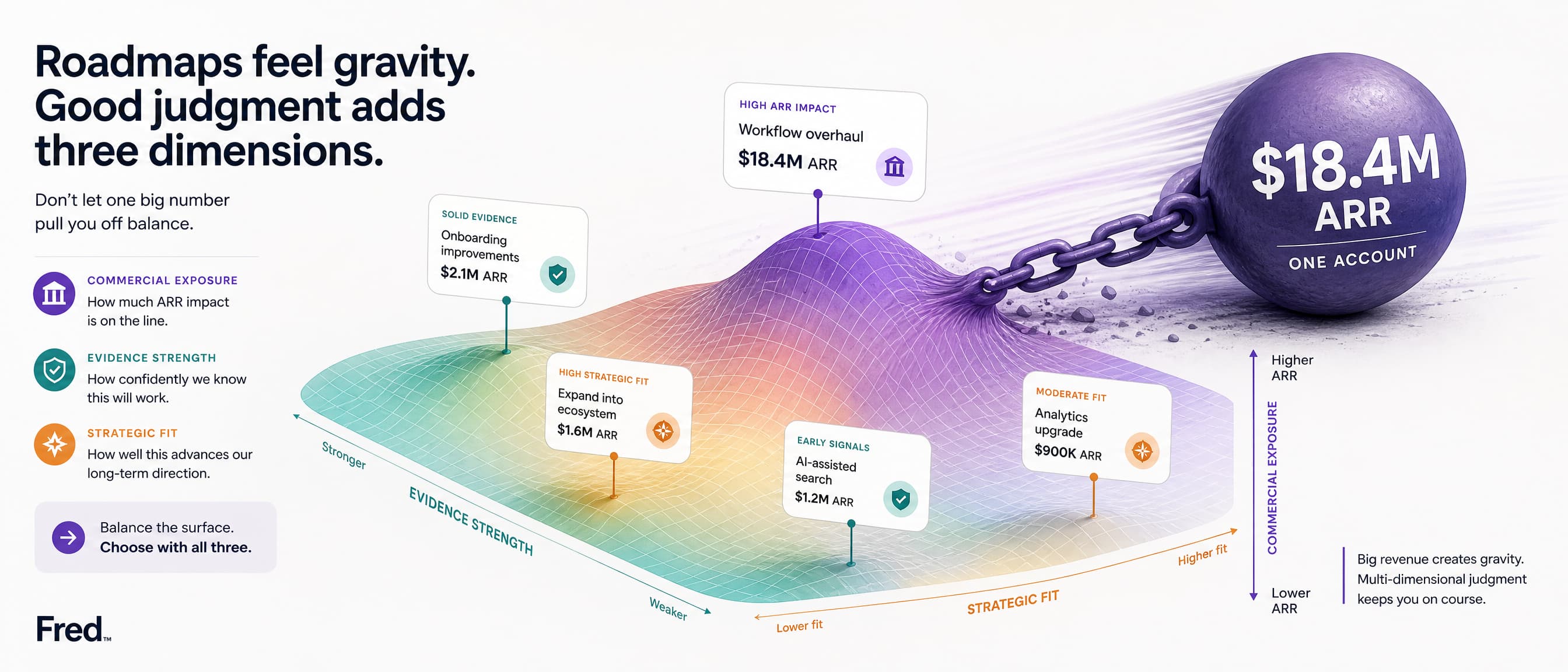
The trouble begins when revenue becomes the ranking logic rather than one part of the decision. ARR is precise, readily available, and legible to executives. Research quality, population coverage, strategic fit, and opportunity cost are harder to express. Once a tool puts all of them into one ordered list, the most measurable factor can dominate without anyone explicitly choosing that policy.
That creates a deceptively calm roadmap. Every idea has a score. Every score appears to have a commercial basis. The underlying judgments remain unsettled: whether the feedback describes a real problem, whether the requested feature would solve it, whether the affected account represents the intended market, and whether the company wants to become the product that request implies.
A weighting rule becomes strategy before the roadmap meeting starts
Customer-feedback systems rarely begin as strategy systems. They centralize support tickets, call transcripts, surveys, app reviews, sales notes, research sessions, and feature requests. Classification reduces the reading burden. Segmentation shows which accounts or cohorts mention a theme. A commercial field then helps Product and Customer Success estimate exposure.
Each step is reasonable. Together they determine which problems become visible to decision-makers.
Suppose a ranking gives strong weight to ARR, request frequency, and recent growth. A problem reported by two enterprise accounts may rise above a workflow failure observed across many smaller customers. That may be correct when the two accounts face imminent renewal risk. It may be damaging when those accounts are asking the product to reproduce a legacy process that conflicts with the company's direction.
The score cannot resolve that tension because the tension is strategic. Someone must decide how much roadmap capacity should protect current revenue, improve the common product, address underserved users, and create future options. A formula can apply the policy after the organization defines it. It should not define the policy by accident.
This distinction becomes more consequential when the ranked output travels directly into Jira, Linear, a PRD, or a coding agent. A weakly interpreted signal no longer ends as a dashboard card. It begins consuming discovery time, design attention, engineering capacity, and stakeholder expectations. Fred's guide to roadmap validation as an evidence pipeline makes the necessary separation: customer input becomes decision evidence only after the team validates the problem, the affected segment, the severity, and the proposed response.
What revenue can tell a product team
Current revenue is valuable because it reveals exposure. When a customer reports a problem, account data can help a team answer questions that research evidence alone cannot:
- How much recurring revenue is associated with affected accounts?
- Is renewal, expansion, or implementation currently at risk?
- Does the problem cluster within a segment the company has chosen to serve?
- Are strategic accounts encountering the same barrier independently?
- Would inaction create support, services, or contractual costs?
These are legitimate business questions. Research teams lose influence when they report a usability failure without explaining its operational or financial consequence. Nielsen Norman Group's July 2026 guidance makes this point directly, and Fred's article on connecting UX research to business outcomes shows how a user signal can be linked to revenue, cost, risk, speed, or retention without pretending that a usability study caused the downstream result by itself.
Commercial context also improves triage. A serious defect affecting a high-value implementation cannot wait for a quarterly prioritization exercise. A compliance or data-integrity problem may require containment before the team completes a broader study. A pattern across accounts approaching renewal can justify immediate investigation even when the final solution remains unclear.
None of this means that the requested feature should be built. Revenue can justify attention, escalation, and faster evidence collection. It cannot establish that the customer's proposed remedy is the right product decision.
A customer asking for configurable approval chains may be exposing a genuine governance problem. The best response could be a full workflow engine, a narrower permission change, better audit visibility, a services workaround, or a clear decision not to serve that operating model. The ARR attached to the account increases the consequence of getting the answer wrong. It does not answer the question.
The people who never acquire an ARR value
Revenue-linked feedback begins after a person or organization has entered the commercial system. Many strategically important users never reach that point.
Prospects may abandon during evaluation because the product is inaccessible, confusing, or missing a basic capability. Trial users can fail before activation and leave no support ticket. A buyer may reject the product during security review. A participant in a usability study may reveal a barrier that current customers have learned to tolerate. Churned accounts may disappear from current-ARR reports precisely because the problem was severe enough to make them leave.
This creates a selection effect. The feedback dataset represents people who have managed to buy, adopt, contact the company, or remain active long enough to be measured. UX Magazine's July 2026 article “More Data Is Not More Insight” highlights the same structural problem: users with limited connectivity, device capability, digital literacy, language access, or success in the product can be absent from high-volume behavioral data. Processing more of the existing dataset does not recover the people it never contained.
Customer-feedback prioritization therefore needs an explicit missing-user review. Before accepting a revenue-ranked theme, the team should ask who could experience the problem without appearing in the calculation. Relevant groups may include non-converters, recently churned customers, low-engagement accounts, users served through intermediaries, disabled users, unsupported languages or regions, and the future segment named in the product strategy.
The missing-user review does not assign equal roadmap capacity to every absent group; it corrects false completeness. A ranking that covers €2 million in affected ARR may still describe only the part of the market already captured by the product. Leaders need to know whether they are protecting the current portfolio, improving the common experience, or learning about future demand. Those are different investments.
Keep three judgments separate
A defensible review preserves three judgments until the team has discussed them. Collapsing them into one number too early hides the reason an idea ranks highly.
Commercial exposure
Commercial exposure describes the business consequence of the problem among accounts the company can currently observe. ARR at risk, expansion potential, implementation delay, support cost, contractual commitment, and renewal timing belong here.
A high value creates urgency. It may justify executive attention, temporary containment, or a faster validation cycle. Commercial exposure does not measure how well the proposed feature is supported.
Evidentiary strength
Evidentiary strength describes what the team actually knows. It depends on source quality, independence of observations, participant and account fit, recency, behavioral confirmation, contradictions, and whether the evidence supports the problem or merely repeats a requested solution.
Twenty sales notes can still represent one deal team copying the same request. Three independent usability sessions can expose a repeated task failure with clearer causal evidence. A large volume of support tickets can show prevalence among people who contact support while saying little about silent failure. Each source contributes differently.
When evidence is weak and commercial exposure is high, the response should usually be rapid investigation rather than immediate commitment. The account deserves attention, and the roadmap still deserves protection.
Strategic fit
Strategic fit asks whether solving the validated problem moves the product toward the market and operating model the company has chosen. It includes target segment, product principles, differentiation, technical direction, regulatory constraints, and the opportunity cost of displacing other work.
This judgment cannot be delegated to customer data. Existing customers naturally describe needs from the product and market they know. They are rarely positioned to decide which category the company should enter, which architecture it should maintain, or which future customer it should pursue.
Rather than a universal score, the review should leave a record showing why commercial exposure, evidence, and strategic fit agree or conflict. Fred's decision-intelligence workflow is designed around that kind of inspectable case: the decision, source evidence, confidence, limitations, and recommendation remain connected.
An imperfect B2B prioritization example
Consider a hypothetical B2B collaboration product preparing its next two quarters. The company has capacity for one major initiative and a smaller reliability improvement. Four signals appear in its customer-intelligence system:
|
Signal |
Commercial context |
Evidence available |
Strategic tension |
|---|---|---|---|
|
Custom approval chains |
Requested by two enterprise accounts representing €520,000 ARR |
Sales notes, one renewal call, no workflow observation |
Could pull the product toward bespoke process management |
|
Mobile upload failures |
Reported by 46 accounts representing €180,000 ARR |
Support tickets, product logs, and six observed task failures |
Broad product-quality issue, but not a differentiator |
|
Simplified guest access |
Repeated in trial interviews and lost-deal notes, €40,000 current ARR |
Nine interviews, funnel abandonment, competitor win-loss evidence |
Supports the intended team-collaboration market |
|
Advanced export controls |
One regulated customer representing €310,000 ARR |
Security questionnaire and admin interview |
Important for enterprise readiness, but solution scope is unclear |
An ARR-first ranking places custom approval chains at the top, followed by export controls. That ordered list is commercially understandable. It still produces a poor decision if the team reads it as a build sequence.
The approval-chain request has the greatest current exposure and the weakest evidence about the underlying workflow. The accounts may need clearer responsibility, audit history, or controlled handoff rather than a configurable process engine. The appropriate next action is a focused study with actual operators, plus a technical exploration of how much configurability the product can support without becoming a bespoke platform. The revenue signal shortens the deadline for learning. It does not justify the feature as described.
Mobile upload failures have lower ARR concentration but stronger behavioral evidence. The issue affects a broad set of customers and already produces support demand. Because the likely fix is smaller and the evidence is convergent, it may deserve the reliability slot immediately. Waiting for more interviews would add little unless logs show multiple unrelated causes.
Guest access has very little current ARR because many affected organizations have not converted. That is exactly why a current-revenue ranking understates it. The evidence connects the problem to trial abandonment and lost deals, and the direction aligns with the company's chosen market. It is a credible candidate for the major initiative, though the team still needs to validate which part of guest access blocks adoption before selecting a solution.
Export controls sit between containment and product development. The account exposure and enterprise strategy justify attention. The single-customer evidence and unclear scope argue against committing a large feature. A short security and admin research track can determine whether the need generalizes to the regulated segment.
The resulting sequence is less tidy than a ranked backlog. Fix the verified mobile failure. Investigate approval chains and export controls under time pressure appropriate to the revenue exposure. Continue validating guest access as the leading strategic opportunity. This answer respects current customers without allowing their contract size to decide what the product becomes.
Evidence could change the judgment. If workflow observation showed that approval chains block daily operations across the enterprise segment, and several pipeline accounts required the same capability, the strategic case would strengthen. If guest-access abandonment turned out to be caused mainly by pricing or procurement, the initiative would weaken. A reviewable decision keeps those conditions visible.
Where automation should stop
Automation is useful throughout the early part of customer-feedback prioritization. It can ingest sources, detect themes, attach account metadata, find duplicate reports, identify demand changes, retrieve supporting clips, and notify an owner when a threshold is crossed. These operations reduce clerical work and make evidence easier to inspect.
The boundary should appear before a surfaced idea becomes a roadmap commitment or build instruction.
A robust workflow retains distinct states: surfaced signal, assembled evidence, candidate problem, validated opportunity, roadmap decision, and authorized delivery work. Moving between them requires different proof. A surfaced signal needs source traceability. A candidate problem needs enough independent evidence to justify investigation. A validated opportunity needs population fit, severity, contradictions, and a connection to strategy. A roadmap commitment also requires cost, feasibility, timing, and an accountable decision owner.
Tools may recommend the transition. A person should authorize the transitions that commit engineering capacity, customer promises, or significant spending. Dovetail's own July release acknowledges this issue in its agent design: write actions can be held for human sign-off. The same principle belongs in customer-feedback prioritization, even when the system is not described as an agent.
Direct movement from revenue-ranked idea to code removes the space where teams test whether the request is a symptom, a workaround, an edge case, or a strategic diversion. The speed is real. So is the possibility of automating the wrong commitment.
A short review for every high-ranked signal
Before a high-ranked item enters roadmap planning, the owner should be able to answer the following questions from the evidence packet:
- Which independent sources support the problem, and which merely repeat the requested solution?
- Which users, accounts, and roles are represented?
- Who may experience the problem without appearing in revenue-linked data?
- What observed behavior establishes severity?
- What commercial consequence is current, and what consequence remains hypothetical?
- Does the proposed response support the chosen product direction?
- What evidence contradicts the ranking or suggests a smaller response?
- Is the next action containment, more research, a reversible experiment, or a roadmap commitment?
- Who is accountable for the decision, and what new evidence would cause reconsideration?
A missing answer does not always block action. An urgent reliability or compliance problem may require containment before the study is complete. The gap should remain visible so that emergency action does not quietly become permanent strategy.
Teams should also retain the weighting configuration used at the time of the decision. If account value, vote count, frequency, severity, or recency influenced the ordering, the record should show how. Otherwise a later reviewer sees an apparently objective priority without the policy that produced it.
Individual scores hide portfolio concentration
Even a careful item-level process can produce a distorted roadmap over time. Each high-ARR request may be reasonable on its own while their combined effect turns the product into a service layer for a small number of accounts.
A quarterly portfolio review can expose this pattern. Product leaders should examine how much delivery capacity is tied to the largest accounts, retention commitments, broad product quality, new-segment learning, regulatory work, infrastructure, and strategic options. The categories will differ by company. The useful measure is concentration.
If 65 percent of roadmap capacity is linked to the top five accounts, leadership should know that it has chosen a concentrated retention strategy. That may be rational during a critical renewal period. It becomes a problem when nobody remembers choosing it.
The review should also separate direct customer requests from generalized problems. Ten bespoke features for ten accounts create a different product from ten requests that reveal the same underlying coordination failure. Research earns its place by finding that underlying pattern, testing whether it generalizes, and showing which response can serve the intended market.
Teams overwhelmed by customer inputs should keep commercial metadata while making the path from signal to decision inspectable. Fred's product-manager workflow starts with one roadmap decision and keeps the supporting evidence, confidence, and trade-offs attached to it before sprint planning locks the commitment.
Revenue should influence urgency, investigation depth, and risk framing. Evidence should establish what is happening and for whom. Strategy should determine whether the opportunity deserves scarce capacity. When those judgments conflict, the conflict is the decision.
Bring one commercially important request to Fred and build the case around it: source evidence, affected users, ARR exposure, missing populations, contradictions, strategic fit, and the next validation step. A roadmap can absorb commercial pressure without surrendering product judgment, but only when the reasoning remains visible.
Source notes
- Dovetail, Our Sun's Out Launch: Introducing Digital Twins, Agents, Channels 2.0, and New Enterprise-Grade Features, 14 July 2026. Primary evidence for revenue-weighted ideas, CRM enrichment, workflow routing, and human approval controls. Product claims establish capability and market direction, not independent outcome validation.
- Nielsen Norman Group, Stop Reporting UX Activity and Report Business Outcomes, 3 July 2026. Supports the legitimate connection between UX evidence and revenue, cost, risk, speed, and retention.
- UX Magazine, More Data Is Not More Insight, 21 July 2026. Supports the analysis of missing users and selection effects in high-volume customer data. This is practitioner commentary rather than a controlled empirical study.
- Pendo, What Is Customer Feedback?. Documents current use of account value, votes, product analytics, and customer metadata in feedback prioritization.
- Pendo, NPS Revenue Insights, updated 26 March 2026. Documents recurring revenue as a prioritization field paired with NPS data.
- Enterpret, How to Prioritize Your Product Roadmap From User Feedback, 8 June 2026. Supports separating frequency, severity, business context, and themes in feedback workflows.
- Intercom, RICE: Simple Prioritization for Product Managers. Background on reach, impact, confidence, and effort as distinct prioritization inputs.