Research Operations
AI-Ready Research Context: Guide Product Generation Without Losing Evidence
Learn how to turn research into bounded, traceable context for AI-generated product work while preserving evidence, uncertainty, permissions, and human review.
A green test result can hide a broken research constraint
The pull request looked reassuring. The AI coding tool had generated a new onboarding flow, the automated checks were green, and the acceptance criteria were all marked complete. The design was cleaner than the previous version and removed two steps.
Then a researcher compared the build with the study that had informed it.
The original finding said: participants who did not have their company registration details available needed to save progress, leave the flow, and return without losing completed work. The generated implementation preserved the form values for 20 minutes in the same browser tab. It did not support returning later, switching devices, or resuming after authentication expired.
No source had established that 20 minutes was sufficient. That number appeared during the transformation from a research report into a ticket, from the ticket into a prompt, and from the prompt into code. By the time the team reviewed the screen, an invented operational limit looked like a product decision.
The immediate question is whether to ship the flow. The larger question is how research should travel into systems that can design and build. If the team gives an AI tool a polished summary, the tool may follow the words while missing the evidence boundary. If the team provides every transcript and artifact, the system may over-focus on a vivid but irrelevant detail, overlook a minority need, or blend conflicting studies into one confident instruction.
Research used for AI product generation needs a different form. It must be concise enough to act on and complete enough to preserve why the constraint exists, who it applies to, what remains uncertain, and when a person must review the result.
Reports persuade people; execution context constrains action
A research report has a human reader. It can use narrative, charts, clips, explanation, and professional judgment to help that reader understand a recommendation. The reader can ask a question, inspect a source, notice a contradiction, or decide that the evidence does not fit the current market.
An AI generation tool consumes context differently. It treats the available text, examples, files, and instructions as material for producing an output. It does not automatically know which sentence is an observation, which is an interpretation, which applies only to one segment, or which must stop generation when evidence is missing.
Nielsen Norman Group's July 2026 proposal for UX-context design makes the directional case clearly: if AI is producing more interface work, research and design knowledge must become part of the context those tools consume. The proposal also leaves important questions open. Which artifacts improve output? How much context is useful? How should the material change as products, users, and models change?
Those questions become urgent when context moves beyond a prototype and into delivery. Dovetail's July 2026 launch provides a current market signal. Its product release describes customer evidence flowing through agents and MCP connections into planning and coding environments, with approval controls for write actions. A vendor announcement can establish that these workflows exist. It cannot establish that the evidence was interpreted correctly or that a generated product change serves the affected users.
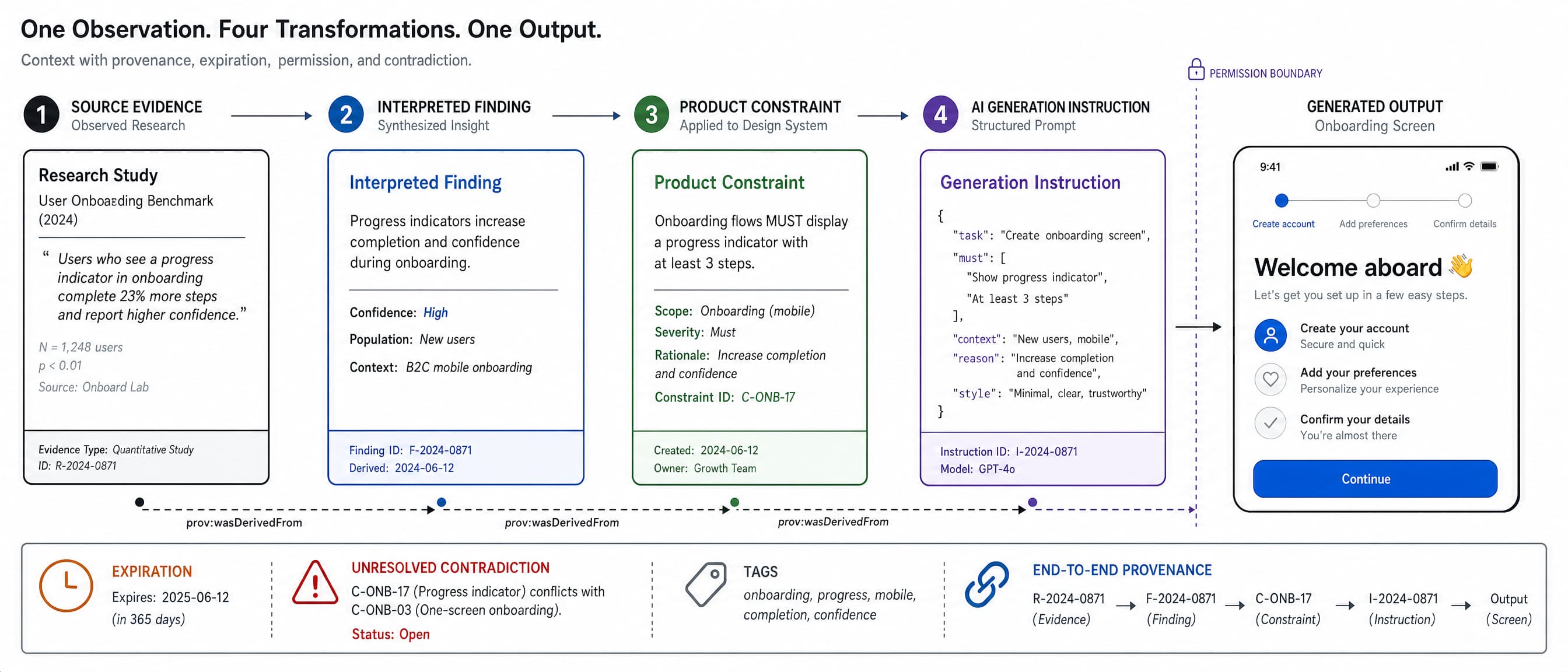
The team therefore needs to distinguish four transformations:
- Source evidence: what a participant did or said, the task and environment, the study method, the sample, and the original material.
- Interpretation: what the team believes the evidence means, including contradictions and alternative explanations.
- Product constraint: the condition a design or implementation must satisfy for a specific decision.
- Execution instruction: the bounded direction given to an AI or human builder, including what it may change and what requires review.
Each transformation adds judgment. Treating them as one block hides where meaning changed. Keeping them separate makes disagreement inspectable.
The Research-to-Execution Contract
The Research-to-Execution Contract is an original Fred editorial model for preparing one decision's evidence for AI-assisted product work. It is not a technical standard or a validated scientific instrument. Its purpose is to make the transformation explicit before a system acts.
A useful contract contains:
- Decision: the product or business choice the generated work will inform.
- Permitted use: the artifact, flow, or question this context may shape.
- Source evidence: direct links to the study, sessions, observations, and relevant product data.
- Interpretation: the current explanation and credible alternatives.
- Affected users: the populations represented, missing, or at higher risk.
- Constraint: the behavior the generated product must preserve or avoid.
- Evidence strength: how confidently the source supports that constraint.
- Contradictions: evidence that weakens or qualifies the instruction.
- Non-goals: nearby decisions the context does not authorize.
- Expiration trigger: the product, user, market, or evidence change that requires review.
- Human review: the owner and moment when generation must pause.
- Recovery: how to reverse the generated change if the constraint fails in validation.
This contract deliberately sits between a repository and a prompt. A searchable research repository keeps prior studies, source material, and decision context retrievable. The contract selects what is relevant to one product decision without pretending that retrieval alone has resolved interpretation.
Follow one finding from observation to instruction
Consider a fictional B2B onboarding redesign. The company wants to reduce the time from account creation to the first collaborative workspace. The commercial pressure is real: sales wants fewer setup steps, product wants more users to invite a teammate, and engineering has one sprint before a planned campaign.
The available evidence is mixed:
- In six moderated sessions with administrators from small companies, four participants paused at the company-details step because they did not have a registration number or billing address available.
- Two returned to the task later on another device. One could not remember which account they had used.
- Analytics show a 31 percent exit rate on the step, but cannot explain why people left.
- Support tickets include requests to save progress, although account tier and organization size are inconsistent.
- An accessibility review found that the step's timeout warning was not announced reliably by one screen-reader and browser combination.
- Enterprise administrators, people using shared devices, and customers outside the studied markets were not represented in the moderated sample.
A summary might say: "Users need a shorter onboarding flow with save and resume." That statement is easy to paste into a prompt and too ambiguous to govern a build. Does shorter mean fewer fields, progressive disclosure, later collection, or faster validation? Does resume mean the same tab, the same device, or any authenticated session? Which fields may be stored, for how long, and under what consent and security rules?
The contract narrows the decision:
Decision: whether the company-details step may move after workspace creation without creating compliance, access, or data-integrity problems.
Permitted use: generate two prototype variants and the associated empty, error, timeout, and return states. Do not change identity verification, billing authorization, retention rules, or production data handling.
Constraint: a person who lacks optional company details must be able to create a draft workspace, leave safely, and understand how to return. Required legal or billing information must remain required at the verified point where it becomes necessary.
Evidence strength: medium. The qualitative pattern is coherent across moderated sessions and support evidence, while the sample is small and incomplete. Analytics confirm exits but not cause.
Contradictions and gaps: some organizations may require administrator verification before workspace creation; shared-device behavior is untested; cross-device resume may create security and account-recovery risks; the accessibility issue may be browser-specific.
Human review: Research reviews whether the variants preserve the observed need. Security and Legal review any cross-device persistence or change in data timing. Product owns the final sequencing decision.
Expiration trigger: authentication changes, company-detail requirements change, or new research contradicts the return behavior.
The execution instruction can now be precise: generate two low-fidelity variants that allow deferring optional company details, include an explicit return path, expose the assumptions in annotations, and stop before specifying persistence duration or production storage. The system may explore interaction structure. It may not invent a retention policy.
That boundary preserves speed. The team can compare credible options without treating generation as authority for decisions that require different evidence and owners.
Context quality is not context volume
When generated work misses user needs, adding more documents can feel like the safest response. It can create a different failure.
Large context sets mix decisions, dates, populations, and levels of evidence. A 2024 study of novice users may conflict with a 2026 study of administrators because the product changed. A support theme may describe frequency without revealing severity. A recommendation written for a marketing page may become a universal interaction rule. A model may select the most repeated wording rather than the evidence most relevant to the decision.
UX Magazine's July 2026 commentary makes a related point: more behavioral data can show what happened at greater scale without explaining why it happened. The article is practitioner interpretation, not a controlled study, but the distinction is useful. Context can be extensive and still omit the people, circumstances, or uncertainty required for a decision.
The practical check is selective:
- Can every material constraint be traced to a source?
- Does the source represent the users affected by the decision?
- Is the evidence recent enough for the current product and market?
- Are contradictions present rather than averaged away?
- Is sensitive material necessary, permitted, and minimized?
- Can the system tell when the evidence does not authorize an answer?
- Will a reviewer recognize when the generated artifact exceeds the context?
If the answer to one of these questions is no, the remedy may be a smaller permitted use, a new study, a human decision, or an explicit abstention. More tokens do not repair a missing evidence relationship.
Test the transformation, not only the generated screen
Teams usually evaluate the artifact at the end: does the prototype look right, does the code compile, and can someone complete the task? Those checks can miss a faithful implementation of a distorted instruction.
User Interviews' 2026 risk-cascade guidance describes how small shifts can compound from transcription through synthesis, analysis, and a final deliverable. Its evaluation blueprint recommends defining accuracy for the specific context, checking outputs against that definition, comparing tools, maintaining evaluations, and asking questions that expose hidden risks. These are practitioner models rather than universal empirical standards, but they point to the right unit of inspection: the full chain.
For the onboarding example, compare four states:
- Evidence to interpretation: Did "participants lacked details during the session" become the broader claim "customers do not need these details"?
- Interpretation to constraint: Did "allow a safe return" become "keep form state for 20 minutes" without evidence?
- Constraint to generated artifact: Does each variant make deferral, return, and required-information timing understandable?
- Artifact to product decision: Is the team choosing a sequence based on observed user need, or because one generated design looks more polished?
Build a small evaluation set from known edge cases and contradictions. Include the participant who returned on another device, the screen-reader timeout problem, the unrepresented enterprise administrator, the shared-device risk, and a user who can complete all details immediately. Run each generated variant against that set. Record what remains unsupported.
The evaluation should follow the context whenever the model, prompt, design system, authentication flow, or evidence changes. A green test result is meaningful only for the version of the contract and artifact that were actually tested.
Ownership and permission must travel with the evidence
Executable context can make research more influential because it appears where product work is generated. It can also separate findings from the people responsible for their use.
ResearchOps can own provenance, access, retention, and the maintenance process. Researchers can own the interpretation and limits of a study. DesignOps or a design-system team can own reusable interaction standards. Product can own the decision under test. Security, Legal, Accessibility, or domain specialists may own constraints that research alone cannot resolve.
The context should state those boundaries in a form that tools and people can follow. A product manager may use a finding to generate prototype options without receiving access to raw participant data. A coding agent may receive a verified constraint and a source identifier rather than a transcript. A sensitive study may be available for human review while only a minimized, approved derivative enters the generation workflow.
Approval also needs to match consequence. Generating a disposable concept can tolerate uncertainty that changing authentication, consent, pricing, accessibility behavior, or participant-data handling cannot. The same evidence may permit exploration and prohibit execution.
This is where AI research quality and product generation meet. Meaning can drift during research analysis, then drift again when the result becomes build context. Human review at the end is weak if nobody preserved what the reviewer should compare.
Make context expire for a reason
A universal expiry date is simple and often arbitrary. Useful context becomes stale when the relationship between evidence and decision changes.
Review the contract when the product flow changes materially, the affected population changes, a new market or policy adds constraints, a new study contradicts the interpretation, or the generating model behaves differently on the evaluation set. Preserve version history so a later team can see why a rule existed and which evidence supported it.
This avoids two common outcomes. In the first, old findings disappear and teams repeat research because they cannot inspect the source. In the second, an old finding survives as an absolute rule after its population, interface, or purpose has changed. Searchable research memory helps with continuity, but reuse still requires a decision about fit.
The product team in the onboarding example should leave the review with more than a preferred screen. It needs a bounded decision: which fields may move, which return behavior is required, which risks need specialist review, what evidence remains missing, and what change will trigger another validation round.
That is the point of roadmap validation. Evidence becomes valuable when it changes a product commitment while there is still time to choose, constrain, test again, or stop.
Prepare one decision, then let the system act within it
Research does not become executable by turning a report into markdown or attaching a repository to an AI tool. It becomes executable when the team makes the transformations and limits visible.
Keep source evidence separate from interpretation. Turn the interpretation into a product constraint for one decision. Define what the generation system may produce, what it must preserve, and where it must abstain. Carry population fit, contradictions, permissions, expiration, review ownership, and recovery alongside the instruction. Test each transformation against known edge cases, not only the polish of the final artifact.
This approach creates some friction. It asks a team to prepare context before asking for output, and it preserves uncertainty that a confident prompt might hide. The trade-off is deliberate. Faster generation is useful only when the team can still tell which evidence shaped the result and which choices the evidence did not authorize.
Bring one roadmap decision into Fred. Connect the hypothesis, source evidence, conflicting signals, confidence, recommendation, and next validation step. Then prepare a bounded Research-to-Execution Contract for the artifact an AI system will generate. The system can move quickly inside that boundary. The team remains accountable for deciding where the boundary belongs.
Source notes
- Nielsen Norman Group, "UX-Context Design: Using UX Knowledge to Inform AI-Generated Design", published July 24, 2026 and opened August 10, 2026. Used for the shift toward curated, machine-readable UX context and for the open questions around artifact efficacy, context volume, model change, and maintenance. The article reports directional experiments and practice observations, not a settled industry standard or universal outcome guarantee.
- Dovetail, "Our Sun's Out launch: Introducing digital twins, agents, Channels 2.0, and new enterprise-grade features", published July 14, 2026 and opened August 10, 2026. Used as first-party evidence that Dovetail announced agents, approval controls, evidence-connected workflows, and MCP distribution into planning and coding environments. Vendor claims and examples establish product direction, not independent proof of decision quality.
- User Interviews, "What is the New AI in Research Risk Cascade? Experts Explain", updated April 10, 2026 and opened August 10, 2026. Used for the practitioner model of compounding meaning drift across multi-step research pipelines. It is an editorial interview and explainer, not peer-reviewed validation.
- User Interviews, "A Blueprint for Evaluating AI Across the Research Pipeline", updated May 22, 2026 and opened August 10, 2026. Used for the five-step evaluation guidance. It is practitioner guidance published by a research-platform company and does not establish one universal accuracy definition.
- UX Magazine, "More Data Is Not More Insight", published July 21, 2026 and opened August 10, 2026. Used for practitioner interpretation of the difference between behavioral scale and explanatory understanding, and for the risk of losing uncertainty and missing-user context. It is commentary that relies partly on secondary examples, not a primary quantitative study.
- The Research-to-Execution Contract, onboarding scenario, transformation checks, context-quality questions, evaluation-set procedure, and expiration triggers are original Fred editorial contributions. They are decision aids, not validated scientific instruments, technical standards, legal advice, customer outcomes, or claims that Fred currently controls external design or coding tools.