Research Operations
The Hidden Cost of AI Research Automation: How to Prevent ResearchOps Operational Debt
Learn how to measure and prevent AI operational debt in UX research with a net-value equation, readiness matrix, maturity model, role design, and 90-day plan.
AI can now accelerate almost every visible part of a research project. A discussion guide appears in seconds. Interviews are transcribed while they are still running. Themes arrive before the debrief, and a polished summary can be ready before the researcher has closed the last video call.
Those gains are useful, especially for teams carrying more product questions than their research capacity can handle. They are also easy to overstate. The stopwatch usually stops when the output appears, even though the work needed to trust, maintain, explain, and recover that output has only begun.
Consider an AI-generated theme that says onboarding friction is the main reason trial users leave. Before that sentence can shape a roadmap, someone needs to know which interviews support it, whether opposing evidence was retained, whether the participants match the intended segment, and how the analysis changed when the prompt or model changed. If the answer is challenged a month later, the original evidence still needs to be available. None of this appears in a product demo, yet all of it consumes attention.
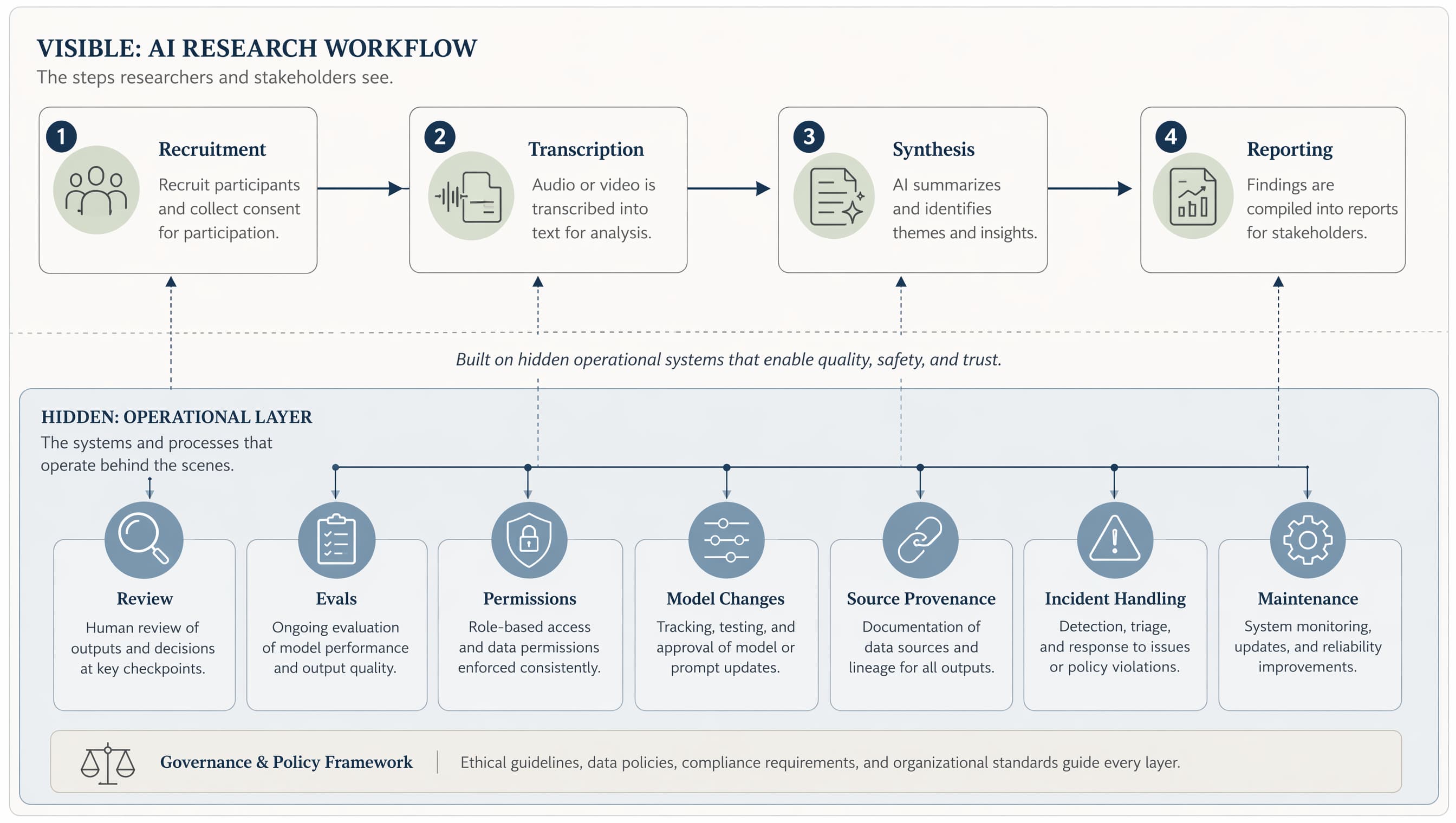
That accumulated burden is AI operational debt. It shows up as repeated checking, undocumented prompt changes, duplicated tools, confusing ownership, brittle integrations, uncertain permissions, and findings that cannot be traced back to their sources. The debt is rarely created by one bad purchase. It grows through reasonable local choices whose ongoing cost is never added together.
The useful question for ResearchOps is therefore practical: after the full operating cost is included, does this workflow help the team make a better decision?
Where the work goes when a research task gets faster
Conventional automation is comfortable when the rules and output are stable. A form can reject an empty required field. A script can rename recordings or move approved files. The same input under the same conditions normally produces the same result, which makes failures relatively easy to detect.
Generative systems behave differently. Their output depends on the model, prompt, supplied context, retrieval sources, language, and even the shape of a particular study. A workflow may summarize straightforward interviews convincingly, then flatten disagreement in a study where participants use similar words to describe different needs. Plausible prose can hide the failure.
As a result, the researcher does not simply hand work to a machine. Work is redistributed. Time previously spent producing a transcript or first draft reappears as source preparation, review, calibration, access management, change testing, incident handling, and explanation to stakeholders. Some of this is skilled research work. Some belongs to operations, security, privacy, or engineering. When nobody assigns it, the burden tends to land on the person who introduced the tool.
A team may still come out well ahead. Ten minutes of transcript review can be an excellent trade for three hours of manual cleanup. The trouble starts when the ten minutes becomes forty, the same errors recur, and only one person knows which prompt fixes them. The dashboard continues to report three hours saved because it measures execution time and ignores the service around it.
Research workflows are particularly vulnerable because a small error can travel a long way. Incorrect speaker attribution affects a quote. The quote affects a theme. The theme appears in a report, which becomes a slide, which then supports a roadmap commitment. By the time somebody questions the conclusion, its origin may be scattered across a transcription vendor, a spreadsheet, a chat thread, and a research repository.
This is why provenance matters as much as output quality. A clear route from claim to source lets a reviewer challenge interpretation while the context is still available. Without that route, polished synthesis creates an expensive choice: trust the text because it sounds reasonable, or redo enough analysis to reconstruct how it was produced.
The hidden layer also changes whenever the system changes. A model update can alter how themes are grouped. A new prompt may improve concision while removing qualifications. A permissions change can make one source unavailable to retrieval without producing an obvious error. Research teams already maintain methods, templates, consent practices, and repositories; AI adds another set of moving dependencies to that operating environment. Guidance on AI-powered UX research is most useful when it treats these dependencies as part of the workflow, rather than background technical detail.
A hypothetical study, counted honestly
Imagine a product team deciding whether to rebuild onboarding for a complex B2B service. This example is hypothetical, but the work and timings are deliberately ordinary. The researcher conducts twelve customer interviews and needs to give the product lead a recommendation before quarterly planning.
In the previous process, transcript preparation and cleanup took four hours. Initial coding and theme organisation took eight, then drafting the report took another five. Seventeen hours of visible analysis work followed the interviews.
The team introduces an AI-assisted workflow. Transcript preparation falls to one hour, first-pass themes take another hour, and the researcher turns the generated structure into a report in ninety minutes. On the surface, human effort has fallen from seventeen hours to three and a half. A savings claim of thirteen and a half hours goes into the internal business case.
The first review complicates that story. The transcription has confused two speakers in one group interview, costing an hour to check and correct. Reading the generated themes against the recordings and transcripts takes two and a half hours. The system has combined two superficially similar complaints, so the researcher spends ninety minutes separating them and inspecting contradictory cases. Correcting claims and citations in the report adds another hour. A recurring failure leads to forty-five minutes of prompt work and thirty minutes documenting what changed.
Human effort for this study is now nine hours and fifteen minutes. The workflow has saved seven hours and forty-five minutes, still worthwhile, but only 57 percent of the advertised saving.
Two months later the vendor changes the underlying model. The output is more fluent, but it now turns tentative participant language into firmer statements. Regression checks take four hours, followed by two hours of prompt and workflow changes. If four studies use the service during that period, allocating the six-hour change cost adds ninety minutes to each study. The effective saving for our onboarding project falls to six hours and fifteen minutes.
Time is only one side of the decision. During review, the researcher notices that three participants from smaller companies resisted the proposed onboarding direction. The generated synthesis had absorbed their objections into a broad theme about setup complexity. That minority evidence matters because the company plans to move downmarket. Preserving it improves the recommendation, even though it makes the report less tidy.
Now imagine the opposite. The minority evidence is missed, the team commits engineering time, and the new onboarding performs poorly with the target segment. It would be misleading to price that failure as another hour of review. Its cost belongs to the product decision influenced by degraded evidence.
This example does not prove that manual analysis is safer. A tired researcher can miss the same contradiction, and an AI system can surface patterns a person overlooks. It shows why research automation should be evaluated over a complete cycle: preparation, production, review, change, evidence recovery, and the eventual decision. A fast summary is a feature output. The business outcome arrives later.
Measuring value at the decision level
A team needs a consistent way to put visible savings and hidden costs in the same conversation. The Research Automation Net Value Equation is a useful starting point:
Net value = execution savings + decision-quality gain + capacity gain - oversight cost - maintenance cost - governance cost - switching cost - incident cost - evidence-recovery cost
The equation is not intended to turn judgment into false precision. Several terms will be estimates, especially at first. Its purpose is to stop predictable costs from disappearing simply because they belong to different budgets or people.
Execution savings should come from observed comparisons with similar studies. Vendor benchmarks can indicate potential, but they cannot tell a team how much time its own sources, methods, review standards, and integrations require. A short time sample across several projects is more useful than a dramatic result from a clean demonstration.
Decision-quality gain asks whether the workflow changes the reliability or usefulness of the conclusion. Better coverage across interviews, quicker access to source context, consistent treatment of evidence, and stronger contradiction checks can all add value. Lost nuance, unsupported certainty, weak segment distinctions, or missing limitations subtract from it. This assessment should be tied to the decision the study supports, because the same error carries different consequences in exploratory work and in a costly product commitment.
Capacity gain deserves its own term. Time released by automation may allow a small research team to analyse more interviews, revisit archived studies, compare evidence across projects, or respond to a question that would otherwise receive no research. That value is different from reducing labour. It should be recorded as additional coverage or decisions supported, not quietly counted again as time saved.
The cost side begins with oversight. Measure review at launch, during ordinary use, after a meaningful change, and following an incident. Teams often count only ordinary use. The onboarding example shows how launch and change reviews can materially alter the result.
Maintenance includes prompts, integrations, metadata, retrieval indexes, access, evaluation cases, and documentation. Governance covers consent, privacy review, data classification, acceptable-use guidance, training, and evidence needed for an audit or client question. These costs may be shared across workflows, but shared does not mean free. Clear AI transparency information can reduce repeated explanation, while it still needs an owner and a process for keeping it current.
Switching cost grows when prompts, sources, evaluation data, or operating knowledge cannot move easily to another service. Incident cost reflects failures such as exposing sensitive data, distributing an unsupported finding, or allowing a distorted synthesis to influence a consequential decision. Evidence-recovery cost is simpler to test: select claims from recent outputs and measure how long it takes to reach the original quote, observation, recording, and study context.
The first calculation will be rough. That is acceptable if the assumptions are visible. Record what was observed, what was estimated, and what remains unknown. Repeat the exercise after enough use, then compare the estimate with the actual review and maintenance log. The quality of the calculation improves as operating evidence accumulates.
Most importantly, use the same unit across the comparison. If the benefit is described per study, periodic maintenance must be allocated per study too. If benefits are annual, include annual licences, training, review, and likely change costs. Mixing a per-task saving with a one-time implementation estimate produces a reassuring number that cannot guide a portfolio decision.
Deciding where automation should stop
Once the full cost is visible, the next question concerns boundaries. Research teams often begin with the most noticeable bottleneck, then ask how much of it can be automated. A better starting point is to examine the consequences of failure and the amount of judgment the task requires.
Stable, reversible transformations are usually strong candidates. File conversion, format normalisation, approved metadata checks, or moving already-reviewed material between systems have predictable outputs and obvious failures. The team can rerun them without changing the meaning of the evidence.
First-pass transcript cleanup, coding suggestions, theme proposals, evidence retrieval, and report structures sit in a different category. They can save substantial time, but their outputs affect interpretation. The system can propose; a qualified person should inspect the result in context, check the sources, and decide what survives. Review should focus on known failure modes rather than generic proofreading. If minority views disappear frequently, the review must explicitly look for them. If citations drift, source recovery becomes part of acceptance.
Some tasks are better served by using AI as a critic. A researcher might ask for alternative explanations, contradictions, gaps in a discussion guide, or evidence that challenges the preferred recommendation. Here the tool expands the field of view without becoming the author of the final interpretation.
High-context judgments remain human-led. Deciding whether evidence is strong enough for a roadmap commitment, interpreting ambiguous emotional signals, resolving conflicting stakeholder values, or approving a consequential recommendation requires accountability that a model cannot hold. AI may inform those choices, but the person making them needs to understand the evidence and accept responsibility for the outcome.
Six questions help set the boundary without creating another elaborate scoring exercise. How repeatable is the task? How much damage could a plausible error cause? Can the result be reversed before anyone acts on it? Is failure obvious or hidden by fluent language? What data is exposed? How much contextual, ethical, or methodological judgment is required? The answers should determine the level of review and the authority given to the system.
The boundary can change. A workflow may begin as a private prototype using synthetic data, then become a reviewed assistant on real studies. It should earn that progression through observed performance. Moving from suggestion to unsupervised action because users have become comfortable with the interface is not evidence of reliability.
Running AI-assisted research as an owned service
Operational debt grows quickly when a workflow is everybody's tool and nobody's responsibility. Each production workflow needs a person who owns its purpose and lifecycle. That person should be able to answer why it exists, who uses it, which decision or research problem it supports, how its value is assessed, and when it should be changed or retired.
Method quality also needs an accountable owner. This responsibility includes evidence standards, acceptable uncertainty, review expectations, and failure modes that cannot be tolerated. A technical maintainer handles prompts, integrations, retrieval sources, permissions, logging, and reproducibility. Finally, the person accountable for the product or research decision reviews confidence, limitations, and contradictory evidence before approving action. In a small team, one person may carry several of these responsibilities. Keeping them explicit still matters because each involves a different question.
Evaluation should reflect the things research needs to preserve. A useful test set includes representative source material, contradictory evidence, minority perspectives, low-quality inputs, sensitive information that must not leak, claims that require citations, and ambiguous cases where uncertainty is the appropriate response. The expected result does not need exact wording. It needs expected behaviour: retain the contradiction, cite the claim, avoid unsupported certainty, or decline to recommend an action.
Those checks should run before launch and after changes to the prompt, model, vendor, retrieval source, permissions, or surrounding workflow. They should also run after a meaningful incident. This is not a demand for heavyweight release management around every experiment. A private prototype and a stakeholder-facing system that influences a six-figure roadmap decision should face different controls. The process should match the stakes.
Explanations also need to match their audience. Researchers need access to sources, analysis steps, contradictions, and uncertainty. Product Managers need to see what the evidence supports, what remains unresolved, and which decision risk persists. Governance teams care about data boundaries, permissions, changes, and documented failures. Technical maintainers need versions, dependencies, logs, and a reproducible recovery path. One generic paragraph about how AI works will not answer all four sets of questions.
Treat meaningful changes as releases. Record why the change happened, who approved it, which workflows it affects, how it performed against evaluation cases, and how to roll back or recover. Prompt edits can alter system behaviour as surely as software changes do. Model upgrades and retrieval-source substitutions can have even wider effects.
Retirement deserves equal attention. AI tool sprawl often begins with successful experiments: a transcription service here, a synthesis agent there, a repository assistant built by another team. Each item may create local value while the collection duplicates authentication, data copies, connectors, review work, and user experience. Quarterly, ask whether each workflow is still used, maintains positive net value, duplicates another capability, has a current owner, and can still trace claims to evidence. Preserve required data and evaluation cases, then remove services whose operating burden exceeds their distinct contribution.
What to change in the next 90 days
The first month is for discovery. Build a register of formal and informal AI use in the research process, including shared prompts, built-in vendor features, scripts, transcription tools, repository assistants, and stakeholder-facing bots. For each, record its purpose, users, owner, data sources, sensitivity, vendor or model, output destination, review practice, known failures, and route back to evidence. Select the few workflows with the highest combination of use, decision impact, and uncertainty. Then take three recent claims from each and time how long source recovery takes. An untraceable claim is already a useful finding.
During the second month, calculate net value for those priority workflows using recent projects. Start a lightweight review and maintenance log rather than relying on memory. Clarify who owns the service, method standard, technical operation, and final decision. Create a small evaluation set from real failure patterns and representative cases. Ten carefully chosen cases can expose more than a large generic benchmark, especially when they include contradiction, ambiguity, sensitive content, and a case where no recommendation is justified.
Use the same period to define escalation conditions. Missing citations in a consequential claim, unauthorised sensitive data in an output, a model change that alters the recommended action, or disappearing contradictory evidence should trigger review. The response can be proportionate, but it should be known before the incident occurs.
In the third month, compare overlapping tools and remove avoidable duplication. Publish a short operating guide covering approved uses, prohibited uses, data boundaries, review expectations, incident reporting, and human accountability. Schedule a quarterly portfolio review where each workflow must show its continuing value, maintenance burden, changes, incidents, and decision contribution.
Do not make the number of generated summaries the headline metric. Track whether the team supported more relevant decisions, reduced uncertainty before committing engineering effort, preserved minority and contradictory evidence, and shortened the path from a challenged claim back to its source. These are signs that automation is improving the evidence system rather than merely increasing its output.
Turn research speed into decision quality with Fred
Research creates leverage when evidence changes what a team decides to build, test, revise, or stop. That requires more than producing a faster summary. It requires a visible connection between the decision, the available evidence, its limitations, and the person accountable for acting on it.
Fred brings study setup, human evidence, AI-assisted synthesis, and decision-ready reporting into the same workflow. Teams can keep confidence, contradictions, limitations, and source context visible while they move from research to decision intelligence.
Bring one roadmap decision into Fred, then test whether the evidence available today is strong enough to justify the next commitment.
Source notes
The article synthesizes current industry and research evidence but does not depend on any single source for its frameworks. The Research Automation Net Value Equation, Automation Readiness Matrix, AI ResearchOps Maturity Model, four-role operating model, AI Research Service Blueprint, retirement checklist, and 90-day plan are original frameworks developed for this article.
- User Interviews, The “Second Layer” Problem: What to Do When AI Tools Create Operational Debt, June 18, 2026. Supports the concept of hidden orchestration, governance, maintenance, cognitive oversight, system design, and permanent quality-control work created by AI research systems.
- User Interviews, A Blueprint for Evaluating AI Across the Research Pipeline, May 22, 2026. Supports the need to define contextual accuracy, compare outputs, maintain evaluation infrastructure, and detect compounding error across research pipelines.
- User Interviews, Calibration Matters More Than Automation: What AI’s History Suggests About Building Agentic Research Systems, May 4, 2026. Supports calibration between human and AI analysis, the risk of automation bias, and the shift from isolated tools to governed workflows.
- Candello et al., The Emerging Use of GenAI for UX Research in Software Development: Challenges and Opportunities, December 17, 2025. Reports limited researcher trust, role tension, and pressure created when Product Managers overestimate AI capabilities.
- Nielsen Norman Group, Crafting AI Explanations for Every Role in Your Enterprise, July 3, 2026. Supports role-specific explainability, source attribution, traceability, and collaborative oversight.
- UX Magazine, Why AI Agent Sprawl Is a UX Problem, July 3, 2026. Supports the portfolio risks of missing inventories, duplicated connectors, weak change control, unowned incidents, inconsistent sources, and absent retirement policies.
- User Interviews, 2026 UX Research Tools Map. Provides market context for the breadth and fragmentation of the current UX research tooling landscape.