Publish research reports stakeholders can actually trust.
Fred turns findings into decision-ready reports where every claim can stay connected to clips, responses, participant context, and the product implication behind it.
Reporting risk
Research reports fail when they separate conclusions from proof.
The report is polished, but the claim is hard to verify.
Stakeholders need to inspect the source behind a finding at the exact moment a decision depends on it.
Researchers rebuild the same story for every audience.
Decks, summaries, clips, and follow-up messages create extra work while weakening consistency across teams.
Decision meetings drift into interpretation debates.
When evidence is not close to the recommendation, teams spend energy arguing what the research means instead of deciding what to do.
Report workflow
Build reports around decisions, evidence, and next action.
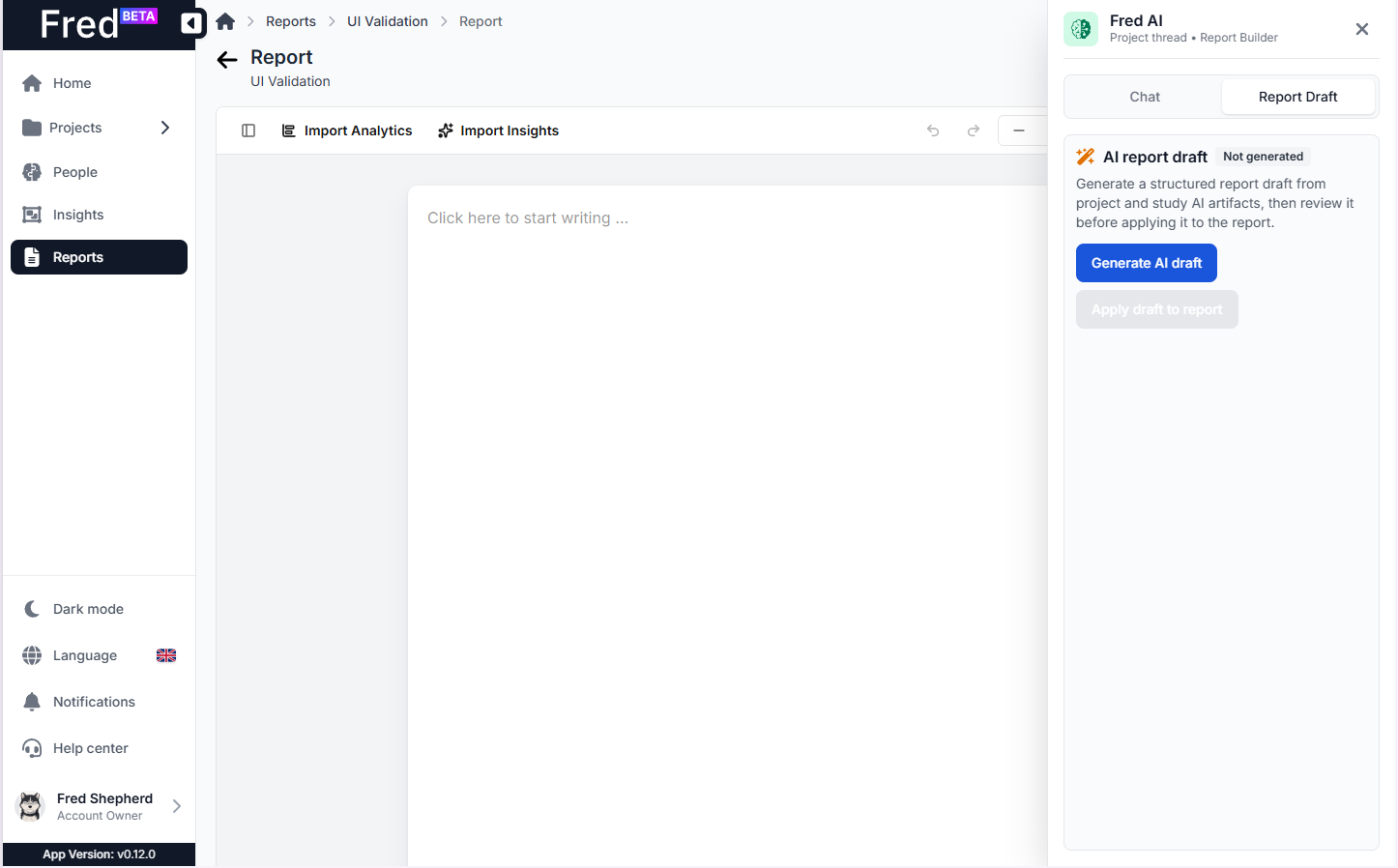
Reporting should not be a manual translation layer after research. Fred helps teams publish findings with source context and implications already attached.
Frame
Start from the decision the report needs to support.
Fred keeps the report focused on audience, question, implication, and action instead of becoming a loose collection of notes.
Attach
Keep each finding connected to source evidence.
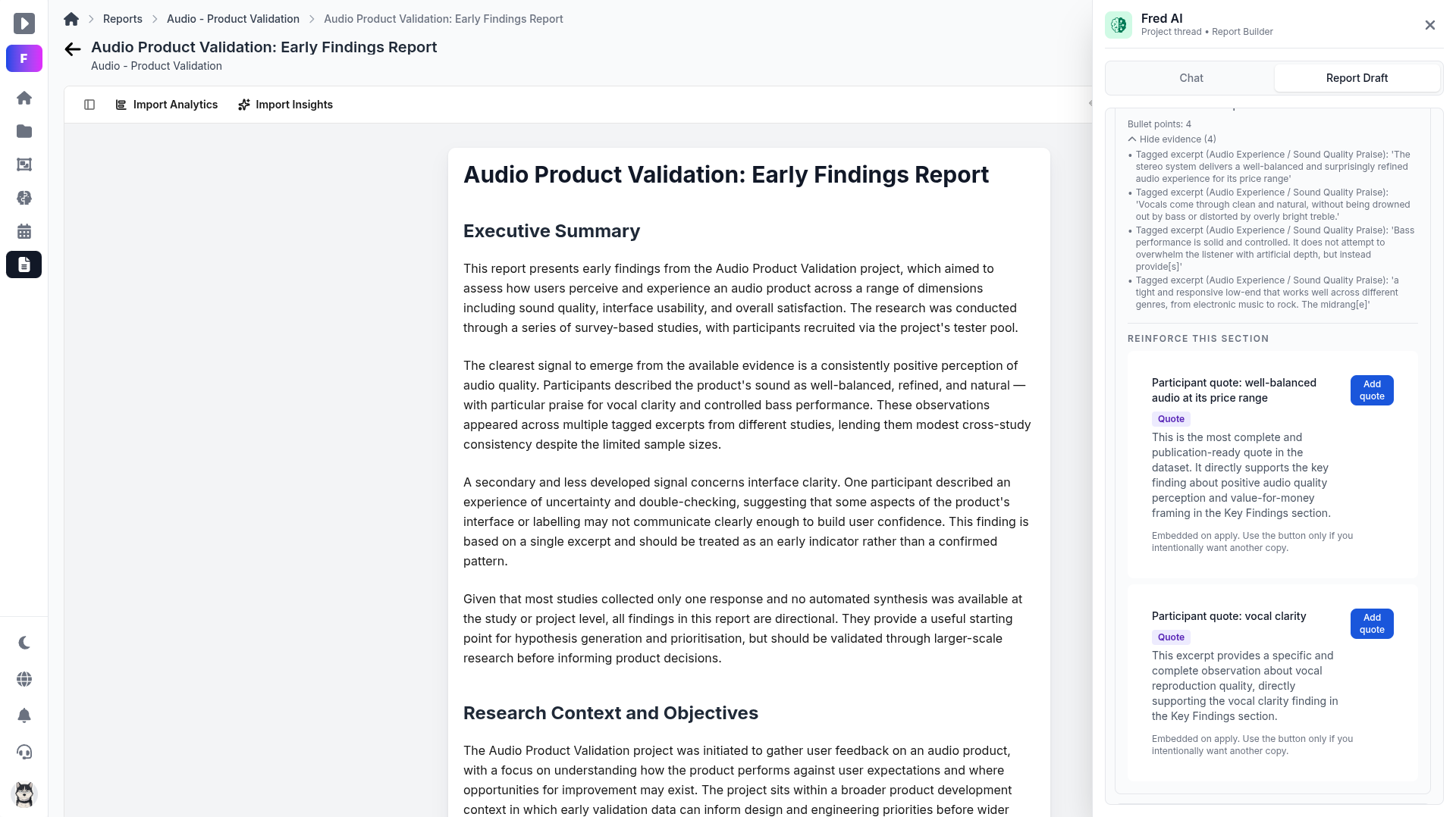
Clips, responses, participant context, and study material can stay attached to the claim they support.
Share
Give stakeholders one artifact they can inspect.
A shareable report helps product, design, engineering, and leadership align around the same source-backed recommendation.
Decision influence
The best report shortens the distance between research and action.
01
Findings can be verified quickly by non-research stakeholders.
Reports expose evidence links directly within each key conclusion.
02
Reporting overhead is reduced.
Teams reuse structured templates instead of rebuilding narratives manually.
03
Decision meetings stay focused on action.
Implications and source evidence are presented in one artifact.
Reporting outcomes
Less reporting overhead, more decision confidence.
Fred helps teams publish one credible artifact instead of rebuilding the story across decks, clips, and follow-ups.
Faster report production
Reduce manual formatting work and publish stakeholder-ready reports sooner.
Higher decision confidence
Provide direct evidence access so teams can validate findings in real time.
Consistent communication
Use repeatable report structures across projects and teams.
Long-term knowledge retention
Keep reports connected to source studies for future reference.
FAQ
Questions before reporting findings in Fred.
Publish with proof
Create reports that help teams decide, not just read.
Turn findings, evidence, and implications into one stakeholder-ready workflow.