Content Impact Template
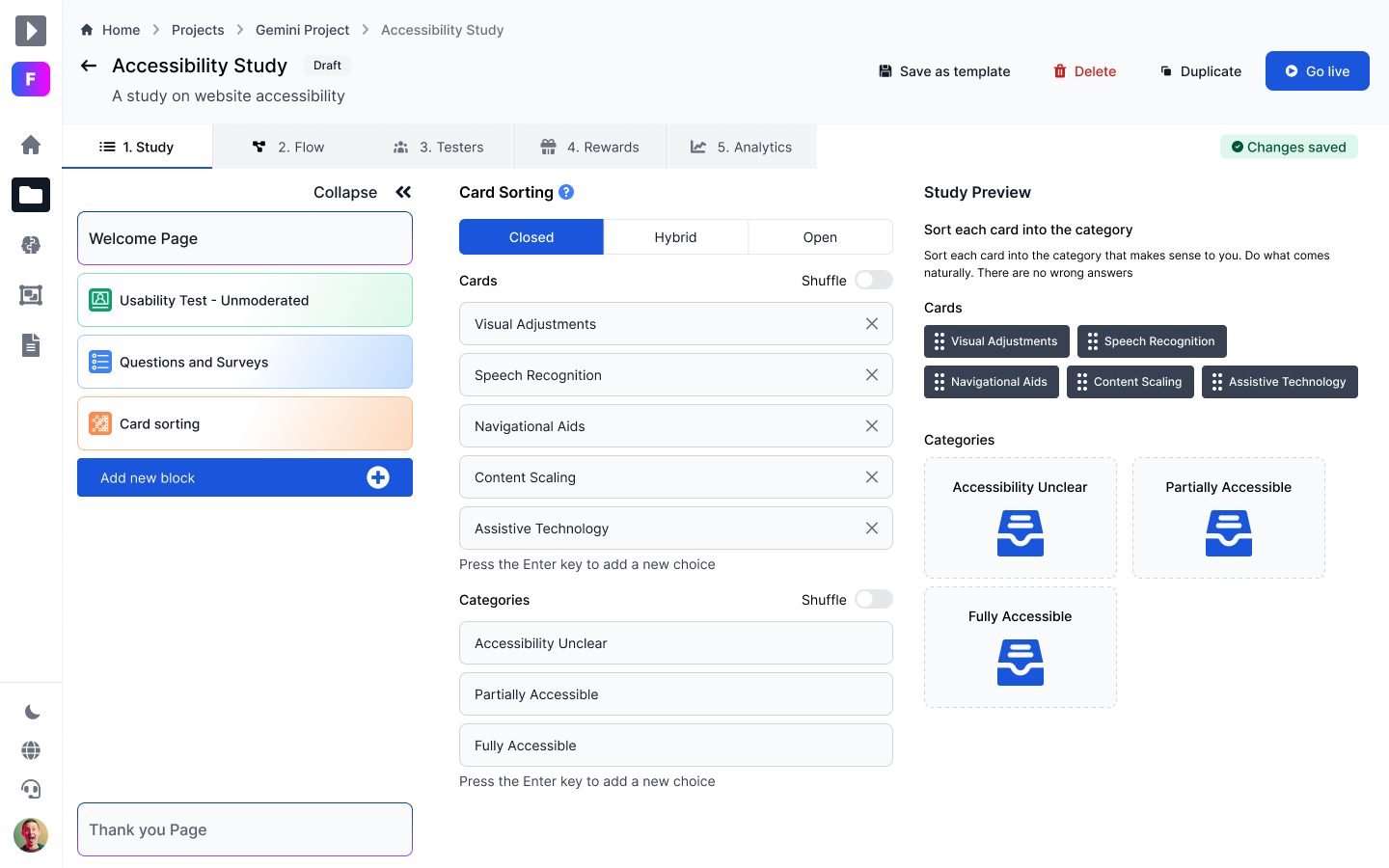
Site Structure Card Sort Test Template
Make your site structure crystal clear. With closed card sorting you'll see if your categories click with users-or confuse them-and refine navigation to boost usability, clarity, and user confidence at every step.
Decision context
Site Structure Card Sort Test helps reduce a real decision risk.
Run this when you want to uncover why users get lost in your menus, bounce off key pages, or can't find what matters. It's the fastest way to stress-test your IA and reveal hidden friction in your site's structure.
Template preview
What is inside the template
The template combines card sorting + questions and surveys with focused follow-up prompts, so the team can collect the specific evidence described in the source study.
Study spine
A focused study spine, ready to adapt.
The preview shows the shape of the study: the stimulus or task, the core prompts, and the follow-up evidence Fred can help you collect.
Prompt 01
Yes/No
Were there any categories that felt unclear or confusing?
Capture the response as part of the study so the team can compare patterns across participants.
Prompt 02
Multiple Choice - Multiple select
Which of the categories did you find unclear?
Options: Products, Real estate, Jobs, Services, Community
Prompt 03
Long text
What made the "Products" category difficult to understand?
Capture the response as part of the study so the team can compare patterns across participants.
Prompt 04
Long text
What made the "Real Estate" category difficult to understand?
Capture the response as part of the study so the team can compare patterns across participants.
Prompt 05
Long text
What made the "Services" category difficult to understand?
Capture the response as part of the study so the team can compare patterns across participants.
Prompt 06
Long text
What made the "Jobs" category difficult to understand?
Capture the response as part of the study so the team can compare patterns across participants.
Methods included
Research methods used by the template.
The preview above shows the template-specific prompts and tasks. This section explains the method types in general, so teams understand what each one is for.
Card Sorting
Mental model mapping
Method purpose
Card sorting reveals how people group information, labels, features, or concepts before teams harden navigation and taxonomy decisions.
Questions and Surveys
Structured response capture
Method purpose
Survey questions collect text, scale, choice, date, numerical, or grid responses so teams can compare user feedback consistently.
Workflow in Fred
From template to decision-ready evidence
Fred gives you a structured starting point for the study, then helps you collect responses and turn recurring signals into evidence your team can review.
- 01Start from the prebuilt structureOpen the site structure card sort test template, then adapt the placeholder stimulus, task, or wording to match your product context.
- 02Collect focused responsesParticipants complete the card sorting + questions and surveys flow and answer the follow-up prompts that capture the decision signal.
- 03Review patterns and confidenceSpot categories that don't resonate, learn which labels confuse, and uncover how people really group content-so you can redesign navigation with confidence, clarity, and real customer- driven insights.
- 04Share a decision-ready reportTurn the recurring evidence into a clear recommendation for the product, design, content, or research decision at hand.
Evidence output
What you can decide after running this template
The output should help the team move from opinions to concrete evidence about what users understood, selected, completed, preferred, or questioned.
Signal
Spot categories that don't resonate, learn which labels confuse, and uncover how people really group content-so you can redesign navigation with confidence, clarity, and real customer- driven insights.
Evidence
Spot categories that don't resonate, learn which labels confuse, and uncover how people really group content-so you can redesign navigation with confidence, clarity, and real customer- driven insights.
Action
Use the results to refine the experience before the decision becomes expensive to change.
Method fit
Use this template when the decision needs focused evidence.
Use this section to decide whether the template is the right starting point, or whether the research question needs a broader plan.
Good fit
Run this when you want to uncover why users get lost in your menus, bounce off key pages, or can't find what matters. It's the fastest way to stress-test your IA and reveal hidden friction in your site's structure.
Use another method
You need statistically representative market sizing rather than directional research evidence. You have not defined the stimulus, task, concept, page, or feature that participants should evaluate. You need a broad discovery program instead of a compact template-led study.
Who it helps
Different teams can use the same evidence for different decisions.
The template keeps the study compact enough for a sprint, while still giving each role the evidence they need to move the decision forward.
Content Strategist
Problem
Needs evidence for a content impact decision without designing the study from scratch.
Outcome
Gets a ready structure for collecting card sorting + questions and surveys evidence.
UX Researcher
Problem
Needs a repeatable method structure that keeps questions, tasks, and follow-ups focused.
Outcome
Gets a study spine that can be adapted, launched, and reported with less setup work.
Product Manager
Problem
Needs to reduce uncertainty before a product, messaging, or experience decision hardens.
Outcome
Gets decision-ready signals that can be shared with the team before the next sprint commitment.
Related resources
Continue from this template to related methods and decisions.
Use these links to connect the template to the broader Fred workflow and supporting educational content.
FAQ
Practical details before you run the template.
Short answers for teams deciding whether this template fits the research decision in front of them.
Start the study
Use this template to collect evidence before the decision hardens.
Start with a structured study, collect focused evidence, and turn the results into a clearer product decision.
Output
A focused study, a clearer decision, and evidence your team can inspect.