Research Operations
Continuous Discovery: A Decision-Cadence Framework
Continuous discovery improves learning, but frequency alone does not validate a decision. Learn how to connect recurring user contact to evidence thresholds, escalation decisions, and documented product choices.
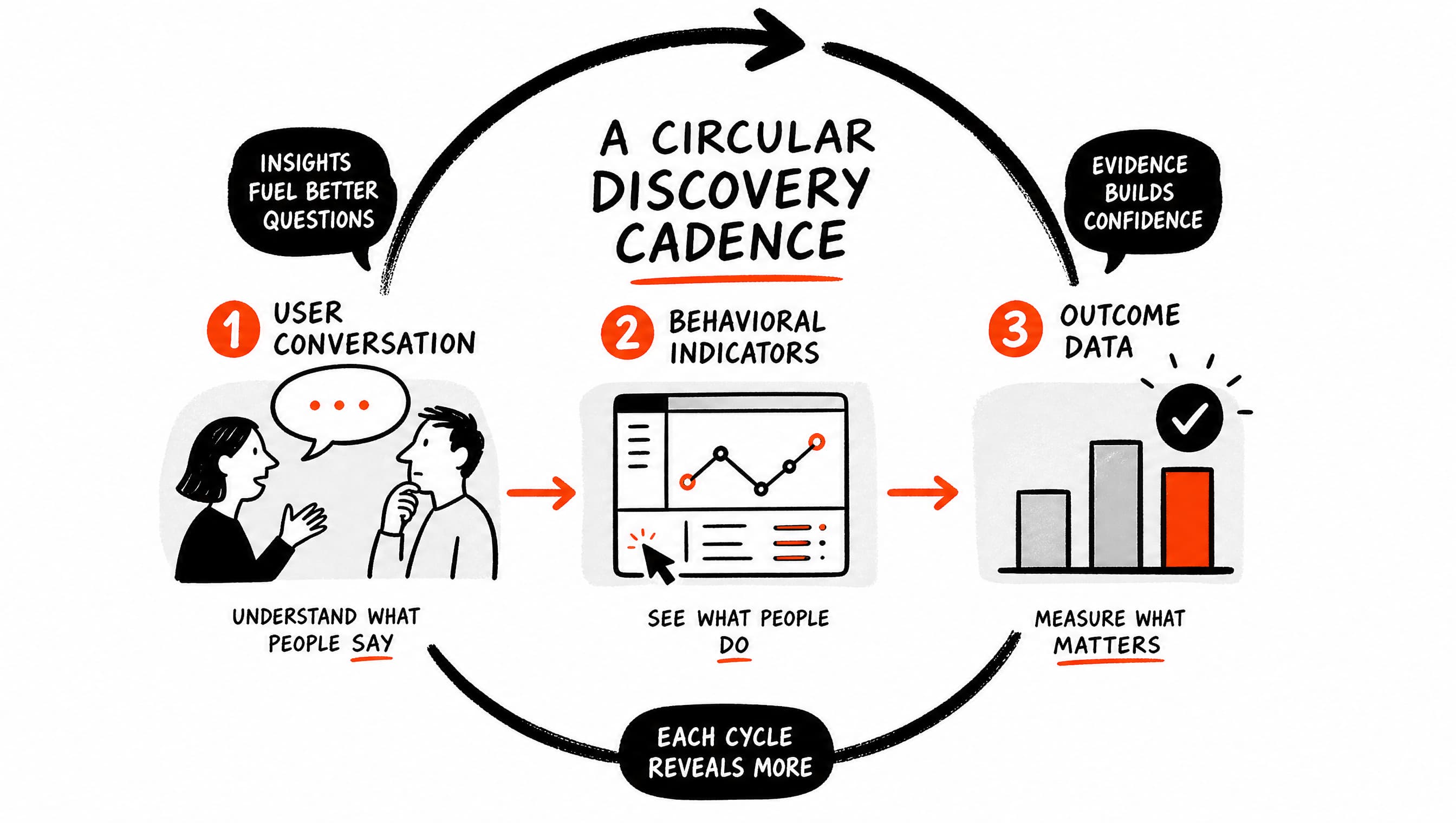
Continuous discovery has given product teams something they lacked for years: regular contact with the people who use what they build. A question no longer has to wait for a quarterly study. A rough prototype can meet a user while it is still cheap to change. Engineers, designers, and Product Managers can hear the hesitation that disappears when a finding is compressed into a slide.
That is real progress. It has also made one old problem harder to see.
When user contact happens every week, the flow of observations can feel like accumulating proof. Notes repeat. Themes become familiar. A summary arrives quickly. Soon a team says that an idea has been validated, although nobody has agreed on what claim was tested, whether the participants represented the affected users, or what evidence would have been sufficient to change the roadmap.
Frequency improves access to evidence. The quality of a decision still depends on how that evidence was produced and what the team expects it to support. A ten-minute conversation may be exactly enough to expose a weak assumption. It may be wholly inadequate for changing enterprise packaging, estimating demand, or releasing a workflow with legal or trust consequences.
Continuous discovery therefore needs a second rhythm alongside user contact: a cadence for making decisions. It should tell a team when a signal is useful, when it is sufficient, when it conflicts with other evidence, and when a convenient research activity must give way to a more appropriate method.
Cadence solved an access problem, not an evidence problem
The operational strength of continuous discovery is easy to see in Josh Morales's account of Miro's program. In the in-person format he describes, five product users rotate among five product teams. Each team has an interviewer and a notetaker, and each exchange lasts ten minutes. Within an hour, every team has met every participant. The monthly event creates a recognizable organizational beat, while a remote variation runs weekly and lets one team recruit a more specific user profile.
The format works because its boundaries are explicit. Morales describes it as suitable for early product ideas, rough prototypes, and assumption checks. Teams bring one or two focused questions and look for directional guidance. He also states where the format stops being appropriate: deep diagnosis, sensitive subjects, and high-stakes validation that requires greater rigor. When a session reveals that the issue is larger than expected, the Miro research team supports a dedicated follow-up study or places the question on its research roadmap.
Those details matter more than the label “continuous.” The program is repeatable because recruitment, roles, timing, preparation, documentation, and follow-up have been designed as a system. Its credibility comes from understanding the kind of evidence that system can produce.
Problems begin when an organization copies the recurring meeting but loses those boundaries. A standing interview slot becomes the answer to every question because it is available. The easiest customers to recruit appear again and again. A stream of self-reported reactions gets treated as evidence of behavior. Repetition then reinforces the same sampling or questioning error instead of correcting it.
This is why continuous contact should feed a roadmap validation evidence pipeline, rather than replace one. The session is an input. What happens after it determines whether an observation remains an interesting prompt, becomes a reason for a low-cost change, or triggers stronger validation.
Start with the decision that must change
“Explore onboarding” is a topic. “Choose whether to release the new setup flow to beta this sprint” is a decision. The second version identifies an action, a time boundary, and at least two possible outcomes. It can be owned. It can also be challenged.
Before selecting a method, the team should write down the choice it is trying to make, the users who will be affected, the assumptions that make one option preferable, and the consequence of getting it wrong. This short discipline prevents a familiar failure: collecting material that is interesting but cannot resolve the actual disagreement.
Method fit becomes much easier to discuss once the claim is visible. Nielsen Norman Group's research-method landscape separates methods along several dimensions. Attitudinal work helps explain what people say, believe, or report. Behavioral work examines what they do. Qualitative approaches are well suited to questions about why something happens and how it might be fixed; quantitative approaches can estimate how much or how many. The context also changes the evidence, from natural use to tightly scripted tasks, limited interaction with a concept, or a conversation in which the product is not used at all.
These are not academic distinctions added after the study. They determine which claims the study can reasonably support. An interview can uncover a purchasing constraint or the context around a recurring problem. Watching someone attempt a task can reveal where the interface blocks them. Analytics can show the scale and distribution of a behavior, but usually cannot explain the intent behind it. A concept test may clarify whether a proposed value proposition resonates, while leaving unanswered whether people will adopt the finished product.
The stage of development matters too. Early work often searches for directions and opportunities. During design, research helps improve an emerging solution. After launch, measurement can compare performance over time or against an alternative. A team that asks a formative method to deliver a market estimate, or asks a broad survey to diagnose a task failure, has created a mismatch before the first participant arrives.
Tool choice can quietly introduce another mismatch. Nielsen Norman Group documents unmoderated testing software that allows only one success URL or does not randomize tasks, both consequential limitations for quantitative testing. Its review of analysis tools also points out that transcript-only tagging can miss meaningful behavior when a participant acts without narrating. A smooth interface and an instant summary do not repair those gaps. The research plan has to account for what the tool records, what it discards, and which methodological controls it actually supports.
The Decision-Cadence Loop
A useful operating model should be light enough to survive a busy product cycle. The Decision-Cadence Loop adds six moves around the research a team already conducts:
- Frame the choice in terms of an action, owner, affected users, and deadline.
- State the most consequential assumption and decide what evidence would be sufficient before collection begins.
- Use the lightest method capable of challenging that assumption, with a sample that fits the people affected.
- Examine supporting observations alongside contradictions, missing data, and limits introduced by the method or tool.
- Choose among proceeding, revising, stopping, or escalating to stronger research.
- Record the rationale and return after release to compare the expected result with what happened.
The second move is often skipped. Teams start collecting evidence, then decide afterwards how much is enough. That invites motivated interpretation. A favorable comment receives more weight than a failure. A surprising segment difference is dismissed as noise. The standard shifts until the preferred idea passes.
Precommitting to an action rule makes this harder. The rule can be qualitative or quantitative, depending on the decision. It might specify that a critical setup failure blocks a beta release, that a pricing change requires evidence from both buyers and administrators, or that a demand claim needs behavioral or commercial data in addition to stated interest. The point is not to force every study into a numerical threshold. It is to agree, while the outcome is still unknown, what would count as evidence for action and what would require another step.
Every decision record should also include an expected useful life for its evidence. Expectations surrounding a fast-changing AI capability may shift quickly. Findings about a stable administrative workflow may remain relevant longer, provided the user population and product context have not changed. Recording a review date prevents an old insight from returning years later as an apparently timeless fact.
The loop ends with the outcome because validation cannot be completed entirely before release. Pre-release research reduces uncertainty. It does not guarantee impact. If the team expected a redesigned flow to increase successful completion, the later behavior belongs in the same decision record. A disappointing outcome is not an embarrassment to remove from the repository. It is evidence about the original reasoning, the implementation, or the conditions that changed.
Know when a signal is enough
Not every observation deserves the same response. A single support request, sales comment, or interview quote can reveal a possibility worth investigating. It should not be silently promoted into a general customer need. Independent recurrence among relevant users makes the signal more useful, especially when the team can rule out a shared prompt or recruitment bias. Confidence grows further when different sources illuminate the same issue: observed behavior, qualitative context, product data, support history, or a survey designed for the population in question.
More sources do not automatically mean better evidence. Three tools can reproduce the same underlying bias. Five interviews recruited from one enthusiastic customer group remain evidence about that group. A survey and an interview may look like triangulation while both measure stated preference. The useful question is whether each source reduces a different uncertainty.
The amount of uncertainty a team can accept depends on the commitment. Copy, labels, and beta experiments are usually easy to reverse and limited in reach. Packaging, migration, pricing, permissions, safety, and regulated workflows can create financial, contractual, or trust costs that remain after the interface changes. Reach matters. Reversibility matters. So do novelty and the team's prior knowledge of the behavior.
For a low-cost, reversible decision, a repeated directional signal followed by monitoring may be responsible. A material decision usually needs a method that directly addresses the claim, broader or more deliberate sampling, visible counterevidence, and an explicit plan for what happens if the result is ambiguous. The escalation is proportional to consequence, not to stakeholder seniority or the amount of research a team enjoys doing.
Contradictions deserve particular attention. Positive concept reactions alongside poor task performance do not cancel each other; they point to separate questions about perceived value and usability. High stated demand alongside low existing usage may reflect switching costs, implementation friction, weak sample fit, or a difference between the person requesting a feature and the person who will use it. Compressing those tensions into one “overall positive” theme destroys information the decision owner needs.
This is also where the choice between moderated and unmoderated user research becomes consequential. Moderation can support probing, context, and adjustment when an unexpected behavior appears. Unmoderated work can provide reach, consistency, and faster task-based evidence when the study and tooling support it. Habit should not decide between them.
Put decisions into the operating rhythm
Continuous discovery succeeds when it becomes ordinary enough to repeat without lowering the standard each time. Morales's account contains several unglamorous choices that make this possible: a preparatory call for colleagues, explicit interviewer and notetaker roles, reusable guidance, over-recruitment to protect the session from no-shows, and a simple learning template completed afterwards. Findings are circulated across teams, and questions that need depth move into follow-up research.
A decision cadence needs similarly mundane infrastructure. Each active discovery stream should have a decision owner. The repository should retain the original observation close to its context, then separate interpretation, recommendation, and final choice. Sample limitations should be recorded while the study is running, not added reluctantly after someone challenges the conclusion. If evidence conflicts, both sides remain visible.
Templates help when they reduce setup work without pretending that every question is the same. Fred's research template library can provide a starting structure, but the team still has to establish which decision the template serves and where it is insufficient. A familiar template is never a reason to avoid a method that better matches the claim.
Program reviews should look beyond the number of sessions or findings produced. Useful operational measures include the share of activities attached to an explicit decision, the share with an evidence threshold agreed in advance, the time from question to a recorded choice, and the proportion of material decisions reviewed after an outcome can be observed. It is also worth examining when teams escalated. If every recurring session ends with permission to proceed, the program may be rewarding confirmation rather than learning.
Volume metrics still have a place. Recruitment time, participation, cancellations, and research throughput reveal whether operations are healthy. They just answer a different question. Ten studies completed this month says nothing about whether the organization chose better work, stopped a weak idea, or detected a risk before commitment.
The monthly review should therefore begin with decisions, not deliverables. Which choices moved? Which remained blocked, and why? Where did the method fail to address the claim? Which result changed the team's confidence? What needs to be revisited because the evidence has aged or the context has shifted? These questions keep the practice connected to product work without reducing research to a vote on the roadmap.
AI makes traceability more important
AI-assisted planning, transcription, synthesis, and reporting can reduce mechanical effort. It can also give weak evidence a polished voice. A neatly written theme does not show whether it came from a representative participant, a leading prompt, a misread silence, or three paraphrases of the same comment.
The current debate in the research field is less about whether AI belongs in the workflow than about the judgment surrounding it. UXinsight's 2026 festival review describes AI as a mirror for unresolved questions about quality and impact. It reports concerns that models tend to average where research needs to distinguish, and that systems drawing on organizational repositories can reproduce outdated insights at scale. The review's practical conclusion is that useful applications still depend on the human judgment around them.
That makes traceability a product requirement for the research system. A reviewer should be able to move from a summary back to the observation, participant context, task or question, timestamp where relevant, and the researcher's interpretation. They should also see what the evidence does not support. AI can help organize this chain, but it should not collapse its layers into one authoritative paragraph.
Tool defaults deserve scrutiny here too. If analysis happens only on transcripts, silent behavior may disappear. If an automated plan primes the participant, fast execution merely scales the flaw. If a repository returns an old finding without its date, audience, and conditions, retrieval creates false continuity. The right control is not a generic warning that AI can make mistakes. It is a workflow that keeps sources, transformations, contradictions, and review decisions inspectable.
What a mature cadence looks like
A mature continuous discovery program feels active, but activity is not its main achievement. Product teams know which questions can be handled in the recurring session and which require specialist design. They can explain why the recruited participants fit the decision. They make a bounded claim from each method, preserve conflicting evidence, and state what would change their mind.
The research function still protects quality, especially for consequential work, while more colleagues gain direct exposure to users. There is no need to choose between participation and rigor. The system can make lightweight contact easy and escalation equally normal.
The first practical step is small. Take the next three discovery activities already on the calendar and write the decision attached to each one. Add the owner, affected users, deadline, consequence of error, evidence threshold, and review date. If a session has no decision, clarify whether its purpose is broad exploration or whether it has simply become a ritual. If the available method cannot support the claim, change the method before collecting more material.
After the work, record one of four outcomes: proceed, revise, stop, or escalate. Return when the expected product result can be observed. Over a month, this creates a usable trail from contact to evidence, evidence to choice, and choice to outcome. It also reveals where the organization's research cadence is genuinely helping and where it is producing motion without resolution.
Fred is designed for that trail. Bring one live roadmap decision into Fred's decision-intelligence workflow, connect the evidence to the claim it supports, preserve the contradictions, and leave the sprint with a decision that another stakeholder can inspect rather than a summary they are asked to trust.
Source notes
- User Interviews, “Delivering Continuous Discovery Programs That Run like Clockwork,” Josh Morales, updated July 15, 2026: User Interviews article. Used for current operational practice, cadence design, directional guidance, repeatability, and the limits of short continuous-discovery sessions.
- Nielsen Norman Group, “When to Use Which User-Experience Research Methods,” Christian Rohrer, updated July 15, 2026: Nielsen Norman Group method guide. Used for the distinctions among attitudinal and behavioral, qualitative and quantitative, context of use, and product-development phases.
- Nielsen Norman Group, “The Methodological Problems Hiding in Your Research Tools”: Nielsen Norman Group tool-methodology article. Used as background for the principle that tool affordances and defaults can introduce methodological limitations.
- UXinsight, “UX Research 2026: Getting Honest About What We Don’t Know,” April 30, 2026: UXinsight 2026 article. Used for the current field-level tension around rigor, human judgment, AI, and research impact.
- Maze, “Continuous Research Report”: Maze continuous research report. Used as market context for the shift toward continuous research operations.
- UX Magazine, “Earning the Right to Research: Stakeholder Buy-In and Influence in the AI x UX Era”: UX Magazine article. Used as context for research influence and organizational credibility.
- Nielsen Norman Group, “Democratize User Research”: Nielsen Norman Group democratization article. Used as context for enabling people who do research while preserving methodological support.
- The Decision-Cadence Loop, Signal Sufficiency Ladder, Validation Escalation Matrix, decision half-life notation, and program health measures are original Fred editorial models created for this article. They are decision aids, not validated scientific instruments.