Research Operations
The Human Data Integrity Crisis: How to Detect AI-Assisted Participant Fraud Without Rejecting Real Users
Learn how to detect AI-assisted participant fraud with a layered, auditable process that protects research quality without rejecting genuine users.
A participant joins a remote interview and gives unusually polished answers. They use the correct terminology, respond quickly, and describe a convincing workflow. The researcher becomes suspicious. Is this a genuine expert, a participant reading AI-generated responses, or simply someone who communicates differently from the people the team usually interviews?
That question is becoming harder to answer. Real-time AI assistants can listen to a conversation, interpret what is on screen, and generate plausible answers within seconds. Survey bots can navigate branching logic and produce open-ended responses that appear thoughtful. At the same time, many legitimate participants pause before speaking, look away while recalling details, use scripts or assistive tools, speak in a second language, or prefer carefully structured answers. A detection process that treats one of these behaviors as proof can remove authentic voices from the study.
The operational challenge is therefore not “how do we catch cheaters?” It is how to protect the integrity of research evidence while controlling the risk of falsely accusing genuine participants. That requires a system built around provenance, consistency, review, and uncertainty, not intuition disguised as certainty.
The old signals of authentic participation no longer work
Research teams have always dealt with low-quality participation. People exaggerate experience to pass a screener, complete the same study more than once, rush through surveys for incentives, or provide answers designed to please the moderator. None of these problems began with generative AI.
What changed is the quality and availability of assistance. A participant no longer needs deep subject knowledge to sound competent for ten minutes. They can receive definitions, examples, and suggested answers during a live session. A bot no longer needs to select random options. It can produce text that is grammatically correct, contextually relevant, and varied enough to pass a superficial review.
This breaks several traditional assumptions.
First, polish is no longer evidence of expertise. A well-structured answer may reflect genuine knowledge, communication training, or AI assistance. The form of the answer does not prove its origin.
Second, speed is not evidence of authenticity. Modern tools can return suggestions quickly, while genuine participants may respond immediately because the topic is familiar. Long pauses are equally ambiguous. A participant may be thinking, translating, managing anxiety, using assistive technology, or waiting for generated text.
Third, confidence is not evidence of truth. A coached participant can read a confident answer. A genuine expert may hedge because real work is complicated and context dependent.
Fourth, visual behavior is not conclusive. Repeated off-screen glances may indicate a hidden assistant, but they may also reflect notes, a second monitor, an interpreter, a screen reader setup, or a participant’s natural communication pattern.
The practical implication is simple: individual cues should trigger inquiry, not judgment. Detection must shift from a list of “tells” to a pattern of corroborated evidence.
This distinction matters across research methods.
In a survey, one sophisticated open-ended response proves very little. A combination of duplicate identifiers, improbable completion time, repeated phrasing, inconsistent eligibility answers, and impossible product details is more meaningful.
In a moderated interview, one long pause proves very little. Repeated question echoing, identical pause timing, fixed reading behavior, shallow answers to experience-based follow-ups, and inconsistencies with the screener create a stronger pattern.
In an unmoderated usability test, a polished spoken explanation proves very little. A mismatch between the explanation and the participant’s actual task behavior may be more informative.
In a customer panel, unusual terminology proves very little. The team can compare the response with account history, role context, prior sessions, and product usage, provided those comparisons are permitted and handled responsibly.
The new operating principle is therefore: no single signal, no single reviewer, and no automatic rejection.
Participant fraud is now a product-decision risk
Participant fraud is often treated as a recruitment problem. That framing is too narrow.
The real cost appears downstream, when weak evidence is transformed into a business decision. A synthetic response can become a coded observation. Several synthetic responses can become a theme. That theme can be summarized by an AI tool, placed in a report, presented to stakeholders, and used to justify a roadmap commitment.
At each step, the original uncertainty becomes less visible. The language becomes cleaner while the evidence becomes harder to inspect.
Consider a team evaluating a new onboarding flow. Three apparently qualified participants say the setup is intuitive and use nearly identical reasoning. The synthesis system clusters their responses into a strong positive theme. The product team interprets this as validation and moves the feature into engineering.
Later, real users fail during setup because the positive theme was based on assisted or fabricated participation. The cost is not the incentive paid to three bad participants. The cost includes design work, engineering capacity, opportunity cost, launch risk, support demand, and loss of stakeholder trust in research.
False positives create another decision risk. Suppose the team wrongly removes two genuine participants because their communication style appears “too scripted.” If those participants represent an accessibility need, a minority workflow, or an uncommon but high-value customer segment, the team may eliminate precisely the evidence that challenges the dominant product assumption.
This is why data integrity must be linked to decision criticality.
A low-stakes exploratory study may tolerate more uncertainty. A study supporting a major pricing change, enterprise workflow, regulated interaction, or expensive platform migration requires stronger provenance and review. The integrity standard should rise with the cost of being wrong.
A useful rule is:
Required integrity rigor = decision exposure × evidence dependence × reversibility cost
Decision exposure reflects the commercial, operational, ethical, or regulatory consequence of the choice. Evidence dependence reflects how strongly the decision relies on the study. Reversibility cost reflects how difficult it will be to undo the decision after implementation.
This does not produce a mathematically precise risk value. It creates a disciplined conversation before the study begins. If the decision has high exposure, relies heavily on a small qualitative sample, and will be expensive to reverse, the team should define stricter integrity controls in advance.
The five layers of the Human Data Integrity Threat Model
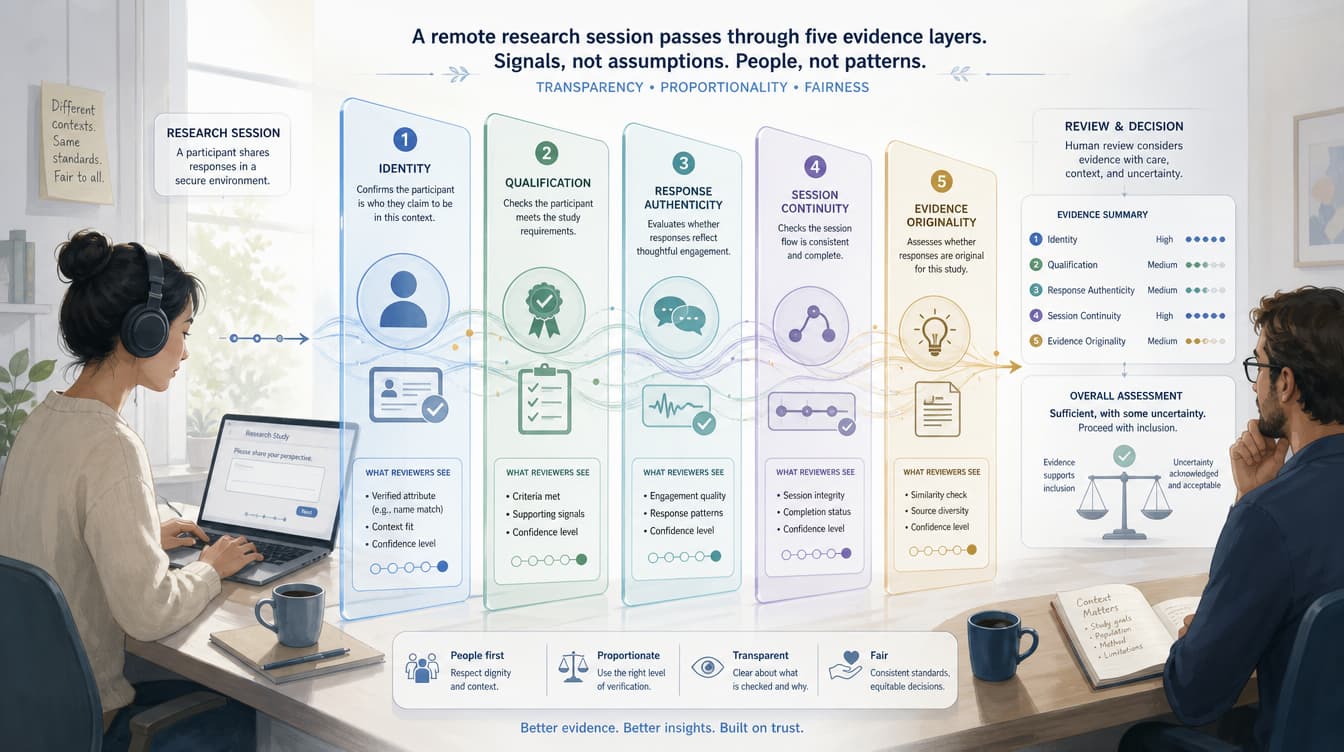
Fraud prevention fails when teams reduce authenticity to identity verification. A person may be real but unqualified. They may be qualified but use AI to fabricate experience. They may begin authentically and receive assistance halfway through a session. They may provide genuine observations that are later copied into multiple submissions.
The Human Data Integrity Threat Model separates the problem into five layers.
1. Identity integrity
Identity integrity asks whether the participant is a distinct, permitted person rather than a duplicate account, stolen identity, automated agent, or coordinated fraud actor.
Relevant signals may include account history, duplicate contact details, repeated device or payment patterns, panel history, and prior participation. These signals must be interpreted under applicable privacy rules and the team’s stated participant terms.
The business consequence of failure is sample inflation. A study that appears to include twelve people may actually represent eight people and four duplicate or coordinated entries.
Identity integrity is necessary, but it is not sufficient. A verified person can still misrepresent their role or use AI during a session.
2. Qualification integrity
Qualification integrity asks whether the participant genuinely meets the study criteria.
The strongest screeners are difficult to reverse engineer. They ask for experience through concrete sequences, trade-offs, artifacts, and recent examples rather than obvious qualifying questions.
For example, “Do you use analytics tools at work?” reveals the desired answer. “Walk us through the last time you investigated a drop in activation. What did you check first, what did you rule out, and what happened next?” is harder to fake consistently.
Qualification integrity also requires cross-checking. A participant who claims to manage a complex enterprise workflow should be able to explain constraints, exceptions, and failure modes. Generic fluency should not outweigh missing experiential detail.
The business consequence of failure is construct mismatch. The study claims to represent a target population that the sample does not actually represent.
3. Response authenticity
Response authenticity asks whether the answers reflect the participant’s own experience and reasoning.
AI assistance is one threat, but not the only one. Participants may read prepared scripts, receive coaching, copy public material, or answer according to what they think the researcher wants.
The most useful probes are not trivia tests. They ask for temporal, causal, and sensory detail:
- What happened immediately before the problem?
- What did you try first?
- What surprised you?
- What did you stop doing?
- Show where you would look for that information.
- What would a colleague disagree with in your description?
- Which workaround feels embarrassing but still saves time?
Genuine experience is not always eloquent, but it usually contains constraints, exceptions, and personal consequences. Generated answers often remain balanced, generic, and frictionless until the moderator probes beyond the initial response.
The business consequence of failure is false meaning. The words may be coherent, but they do not represent lived behavior.
4. Session continuity
Session continuity asks whether authenticity remains stable throughout the interaction.
A participant may pass screening honestly and begin a session without assistance, then activate an AI tool when the questions become difficult. In an unmoderated test, a person may complete part of the task and automate the rest. In a diary study, some entries may be genuine while others are generated.
Teams should therefore review changes, not just static cues. Sudden shifts in vocabulary, detail, response latency, tone, or task competence can justify follow-up questions. They do not prove fraud, but they identify where continuity may have broken.
The business consequence of failure is mixed evidence. Genuine and synthetic material becomes inseparable unless the session is segmented and annotated.
5. Evidence originality
Evidence originality asks whether the submitted material is unique to this participant and study.
A response can be human-authored and still be invalid if it was copied from another participant, reused across studies, or generated from public product documentation. Repeated phrases, identical examples, matching error patterns, and duplicated recordings may indicate coordination or reuse.
This layer is especially important in open surveys and large panels. The team should review both within-study duplication and, where lawful and proportionate, repeated patterns across prior studies.
The business consequence of failure is false convergence. Duplicate evidence appears to be independent confirmation and artificially increases confidence.
Together, these five layers prevent a common mistake: treating authenticity as a yes-or-no property of a person. Integrity belongs to the evidence chain. A participant can be strong on one layer and uncertain on another. The correct response may be to retain some evidence with a caveat rather than exclude the entire person.
Why intuition creates false negatives and false positives
Experienced researchers develop pattern recognition. That skill is valuable, but it becomes dangerous when the environment changes faster than the patterns.
The July 2026 User Interviews pilot illustrates the problem. Observers correctly identified many sessions, yet their confidence was especially high when they wrongly accused genuine participants. This is a classic operational hazard: confidence grows even when accuracy falls.
False negatives are easy to understand. A researcher fails to detect assistance, so synthetic evidence enters the study.
False positives are often underestimated. A researcher sees an unusual behavior, interprets it as deception, and removes a genuine participant. The team may never learn that the judgment was wrong because most ResearchOps workflows lack a feedback mechanism.
False positives can also be distributed unevenly. People who use assistive technologies, communicate in a second language, process questions slowly, avoid eye contact, rely on written notes, or speak in highly structured ways may be flagged more often. A crude fraud policy can therefore create a hidden accessibility and representation problem.
The solution is not to eliminate expert judgment. It is to constrain and audit it.
Use these four safeguards:
- Separate observation from interpretation. Record “participant looked to the same location after six questions,” not “participant was reading AI answers.”
- Require corroboration. One cue can trigger a probe. Exclusion requires multiple independent signals or direct evidence.
- Use a second reviewer for high-impact decisions. The original moderator is vulnerable to confirmation bias after becoming suspicious.
- Track outcomes. Record how many sessions were flagged, how many were confirmed, how many were retained, and what happened after recontact. Without outcome data, the team cannot calibrate its judgment.
The aim is not perfect certainty. Perfect certainty is usually unavailable. The aim is a process in which uncertainty is visible, decisions are reviewable, and errors can be measured.
Building an Authenticity Confidence Score without biometric overreach
Teams need a consistent way to combine signals, but an automated “fraud probability” can create false precision. The proposed Authenticity Confidence Score, or ACS, is therefore a structured review aid, not a diagnostic model.
The score evaluates the strength of evidence supporting authenticity across five dimensions:
- Provenance confidence, 0 to 20 points: Is the participant’s recruitment and participation history coherent and free from unresolved duplication?
- Qualification consistency, 0 to 20 points: Do screener answers, role claims, and session details align?
- Behavioral continuity, 0 to 20 points: Does the participant’s interaction remain coherent across the session, including changes in language, latency, and task performance?
- Experiential depth, 0 to 25 points: Can the participant provide specific, causal, and personally grounded detail when probed?
- Cross-channel consistency, 0 to 15 points: Do survey responses, interview answers, task behavior, and available account context support one another?
The total ranges from 0 to 100, but the number should not be interpreted as a scientifically validated probability. It is a summary of documented evidence.
Suggested review bands:
- 80 to 100, strong confidence: Retain normally, while preserving any ordinary study limitations.
- 60 to 79, usable with caveat: Retain evidence, annotate unresolved concerns, and avoid letting the session carry disproportionate decision weight.
- 40 to 59, verification required: Pause final synthesis, obtain a second review, and consider recontact or a short verification task.
- Below 40, exclusion may be justified: Exclude only after reviewing the underlying signals, checking for accessibility or technical explanations, and documenting the decision.
Two rules are non-negotiable.
First, no single dimension should automatically determine the outcome. A participant with weak provenance but rich, consistent, directly observed task behavior may still provide useful evidence. A participant with verified identity but generic, contradictory responses may not.
Second, the score should avoid biometric inference. Facial recognition, emotion classification, or automated judgments about eye movement can introduce privacy, bias, and proportionality concerns. Teams should prefer observable study evidence, account provenance, response consistency, and human review.
The ACS should also be calibrated by method.
For surveys, increase the weight of provenance, duplication, completion patterns, and answer consistency.
For moderated interviews, increase the weight of experiential depth, follow-up performance, and session continuity.
For unmoderated usability tests, increase the weight of task behavior and alignment between what the participant says and does.
For customer panels, increase the weight of verified relationship context and continuity across prior interactions, provided the participant has been informed and the use is appropriate.
A team should pilot the ACS against a reviewed sample, compare reviewer agreement, and revise the thresholds. The objective is not to universalize one scoring system. It is to replace undocumented intuition with a transparent decision record.
A defense-in-depth workflow for every research stage
The strongest integrity program does not wait until a researcher feels suspicious during an interview. It distributes controls across the entire research lifecycle.
Before recruitment
Define the integrity requirements based on decision risk. Specify prohibited assistance, acceptable support tools, verification methods, data-retention rules, and escalation owners.
Write participant terms in plain language. Explain that answers must reflect the participant’s own experience, clarify whether AI assistance is prohibited, and state what may happen if evidence suggests misrepresentation. Avoid threatening language. The purpose is informed participation and deterrence, not intimidation.
Design screeners around experience rather than obvious qualification. Include questions whose answers can be compared later, but do not collect unnecessary personal data.
During screening
Use multiple forms of consistency checking. Compare role, recency, workflow, and tool-use claims. Look for contradictory combinations rather than one “wrong” answer.
In open surveys, monitor response bursts, duplicate patterns, improbable timing, repeated text structures, and inconsistent branching. Attention checks can help, but sophisticated bots may pass them. No single check should be considered decisive.
Before the session
Give the moderator a short integrity brief. Include the participant’s relevant screener answers, known accommodations, approved support tools, and specific follow-up questions.
Tell participants that imperfect answers are welcome. This reduces the perceived need to sound polished. For moderated sessions, ask them to close unapproved assistance tools when appropriate, but do not demand invasive device access.
During moderated interviews
Begin with grounded questions that establish a baseline. Ask for a recent example, sequence of actions, and concrete consequence.
When a suspicious pattern appears, probe neutrally:
- “Could you show me how that worked in practice?”
- “What happened the last time it failed?”
- “You mentioned a different process in the screener. What changed?”
- “Take your time and answer from your own experience. There is no ideal answer.”
Do not accuse the participant during the session unless there is direct evidence and a predefined policy. An accusation can contaminate the remainder of the interaction and harm a legitimate participant.
During unmoderated usability tests
Use behavior as a primary signal. Compare narration with clicks, task paths, hesitation, errors, and recovery. Generated commentary that does not match observed behavior should be flagged for review.
Include tasks that require interaction with the product or prototype rather than purely verbal opinions. A participant who cannot perform the workflow they claim to use may be unqualified, assisted, or simply unfamiliar with the test environment. Follow-up review is still required.
After the session
Do not let the moderator make the final decision alone. Capture observations in neutral language, calculate the provisional ACS, and assign a second reviewer when the case falls below the strong-confidence band.
Segment mixed sessions. If the first half appears authentic and the second half becomes unreliable, do not automatically discard everything. Mark the uncertain segment and preserve the defensible evidence.
Before synthesis
Apply evidence weights. Strong-confidence sessions can contribute normally. Caveated sessions should not define a theme without corroboration. Verification-required sessions should remain outside final synthesis until reviewed.
Keep quality flags connected to the original evidence. A summary that removes the caveat recreates the contamination risk.
This workflow creates friction, but it places friction where it is cheapest. A five-minute review before synthesis is less expensive than reversing a roadmap decision after build.
Fair adjudication and containment of contaminated evidence
When concerns remain, teams need outcomes more nuanced than “valid” or “fraud.”
A fair protocol has four possible decisions.
Accept
Use when the evidence is coherent and concerns are resolved or minor. Document ordinary limitations, but do not stigmatize the participant with an unnecessary fraud label.
Accept with caveat
Use when the session contains useful evidence but unresolved uncertainty remains. The caveat should specify which evidence is affected and how much decision weight it should carry.
Example: a participant’s task behavior is credible, but several verbal explanations appear externally assisted. Retain the observed usability breakdowns, reduce confidence in attitudinal statements, and prevent the session from establishing a theme alone.
Request verification
Use when uncertainty is material but potentially resolvable. Verification may include a short recontact interview, a product-specific task, clarification of contradictory screener answers, or confirmation through an approved customer relationship.
Verification should be proportionate. Do not request sensitive documents or invasive proof merely to protect a low-stakes study.
Exclude
Use when multiple signals support material misrepresentation, direct evidence exists, or verification fails. Record the specific reason, reviewer, date, and evidence affected. Avoid broad labels such as “fraudster” when the defensible conclusion is narrower, for example “responses excluded because eligibility claims were inconsistent and could not be verified.”
Adjudication should then feed a Decision Contamination Map.
The map traces five stages:
- Participant evidence: Which sessions or responses are uncertain?
- Observation: Which coded notes depend on that evidence?
- Theme: Which patterns would weaken if the evidence were removed?
- Recommendation: Which product recommendation depends on those themes?
- Commitment: Which roadmap, budget, or design action is exposed?
This map prevents both overreaction and underreaction. If a suspicious response has no effect on any theme, the decision risk is low. If a recommendation depends heavily on two uncertain sessions, the team should pause and collect stronger evidence.
For AI-assisted synthesis, the rule is especially important. The model should receive integrity metadata with the transcript or response. It should not treat every quote as equally trustworthy. Human reviewers should be able to inspect the source, quality flag, confidence band, and study limitation behind every generated conclusion.
The point is not to make AI the judge of authenticity. The point is to prevent AI from laundering uncertain evidence into confident language.
Metrics and a 30, 60, and 90-day implementation roadmap
An integrity process cannot improve if it only counts excluded participants. That metric rewards suspicion and hides false positives.
Track a balanced set of measures:
- Flagged-session rate: Percentage of sessions sent for review.
- Confirmed-exclusion rate: Percentage excluded after review.
- False-positive proxy: Percentage of flagged sessions cleared after second review or verification.
- Reviewer agreement: How often independent reviewers reach the same decision.
- Recontact success: Percentage of verification cases resolved through recontact.
- Evidence-at-risk: Percentage of findings or recommendations dependent on uncertain sessions.
- Duplicate-evidence rate: Percentage of responses with material reuse or duplication.
- Time to adjudication: Operational cost from flag to decision.
- Participant complaint rate: Signals that the process may be unfair, unclear, or intrusive.
- Decision impact: Number of recommendations changed after integrity review.
The implementation can begin without buying specialized detection software.
First 30 days: establish visibility
Document the current process from recruitment to synthesis. Identify where participant provenance, screener responses, recordings, notes, and quality decisions are stored.
Create a neutral observation checklist and prohibit exclusion from one signal. Add the four adjudication outcomes. Start recording flagged cases and reviewer decisions.
Update participant instructions to clarify acceptable and prohibited assistance. Review the wording with privacy, legal, accessibility, or ethics stakeholders where appropriate.
Select a small sample of completed studies and test the Human Data Integrity Threat Model retrospectively. The goal is to discover gaps, not relabel past participants.
Days 31 to 60: calibrate the system
Pilot the ACS with two reviewers on a limited number of new studies. Compare scores, disagreements, and outcomes.
Refine screener questions to elicit experience rather than obvious qualification. Add grounded follow-ups to moderator guides and behavioral tasks to unmoderated studies.
Implement quality metadata in the repository or analysis workflow. Every session should carry its review state, caveats, and permitted use in synthesis.
Audit whether flagged behaviors correlate with language, disability, geography, seniority, or technology use. A pattern of uneven flags is a warning that the process may be encoding bias.
Days 61 to 90: connect integrity to decisions
Introduce the Decision Contamination Map for high-exposure studies. Require teams to identify which recommendation depends on which evidence and how uncertainty changes confidence.
Create a monthly integrity review across ResearchOps, researchers, and product stakeholders. Review metrics, difficult cases, false-positive proxies, vendor performance, and policy changes.
Only then evaluate specialized tooling. Test any product against known genuine and assisted sessions. Measure false positives, explainability, accessibility effects, privacy implications, and operational burden. A detection tool that produces opaque risk scores can make the system less defensible, not more.
At the end of 90 days, the team should have something more valuable than a blacklist. It should have a measurable evidence-integrity practice that improves recruitment, moderation, synthesis, and product decision quality.
Conclusion
AI-assisted participant fraud is not solved by becoming more suspicious. Suspicion without calibration increases both false negatives and false positives.
The defensible response is to treat authenticity as a layered property of evidence. Identity, qualification, response authenticity, session continuity, and originality each answer a different question. A structured confidence score can combine those questions, provided it remains transparent and does not pretend to be a validated fraud probability. A four-outcome adjudication process can preserve useful evidence without forcing every ambiguous case into acceptance or exclusion.
Most importantly, integrity decisions must remain connected to synthesis and product decisions. A suspicious session matters because of the evidence, themes, recommendations, and commitments it may influence. Once that chain is visible, teams can respond proportionately.
The goal is not a perfectly clean dataset. That promise is unrealistic. The goal is a research system that knows what it trusts, why it trusts it, where uncertainty remains, and how that uncertainty changes the decision.
Make evidence integrity part of the decision, not an afterthought
Fred helps product teams keep sessions, responses, signals, contradictions, confidence, limitations, and recommendations connected to the roadmap decision under review.
That traceability matters when evidence quality is uncertain. Instead of allowing a polished summary to hide weak provenance, teams can inspect the source material, review conflicting signals, state limitations, and define the next validation step before engineering capacity is committed.
Bring one roadmap decision to Fred and turn fragmented research evidence into a decision case your stakeholders can inspect.
Source notes
- User Interviews, “Spotting an AI Cheater in Research: Investigating the Limits of Intuition in Remote Interviews,” July 2, 2026. Supports the discussion of real-time assistance, ambiguous behavioral cues, the pilot’s false-positive confidence problem, and multi-cue operational safeguards.
- Nielsen Norman Group, “Kick the Bots Out of Your Survey Data,” June 26, 2026. Supports the discussion of survey bots, multi-indicator review, data cleaning, and documentation.
- Santos et al., “An Investigation on How AI-Generated Responses Affect Software Engineering Surveys,” December 2025. Supports the concept of data authenticity as an emerging validity dimension and the risk of coherent but fabricated survey narratives.
- Zhang, Katoh, and Pei, “Detecting the Use of Generative AI in Crowdsourced Surveys: Implications for Data Integrity,” October 2025. Supports the discussion of AI-generated responses in crowdsourced surveys and the limits of relying on one detection approach.
- González-Bustamante, Verelst, and Cisternas, “Emulating Public Opinion: A Proof-of-Concept of AI-Generated Synthetic Survey Responses for the Chilean Case,” September 2025. Supports the distinction between deliberate synthetic research methods and undisclosed synthetic participation, and the warning that aggregate alignment can hide item-level heterogeneity.
- Fred, “Roadmap Validation and Decision Intelligence,” accessed July 13, 2026. Supports the Fred-specific description of evidence trails, human-reviewed AI synthesis, confidence, limitations, and decision-ready reporting.
Originality disclosure: The Human Data Integrity Threat Model, Required Integrity Rigor formula, Authenticity Confidence Score, four-outcome adjudication protocol, Decision Contamination Map, metrics set, and 30, 60, and 90-day roadmap are original frameworks proposed for this article. They are management tools, not validated forensic, biometric, psychometric, or legal standards.