Research Operations
AI Act Article 50: Test Transparency at First Contact
Turn AI Act Article 50 transparency into testable UX criteria for first contact, accessibility, comprehension, handoffs, and trust calibration.
The notice is in the build. What did the person understand?
The release review begins with reassuring evidence.
Legal has approved the words. Design shows the disclosure above the first message. Engineering confirms that it appears for new accounts. Accessibility has a passing automated scan. Product has a screenshot attached to the launch ticket.
Then a researcher asks a different question: when participants reached the assistant through an appointment reminder, what did they think they were talking to?
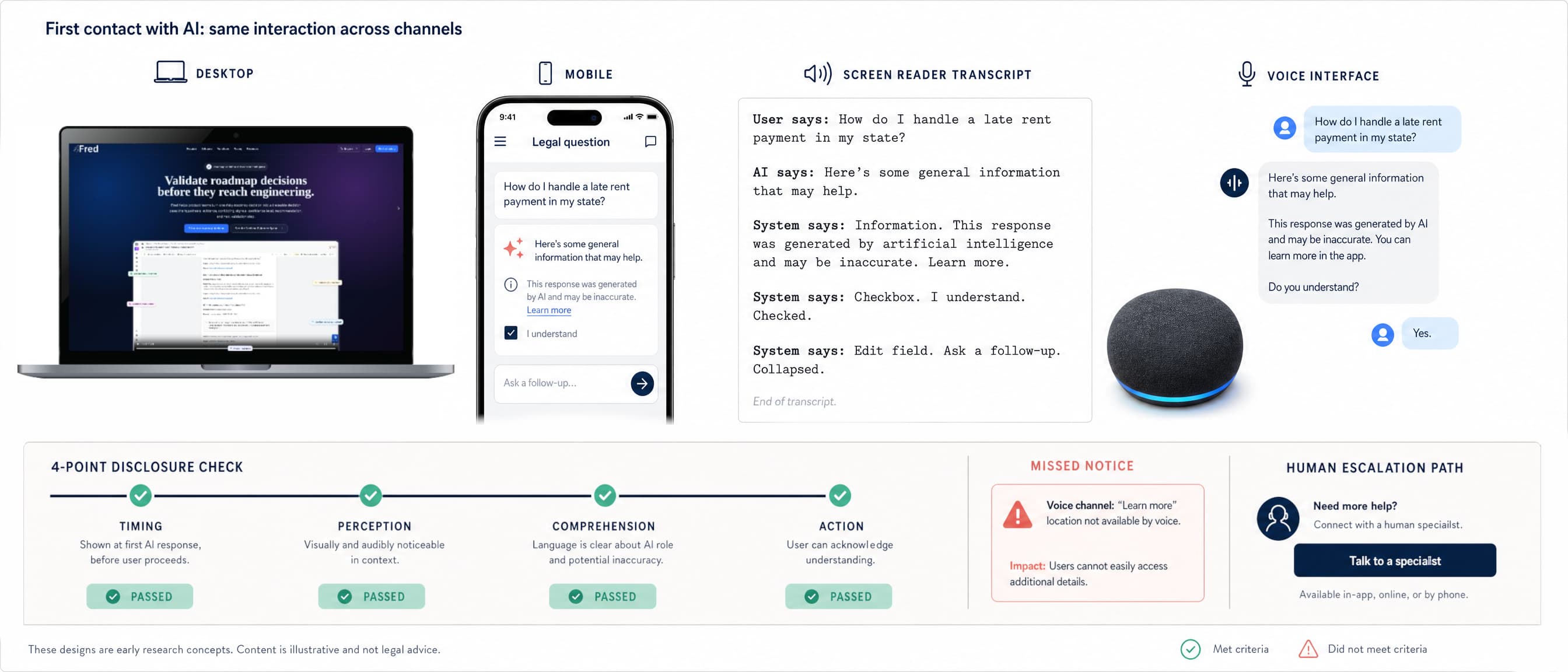
One person thought a staff member had opened the conversation because the reminder used the service team's name. Another saw the notice but believed only the suggested replies were generated by AI. A screen-reader user heard the message composer before the disclosure because focus moved directly into the input. A returning user never encountered the notice after the assistant gained a new capability to reschedule appointments.
The implementation evidence is real. It is also incomplete.
Article 50 of the EU AI Act now gives this gap immediate product significance. The European Commission says the relevant transparency obligations apply from 2 August 2026. Its current FAQ states that, for covered AI systems designed for direct interaction with people, notice should reach people from the start of the first interaction, clearly and distinguishably, and in accordance with accessibility requirements. The Commission connects this information with informed decisions about the interaction and calibrated trust.
This article is educational product guidance, not legal advice. Whether a system, provider, deployer, interaction, or exception falls within Article 50 requires legal analysis based on the actual facts. Usability research cannot certify compliance. It can reveal whether a chosen implementation is present in the experience, perceivable through relevant access modes, understood by the intended audience, and capable of supporting the decisions people need to make.
That evidence belongs beside legal review, not in place of it.
Four duties should not become one generic AI label
Teams often discuss Article 50 as a single labelling rule. The official sources describe several different obligations and actors.
For direct interactive systems, providers have a duty to design the system so that people are informed they are interacting with AI unless that is obvious in the relevant context. Providers of systems that generate synthetic audio, image, video, or text also face machine-readable marking and detectability requirements, subject to the scope, feasibility language, and exceptions in the law and guidance. Deployers have separate disclosure duties for uses such as emotion recognition or biometric categorisation and for specified deepfake or public-interest content cases.
These categories lead to different product questions. A human-readable first-contact notice is not a substitute for machine-readable output marking. An embedded machine-readable mark does not by itself ensure that a person perceives a deepfake disclosure. A chatbot notice does not settle what must happen when content leaves the interface, is shared by another person, or enters a public-interest publication workflow.
The Commission's Code of Practice on Transparency of AI-generated Content focuses on marking and labelling generated content under specific parts of Article 50. Its provider and deployer working groups address technical marking, detectability, and disclosure measures. It should not be stretched into a universal interaction-design checklist.
Product teams should begin with a scoped obligation from qualified counsel and an identified owner. Only then can design and research translate the requirement into an interface state and an evidence plan. Starting from a generic “AI-powered” badge risks solving the wrong duty while giving everyone a comforting artifact.
The same discipline prevents overclaiming. A disclosure may be good product practice even where a particular legal obligation does not apply. Conversely, a familiar AI icon may look transparent and still fail a specific requirement. Legal scope and experience quality can inform each other without becoming the same judgment.
First contact is a state, not a screen
“From the start of the first interaction” sounds like a placement instruction. Real journeys make it a state-management problem.
A person may arrive through a product home page, embedded support panel, QR code, notification, deep link, voice channel, third-party integration, or handoff from a human employee. The system may open with a proactive message before the person types. Authentication might happen before or after AI interaction begins. A session may resume on another device. A previously simple assistant may later gain the ability to take actions.
For each route, identify the earliest point at which the AI system directly interacts with the person. Then inspect what appears before, during, and immediately after that point. A disclosure below a long welcome message may be technically early in the screen and late in the exchange. A visual banner can precede a chat while appearing after the input in keyboard or screen-reader order. A voice assistant may play a notice that is clipped when the person starts speaking.
Handoffs deserve special attention. If a human support agent transfers a person to an AI assistant, the message “I am transferring you to support” may preserve ambiguity. If an AI assistant escalates to a human, the person also needs to know when responsibility and data access change. Fred's guide to agent-mediated journeys treats handoffs, authority, and recovery as separate evidence questions. The same journey-level view helps transparency testing, even though the legal analysis remains distinct.