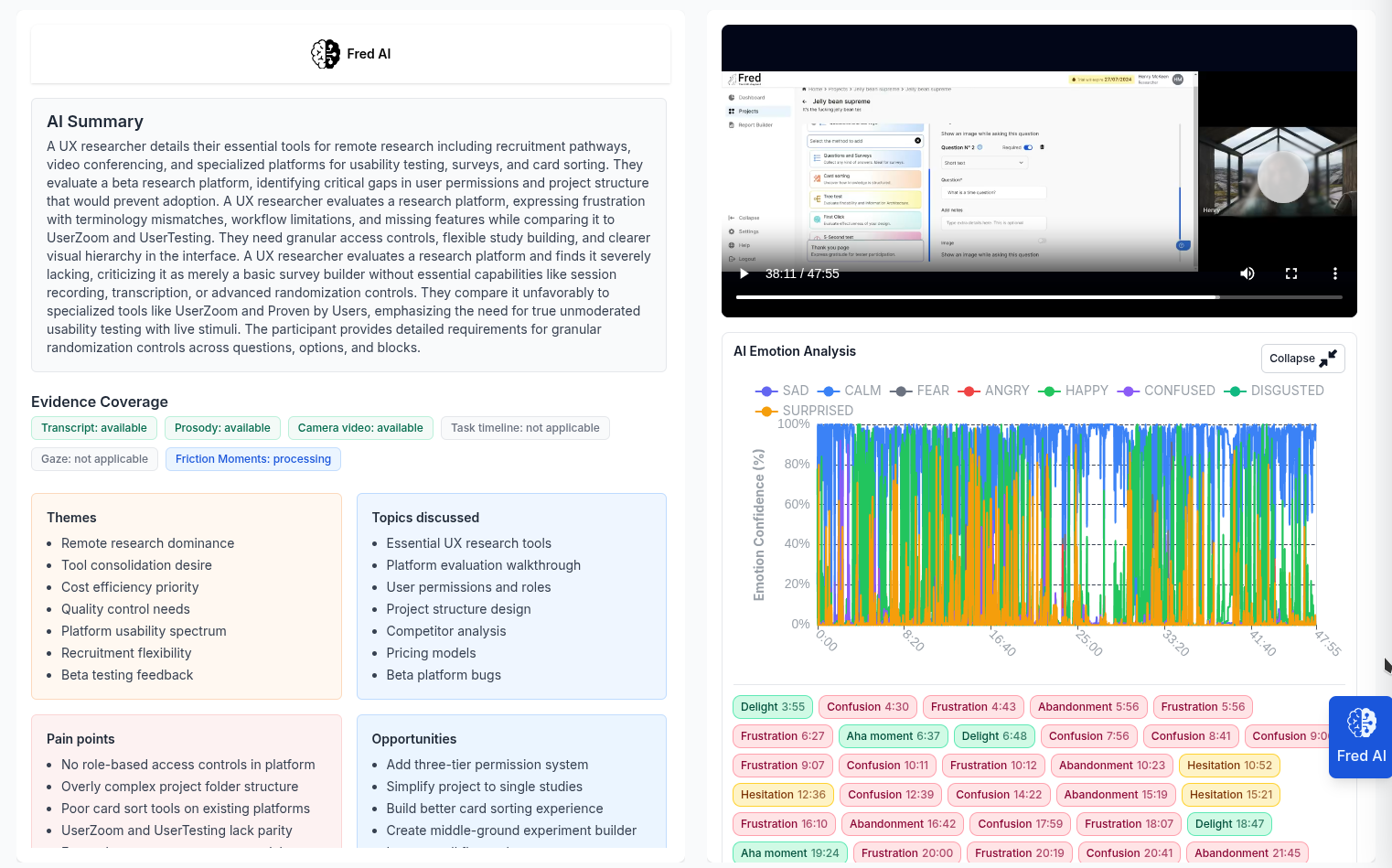
Feature: Insight Signals

See what people say, feel, and focus on in one evidence layer.

Insight Signals adds emotion, sentiment, gaze, and interaction context to the session review workflow so the team can interpret behavior at the moment it happened.

Fred insight signals dashboard with layered participant evidence
01

Emotion and sentiment connected to the same participant moment

02

Attention and interaction patterns visible in context

03

Richer playback without a separate interpretation toolchain

Where session evidence gets flattened

Teams often leave the session with a transcript, but not with enough behavioral context.

Recordings and notes explain part of what happened, but teams still miss the emotional shifts, attention cues, and interaction patterns that make behavior easier to interpret.

01

A participant completes the task

02

The team sees the outcome but misses part of the reaction layer

03

Playback becomes less useful when trying to explain why it happened

The gap is not about collecting more novelty metrics. It is about keeping meaningful signals attached to the same moment the team is trying to understand.

During review

Signal-rich sessions become hard to interpret when the cues live outside the main evidence flow.

Emotional shifts

Interesting reactions are easy to notice live but hard to preserve cleanly for later review.

Sentiment patterns

Useful signals lose value when they are detached from the exact quote and screen state.

Interaction flow

Clicks, pauses, and navigation behavior need context to become actionable.

Attention cues

Gaze behavior matters most when it can be inspected next to the task moment that caused it.

Why teams subscribe

They are buying a richer evidence layer, not just more metrics.

Insight Signals matters when the team needs session review to answer harder questions about attention, hesitation, and emotional response.

What changes

Fred keeps behavioral signals in the same review flow as notes, transcript, and session context, so interpretation gets stronger instead of noisier.

Signals stay in context

Emotion, sentiment, gaze, and task behavior remain attached to the same participant moment.

Playback becomes more useful

The team can revisit not just what happened, but how the participant reacted while it happened.

Prioritization gets sharper

Richer evidence helps teams judge severity and confidence more clearly during review.

How Insight Signals fixes it

Layer emotional, attention, and interaction cues into the same session review surface.

The feature is valuable because it strengthens interpretation at review time, not because it produces standalone analytics dashboards.

01 / Capture reaction shifts

Keep reaction signals tied to the exact moment that triggered them.

Behavioral interpretation is stronger when emotional and sentiment cues can be inspected next to the task, quote, and participant state.

  • Map reaction signals to the same point on the session timeline
  • Preserve source context for every observed shift
  • Reduce guesswork when explaining hesitation or confusion

Signals only matter if they stay interpretable.

Fred eye tracking visual showing attention signals during session review

02 / Track attention and behavior

Review where participants look, click, pause, and struggle in context.

Attention and interaction patterns become useful when they help the team explain why a task succeeded, stalled, or failed.

  • Inspect gaze and interaction behavior near the triggering screen state
  • See where attention diverged from the intended flow
  • Spot hesitation patterns that static summaries miss

This is not a separate lab tool. It is an evidence layer for real session review.

Temporary Insight Signals visual showing interaction flow on a study surface

03 / Carry stronger evidence forward

Move the most revealing signals into reporting without losing their source context.

Richer playback only matters if the best moments survive into synthesis and stakeholder review.

  • Keep signals attached to clips, quotes, and tasks in reports
  • Make behavioral evidence easier to defend in product conversations
  • Turn playback into something the wider team can actually use

The point is better decisions, not just richer instrumentation.

Temporary Insight Signals visual showing evidence-rich reporting handoff

What teams get back

A sharper read on user behavior without leaving the core research workflow.

When the reaction layer stays connected to the session, the team can interpret what happened with more depth and less reconstruction work.

Temporary Insight Signals proof visual with layered participant behavior

Emotion in context

Review reaction shifts without detaching them from the task moment that caused them.

Interaction clarity

Understand where people pause, misclick, or struggle in the flow.

Attention visibility

See where focus goes when the intended journey breaks down.

Evidence-rich handoff

Carry the strongest signal-backed moments into reporting and stakeholder review.

Ready to add a richer evidence layer

Use Insight Signals to make session playback more interpretable and more useful.

Bring emotion, attention, and interaction cues into the same workflow where the team already reviews, synthesizes, and shares evidence.

More context

Behavioral signals are useful because they stay tied to the moment, not because they exist in isolation.

Better decisions

The stronger the review context, the easier it is to prioritize with confidence.